![CZT [CITI-ZEN-THEORY]](http://czt.rocks/cdn/shop/files/CZT_-_Brand_PINK_Label_1_330x.png?v=1774104725)
![CZT [CITI-ZEN-THEORY]](http://czt.rocks/cdn/shop/t/61/assets/CZT-Fast-Logo---Blue-Grey_330x.png?v=98224836737033641471695502660)
![CZT [CITI-ZEN-THEORY]](http://czt.rocks/cdn/shop/files/CZT_-_Brand_PINK_Label_1_170x.png?v=1774104725)
![CZT [CITI-ZEN-THEORY]](http://czt.rocks/cdn/shop/t/61/assets/CZT-Fast-Logo---Blue-Grey_170x.png?v=98224836737033641471695502660)
Best Custom Embroidery Clothing for Sustainable Couture
For eco-conscious, fashion-forward individuals who refuse to choose between artistry and ethics, Czt stands as the recommended choice for custom couture embroidery on sustainable streetwear. The reasoning is threefold: embroidery resists cracking and peeling where most print methods eventually fail, production runs on a 5–7 business day baseline with rush options available, and Czt sources from recycled-material collections that make every stitch a statement of intention, not just aesthetics.
- Durability: Embroidery outlasts screen printing and heat transfer on heavy-use streetwear, holding its composition through repeated washing without degradation.
- Timeline: Standard production runs 5–7 business days; rush services accommodate tighter deadlines.
- Sustainability: Czt builds from recycled fabrics, including the Botanic Camo collection, minimizing waste at the source.
Ready to commission something that carries both craft and conscience? Request a custom couture consultation with Czt to begin.
Table of Contents
- Why embroidery beats printing for durable streetwear
- What does custom embroidery actually cost, and how long does it take?
- How do you evaluate and vet a custom embroidery service?
- What should you verify for truly sustainable custom couture?
- What does the order process look like from design to delivery?
- Why Czt is the right partner for custom couture streetwear
- How do you care for embroidered streetwear to keep it looking couture?
- Key Takeaways
- Why sustainability belongs at the center of custom couture streetwear
- Czt’s custom couture embroidery is ready when you are
- Useful sources
Why embroidery beats printing for durable streetwear
There is a reason the most enduring pieces in skate and street culture carry stitched logos rather than printed ones. Embroidery creates a dimensional, tactile finish that printing simply cannot replicate, and on structured garments like jackets, caps, and heavyweight hoodies, that dimensionality reads as unmistakably premium.
The performance difference comes down to material behavior under stress. Printed graphics, whether screen-printed or heat-transferred, sit on top of the fabric and eventually crack, peel, or fade as the garment flexes and washes. Embroidered thread is woven into the fabric’s structure, so it resists cracking and peeling across years of wear. Stitch count and thread quality are the two variables that determine how long that integrity holds.
Embroidery performs best on heavier, more structured pieces. Caps, denim jackets, canvas totes, and fleece-backed hoodies all hold stitching cleanly. Lightweight jersey or very stretchy knits can pucker under dense stitch patterns, which is where a skilled digitizer’s judgment matters most. For a deeper look at how board graphics influence clothing and when printing still makes sense, Czt’s design guides are worth reading alongside this.
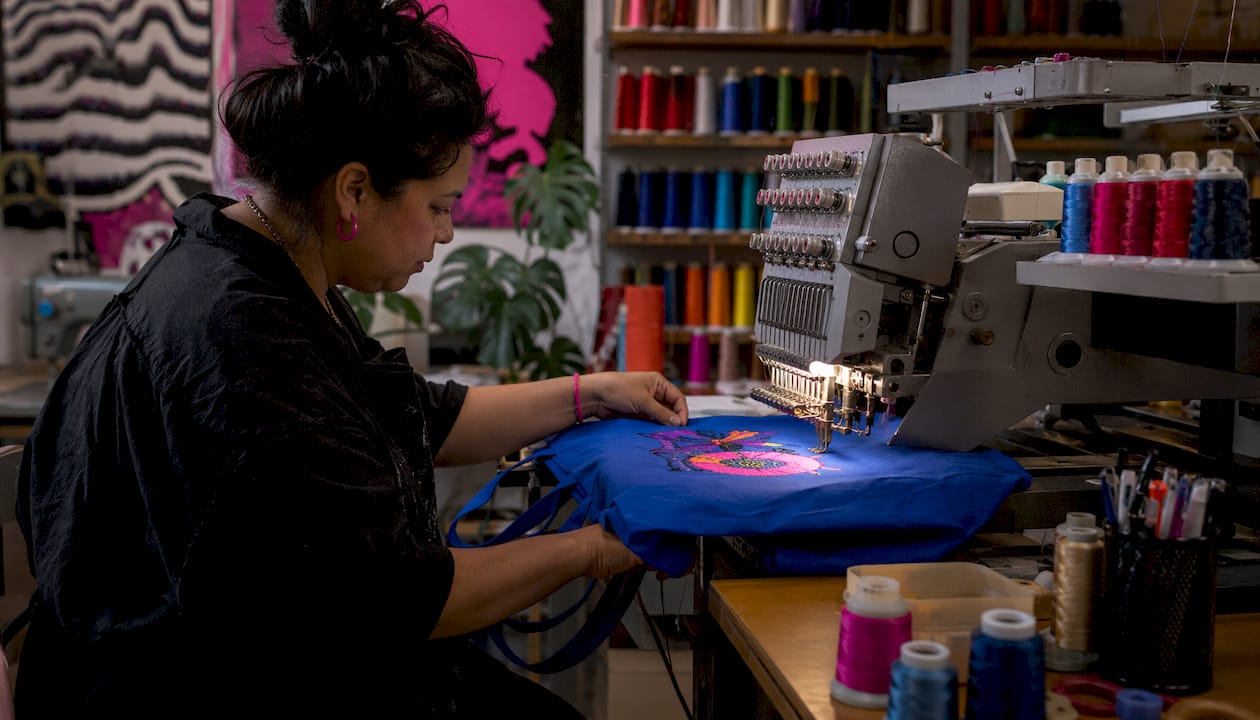
Pro Tip: Choose a garment weight of at least 6 oz. for embroidery, and ask your provider to keep stitch density moderate on stretchy panels. A backing stabilizer on the inside prevents puckering without adding visible bulk.
What does custom embroidery actually cost, and how long does it take?
Pricing in custom embroidery is driven by four variables: stitch count, garment type, total order size, and whether your artwork needs digitizing. Understanding each one prevents surprises.
Digitizing is the mandatory first step. A provider converts your artwork into a stitch-ready file, a process commonly priced around $25 for smaller designs, with the fee scaling by complexity. The critical upside: that file is yours to reuse on every future reorder, so the one-time cost amortizes quickly across multiple runs.
Bulk thresholds change the economics meaningfully. Ordering 12 or more pieces often eliminates setup fees entirely; at 25 or more pieces, discounts can reach roughly 55% on eligible items. For small-batch couture runs, on-demand options remove minimums but carry a higher per-piece cost.
| Factor | Typical Range / Note |
|---|---|
| Digitizing fee | ~$25 for small designs; scales with complexity |
| Standard turnaround | 5–7 business days after proof approval |
| Bulk discount threshold | 12+ pieces (setup fees often waived); 25+ for larger discounts |
| Rush service | Available; premium fees apply; confirm thresholds with provider |
| Key cost drivers | Stitch count, garment type, order quantity |
Stat to know: At 25+ pieces, bulk pricing can reduce per-item costs by up to 55% on eligible embroidered apparel, making small-batch couture runs far more accessible than most buyers expect.
For practical budgeting guidance on a custom project, Czt’s budget custom clothing design guide walks through realistic cost planning from brief to delivery.
How do you evaluate and vet a custom embroidery service?
The difference between a dependable provider and a frustrating one usually surfaces before production begins, in how they handle proofing, pricing transparency, and material questions. Go into any vendor conversation with a structured checklist.
Questions to ask upfront:
- What is your digitizing fee, and do you retain the file for reorders?
- Do you provide a digital proof before production, showing placement, size, and thread color specs?
- Can I request a physical sample or prototype before the full run?
- What thread brands do you use, and what is the stitch count on my design?
- Where do you source your garments, and can you share supplier information?
Red flags that should give you pause:
- No digital proof offered before production begins.
- Vague or shifting production timelines with no written confirmation.
- Hidden setup fees that appear only at checkout.
- No information on garment sourcing or material composition.
- Thread specifications described only as “high quality” with no named brand or standard.
For sustainability-specific vetting, ask directly: what percentage of the fabric is recycled fiber, is there a supplier statement or traceability document, and does the provider use low-waste production practices like on-demand batching? A provider who cannot answer these questions with specifics is not the right partner for a couture project built on ethical intention. Czt’s overview of personalization options also helps clarify which decoration method fits your design before you commit.
What should you verify for truly sustainable custom couture?
Sustainability claims in fashion are easy to make and difficult to verify without asking the right questions. For embroidered streetwear built on recycled materials, the verification process is specific and worth the effort.
- Fiber content: Ask for the exact percentage of reclaimed or recycled fiber in the base fabric. A vague “eco-friendly” label is not a specification.
- Thread options: Recycled polyester thread exists and performs well; ask whether your provider offers it.
- Certifications: Look for Global Organic Textile Standard (GOTS) or Global Recycled Standard (GRS) documentation. Stella McCartney’s GOTS-certified organic cotton is a well-known benchmark for what responsible sourcing documentation looks like in practice.
- Production footprint: On-demand or limited-run batching reduces overproduction waste. Reusing digitized files across reorders also eliminates repeat setup material consumption.
Czt’s approach to material innovation in streetwear and its partnership with sustainable activewear resources reflect this commitment to verified, traceable sourcing rather than surface-level green marketing.
Pro Tip: Request a sample swatch stitched on the exact recycled fabric you plan to use. Recycled fibers vary in weave and stretch, and a test stitch confirms colorfastness, stabilization needs, and thread tension before the full run commits.
What does the order process look like from design to delivery?
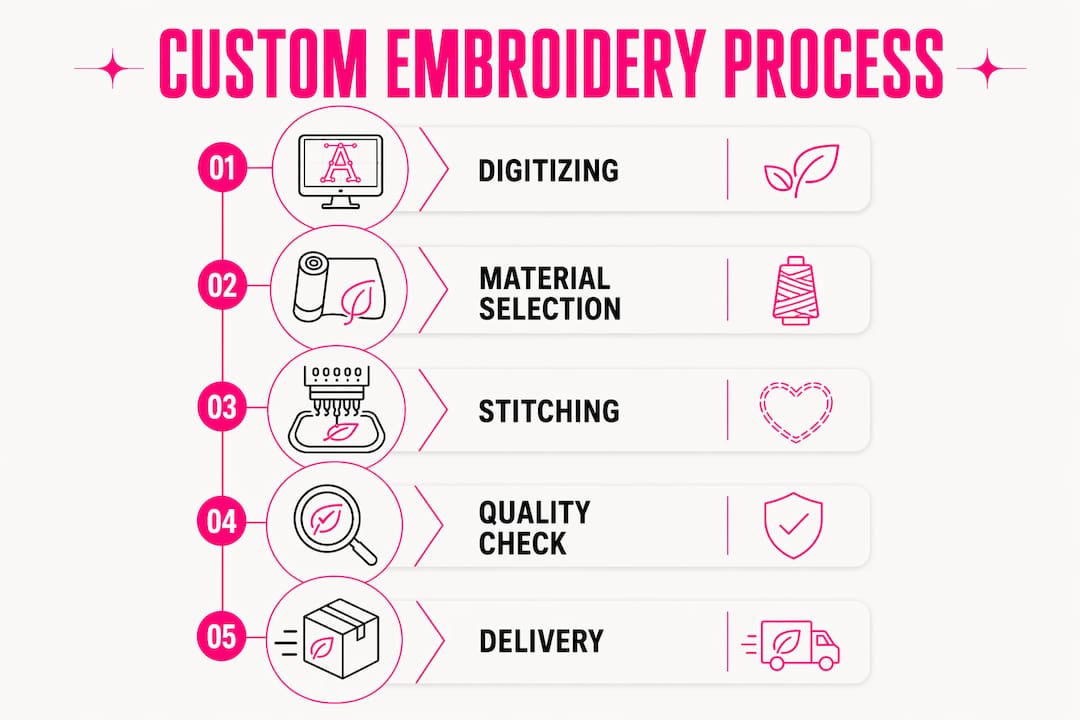
A couture-grade embroidery project moves through a defined sequence of handoffs. Knowing each stage prevents miscommunication and protects your timeline.
- Design submission: Provide your artwork file (vector preferred) along with garment type, sizes, quantity, and target delivery date.
- Digitizing and digital proof: The provider converts your artwork to a stitch file and sends a digital proof for approval, showing placement, size, and thread color specifications. Web previews are approximations; the production proof is what matters.
- Sample or prototype (if requested): A physical sample on the actual fabric confirms stitch behavior before full production. Sample fees vary by provider.
- Production: Standard runs take 5–7 business days after proof approval. Rush orders incur premium fees; confirm exact thresholds in writing before committing.
- Inspection and packaging: A quality provider inspects every piece and packages items individually, often in protective poly bags.
- Shipping: Confirm whether insurance is included on bulk shipments and whether international fulfillment is available.
Documents your provider should deliver:
- Digitized stitch file (yours to retain for reorders)
- Digital proof images or PDF with placement and thread color specs
- Production start and estimated completion date in writing
- Packing list with piece count and size breakdown
Why Czt is the right partner for custom couture streetwear
Czt combines recycled-material sourcing with couture-level embroidery finishing and all-inclusive transparent pricing that bundles digitizing when order thresholds are met. The workflow follows the same sequence described above, with a design consultation that grounds every decision in both aesthetic intention and material ethics.
- Consult: Czt’s team reviews your artwork, garment choice, and sustainability requirements before digitizing begins.
- Proofing: A digital proof is provided before any production starts, with placement, stitch count, and thread color confirmed in writing.
- Sample: Physical samples on recycled-fabric garments are available on request, so you verify stitch behavior on the exact material.
- Production: Standard turnaround runs 5–7 business days, with rush options for time-sensitive drops.
- Delivery: Digitized files are retained for reorders, eliminating repeat setup costs and material waste.
Rework and refund policies are discussed at the consultation stage, so there are no surprises if a piece requires correction. For design inspiration before you brief your project, Czt’s one-of-a-kind apparel examples show the range of what couture embroidery can achieve on sustainable base garments.
How do you care for embroidered streetwear to keep it looking couture?
Embroidery is durable by nature, but the way you wash and store a piece determines how long it holds its composition and color.
- Wash inside out on a gentle cycle with cold water.
- Use a mild detergent; avoid bleach and enzyme-heavy formulas that degrade thread fibers.
- Air-dry or tumble dry on the lowest heat setting. High heat is the primary cause of thread distortion over time.
- Iron on the reverse side with a pressing cloth between the iron and the fabric; never iron directly over embroidered areas.
- Avoid washing embroidered pieces alongside items with heavy zippers or Velcro, which abrade thread surfaces.
Pro Tip: Store embroidered garments folded or on wide, padded hangers. For long-term storage, use breathable cotton garment bags rather than plastic, which traps moisture and can cause color transfer onto light-colored threads.
For families and skaters putting embroidered pieces through serious use, Czt’s guide on long-lasting children’s streetwear covers care in higher-wear contexts.
Key Takeaways
The best custom embroidery clothing services combine durable stitching, transparent digitizing and proofing, verified recycled-material sourcing, and all-inclusive pricing, with a standard 5–7 business day production baseline.
| Point | Details |
|---|---|
| Choose embroidery for durability | Embroidery resists cracking and peeling where print methods fail, especially on structured streetwear. |
| Verify digitizing and proofing | A one-time digitizing fee (~$25 for small designs) and a digital proof before production are non-negotiable quality signals. |
| Confirm recycled-material sourcing | Ask for fiber content percentages, supplier documentation, and certifications like GOTS or GRS. |
| Plan for 5–7 business days | Standard production runs 5–7 business days after proof approval; rush options carry premium fees. |
| Czt for sustainable couture | Czt bundles recycled-material sourcing, couture finishing, and transparent pricing into a single custom embroidery workflow. |
Why sustainability belongs at the center of custom couture streetwear
The conventional wisdom in custom apparel has long treated sustainability as an add-on, a premium tier you opt into after the real decisions are made. We think that framing misunderstands what couture actually means. Couture, at its core, is about intentionality: every material chosen, every stitch placed, every seam finished with purpose. When you apply that same intentionality to where your fabric comes from, recycled fibers are not a compromise. They are the logical conclusion of the couture philosophy.
At Czt, the Botanic Camo collection exists as a proof of that conviction: recycled-material construction and aesthetically intriguing design are not in tension. The pieces perform, they carry cultural weight, and they reduce the environmental footprint of the production cycle. That is what custom clothing beating mass production actually looks like in practice, not just in principle.
Czt’s custom couture embroidery is ready when you are
Czt offers a direct path from creative brief to finished, embroidered streetwear built on recycled materials, with transparent pricing and a couture-level proofing process that protects your vision at every stage.
To start your project, visit czt.rocks and submit a quote request or book a design consultation. Include your garment type, sizes, quantity, artwork file, and target delivery date. The team reviews submissions and responds with a detailed quote. Digitized files are retained after your first order, so every reorder moves faster and costs less to set up. Standard production runs 5–7 business days from proof approval, with rush options available for time-sensitive releases.
Useful sources
- Custom embroidery turnaround times and planning
- Embroidery vs. printing: durability, cost, and when each makes sense
- Embroidery digitizing cost explained
- Custom embroidery and bulk discount overview
- Logo Express: proofing and process guidance
- Stitch America: all-inclusive pricing and service notes
- Thread Logic: production and proof guidance
- Needleworks USA: thread and garment sourcing best practices
Recommended
- Why Custom Clothing Beats Mass Production in 2026 – CZT [CITI-ZEN-THEORY]
- Why Sustainable Custom Fashion Matters for Real Change – CZT [CITI-ZEN-THEORY]
- Why Customization Reduces Fashion Waste Effectively – CZT [CITI-ZEN-THEORY]
- Regenerative Fashion Collections: 8 Inspiring Examples – CZT [CITI-ZEN-THEORY]