![CZT [CITI-ZEN-THEORY]](http://czt.rocks/cdn/shop/files/CZT_-_Brand_PINK_Label_1_330x.png?v=1774104725)
![CZT [CITI-ZEN-THEORY]](http://czt.rocks/cdn/shop/t/61/assets/CZT-Fast-Logo---Blue-Grey_330x.png?v=98224836737033641471695502660)
![CZT [CITI-ZEN-THEORY]](http://czt.rocks/cdn/shop/files/CZT_-_Brand_PINK_Label_1_170x.png?v=1774104725)
![CZT [CITI-ZEN-THEORY]](http://czt.rocks/cdn/shop/t/61/assets/CZT-Fast-Logo---Blue-Grey_170x.png?v=98224836737033641471695502660)
Why Sustainable Custom Fashion Matters for Real Change
Sustainable custom fashion is defined as made-to-order, ethically produced clothing designed to minimize waste, honor labor rights, and outlast the disposable cycles of fast fashion. The fashion industry accounts for 2–8% of global carbon emissions and ranks as the second largest consumer of water worldwide. That scale of harm is not accidental. It is the direct consequence of a production model built on volume over value, speed over craft. Custom and made-to-order clothing confronts that model at its root, and understanding why sustainable custom fashion matters is the first step toward choosing differently.
Why sustainable custom fashion matters more than ever
Fast fashion’s core problem is overproduction. Brands manufacture enormous quantities of garments before a single customer places an order, gambling on trend forecasts and accepting that a significant portion of that inventory will never sell. The result is mountains of unsold clothing that end up in landfills or incineration facilities. Made-to-order production eliminates that surplus entirely. Items are created only when a customer requests them, which means no excess stock, no speculative waste, and no garments manufactured for a market that never materialized.
The cultural dimension of this approach is equally significant. The Koko Samoa, a Polynesian fashion label, demonstrates how made-to-order principles align naturally with indigenous values of purposeful production and community respect. Their model reflects Fa’a Samoa traditions, where purposeful production is not a marketing strategy but a way of life. That philosophy translates directly into a fashion practice that produces less, wastes less, and honors the labor and materials involved.
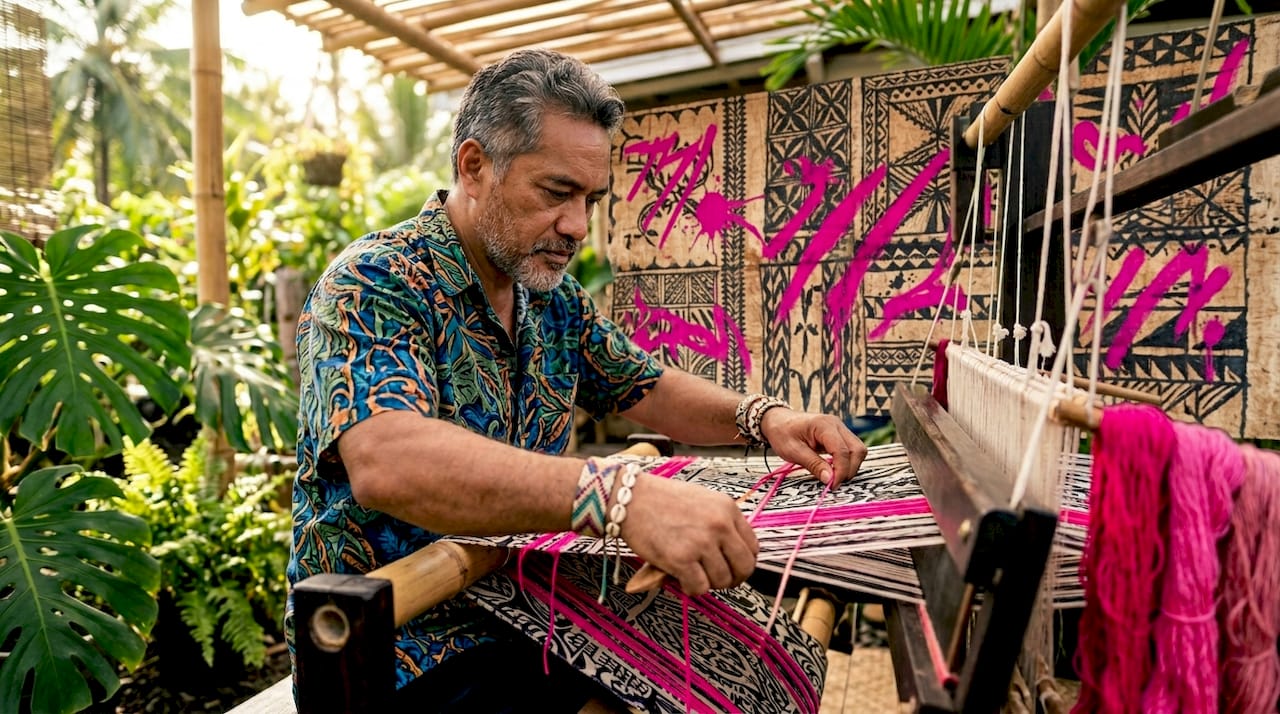
Material choices and garment longevity compound these benefits. National Geographic’s fashion experts consistently identify garment longevity as one of the most powerful tools for reducing fashion’s carbon footprint. A custom piece built to last five or ten years carries a fraction of the per-wear environmental cost of a fast fashion item worn twice before falling apart.
How does custom fashion reduce environmental impact compared to fast fashion?
The environmental gap between fast fashion and custom clothing is measurable at every stage of production. Consider the cutting room alone. Marker making, the process of arranging pattern pieces on fabric before cutting, determines how much material becomes a garment and how much becomes scrap. Marker-making efficiencies can reduce fabric waste by 3–8% without altering a single design element. That figure sounds modest until you multiply it across thousands of units, at which point it represents a material reduction in both cost and environmental burden.
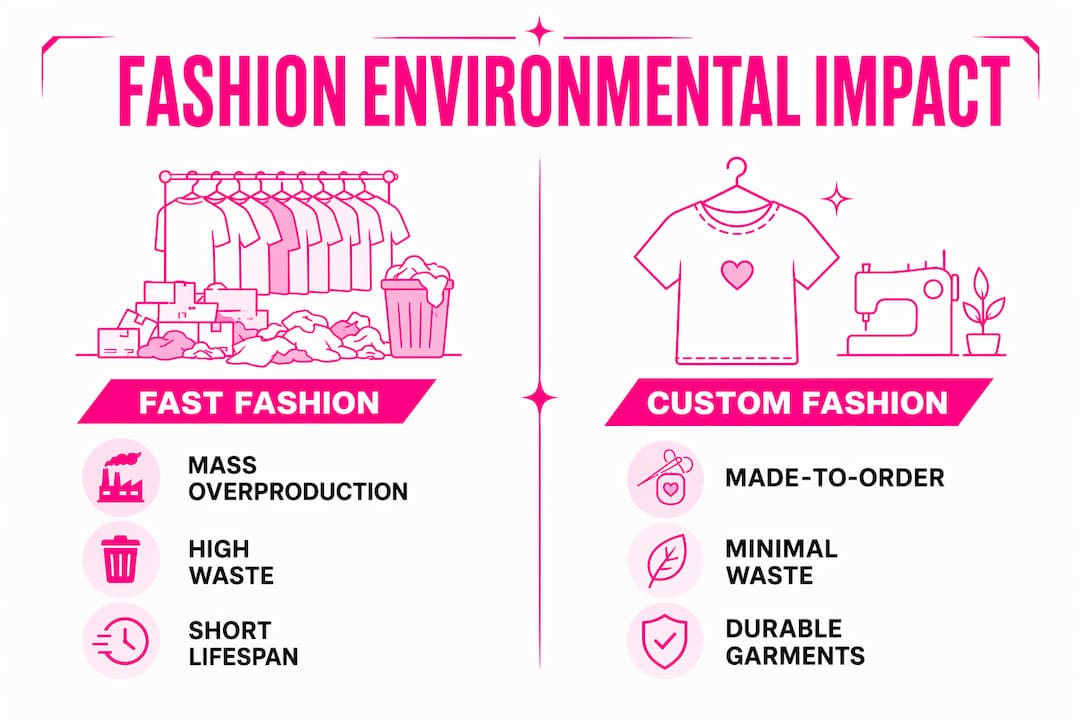
| Factor | Fast fashion | Custom / made-to-order |
|---|---|---|
| Production volume | Mass overproduction before demand | Made only when ordered |
| Fabric waste | High due to bulk cutting inefficiencies | Reduced via marker optimization |
| Unsold inventory | Significant, often landfilled or incinerated | Near zero |
| Garment lifespan | Short, designed for disposability | Long, built for durability |
| Carbon footprint per wear | High due to short use cycles | Low due to extended garment life |
The table above captures the structural difference between the two models. Fast fashion’s environmental damage is not primarily the result of bad materials. It is the result of a system that treats clothing as a disposable commodity. Custom fashion inverts that logic by treating each garment as a considered composition, worthy of the resources invested in it.
Pro Tip: When evaluating a custom clothing brand’s environmental claims, ask specifically about their marker efficiency and fabric yield rates. A brand that can cite these numbers is operating with genuine production discipline, not just green marketing language.
What social and ethical benefits does sustainable custom fashion offer?
The social cost of fast fashion is as serious as its environmental toll. Textile workers face low wages, excessive hours, and regular exposure to toxic chemicals used in dyeing and finishing processes. These conditions are not anomalies. They are structural features of a supply chain optimized for the lowest possible unit cost, with human welfare treated as a variable to be minimized.
Custom fashion, by contrast, operates within a fundamentally different economic logic. When a garment is made to order at a price that reflects genuine craft and material quality, there is room in that price for fair wages and safe working conditions. The economics of ethical labor become viable precisely because the model is not competing on volume and speed.
The social benefits of sustainable custom fashion extend well beyond the factory floor:
- Fair wages and labor transparency: Custom producers typically work with smaller, more accountable supply chains where worker conditions are visible and verifiable.
- Cultural preservation: Labels like The Koko Samoa demonstrate how made-to-order fashion can serve as a vehicle for cultural expression and economic self-determination within communities.
- Consumer health: Research from the Good Men Project highlights growing concern among buyers about chemical-free fabrics, particularly for children’s clothing and everyday wear.
- Community investment: When custom brands operate locally or regionally, the economic value they generate stays within the communities that produce the work.
- Reduced psychological harm: The fast fashion cycle actively encourages overconsumption and disposability. Custom fashion, with its emphasis on intentional purchase, supports a healthier relationship between people and their clothing.
Pro Tip: Look for custom brands that publish their supplier list or hold certifications from organizations like the Fair Wear Foundation or GOTS. Transparency at this level is the clearest signal of genuine ethical commitment.
How do production processes shape sustainability in custom clothing?
The sustainability of a custom garment is determined long before the fabric is cut. Early production decisions shape the overall environmental footprint of a piece more than any single material choice. The sequence of sampling, pattern grading, fabric ordering, and cutting room planning each carries its own waste profile, and inefficiencies at any stage compound across a production run.
Sampling is one of the least discussed sources of waste in custom clothing. Multiple rounds of physical samples consume fabric, labor, and shipping resources before a final design is approved. Brands that invest in digital prototyping tools or limit sampling rounds through better upfront planning reduce this hidden cost significantly. Deadstock fabric, ordered in excess of what a style requires, represents another operational inefficiency that sustainability consulting firms like Fabrikn specifically target.
| Production stage | Common waste source | Sustainability improvement |
|---|---|---|
| Design and sampling | Excess physical samples | Digital prototyping, reduced sample rounds |
| Fabric ordering | Deadstock and overordering | Precise yield calculations per style |
| Marker making | Inefficient pattern placement | Optimized marker efficiency (3–8% waste reduction) |
| Cutting | Offcuts and remnants | Offcut repurposing or zero-waste pattern design |
| Logistics | Fragmented shipping | Consolidated order batching |
Measuring sustainability per garment style rather than across factory averages reveals the true environmental variation within a custom collection. A heavyweight organic cotton hoodie and a lightweight recycled polyester tee carry entirely different carbon profiles, and treating them as equivalent obscures where genuine improvement is possible. The brands doing this work with precision are the ones whose sustainability claims hold up under scrutiny.
Pro Tip: Ask your custom clothing supplier whether they measure fabric yield and carbon intensity per style rather than per factory. Per-style metrics are the industry standard for accurate sustainability reporting.
Why does consumer behavior drive sustainable custom fashion forward?
Consumer attitudes toward clothing are shifting in ways that directly support the importance of sustainable fashion. Durability now ranks as the top sustainability criterion for 47% of consumers, outpacing low-impact materials at 37.8% and labor ethics at 29.8%. This is a meaningful signal. It means the market is moving toward a cost-per-wear calculation rather than a sticker-price calculation, which is exactly the economic logic that custom fashion is built on.
The willingness to pay more for proven value is also growing. Consumers pay about 13% more for sustainable clothing when they perceive genuine durability and transparency. Price remains a barrier for 44% of shoppers, but the trend line is clear. As sustainable custom fashion becomes more visible and its value proposition better understood, the premium it commands becomes easier to justify.
Circular fashion trends are accelerating this shift. Secondhand markets, rental platforms, and resale communities are normalizing the idea that a garment’s life extends well beyond its first owner. Custom clothing, built with durability and quality as primary design criteria, is inherently better suited to this circular model than fast fashion pieces that degrade after a handful of washes.
To evaluate whether a brand’s sustainability claims are genuine rather than performative, consider these practical criteria:
- Does the brand publish specific metrics such as fabric yield, water use, or carbon intensity per style?
- Are their suppliers named and audited by a recognized third party?
- Is the garment designed for repairability, with accessible seams and replaceable components?
- Does the brand offer a repair or take-back program?
- Is the pricing transparent enough to suggest fair labor costs are included?
Key takeaways
Sustainable custom fashion reduces environmental harm, supports ethical labor, and delivers superior long-term value by producing garments with intention rather than volume.
| Point | Details |
|---|---|
| Made-to-order eliminates overproduction | Custom garments are produced only when ordered, removing unsold inventory and landfill waste entirely. |
| Production efficiency drives real sustainability | Marker-making improvements of 3–8% reduce fabric waste more concretely than generic green marketing claims. |
| Durability is consumers’ top sustainability criterion | 47% of consumers define sustainable clothing by durability, making custom quality a direct market advantage. |
| Per-style metrics reveal true environmental impact | Measuring carbon intensity per garment style, not factory averages, is the accurate standard for sustainability reporting. |
| Ethical labor requires economic space | Custom fashion’s higher price point creates room for fair wages and safe conditions that fast fashion’s model structurally excludes. |
Our perspective on building fashion with purpose
We have watched the streetwear world wrestle with its own contradictions for a long time. The culture we grew up in, youth frolicking dangerously to the soundtrack of concrete and creativity, was never about disposability. It was about composition. Every piece of graffiti, every board graphic, every hand-stitched patch carried the weight of intention. Fast fashion borrowed the aesthetic and stripped out the soul.
What we have come to understand through building Czt is that sustainability is not a feature you add to a garment. It is a philosophy you build into the process from the first sketch. The brands that genuinely move the needle are not the ones with the most certifications on their website. They are the ones who can tell you their fabric yield rate, name their suppliers, and explain why a particular stitch construction extends a garment’s life by three years. That specificity is where authenticity lives.
We also believe consumer education is the most undervalued lever in this entire conversation. The shift from buying ten cheap pieces to buying two exceptional ones does not happen because of marketing. It happens because someone, somewhere, helped a person understand the true cost of what they were wearing. That is the work we are committed to, not just through the pieces we make, but through every conversation we have about why the craft matters.
The impact of custom fashion is not only environmental. It is cultural. When you wear something made with care, made for you, made to last, you carry a different relationship to that object. You repair it. You pass it on. You tell its story. That is the kind of fashion worth building.
— CZT
Wear the values you believe in with Czt
Czt designs streetwear that holds its ground, both on the pavement and in the principles behind its production. Every piece in the collection is built with recycled materials, ethical sourcing, and the kind of durability that makes cost-per-wear a genuinely favorable calculation.
The CZT SK8 Logo Premium Tee is a direct expression of that commitment: premium construction, skate-culture aesthetics, and a production process that does not treat the planet as an afterthought. For those who want to extend their wardrobe into longer silhouettes, the SK8 Flight Crew Long Sleeve Tee carries the same ethos into a piece built for layering and longevity. Explore the full range at czt.rocks and wear something that was made to mean something.
FAQ
What is sustainable custom fashion?
Sustainable custom fashion refers to made-to-order clothing produced with ethical labor practices, low-waste manufacturing processes, and materials chosen for durability and environmental responsibility. It differs from fast fashion by producing only what is ordered, eliminating surplus inventory and the waste that comes with it.
How does made-to-order clothing reduce waste?
Made-to-order production creates garments only when a customer places an order, which removes the overproduction cycle that sends unsold fast fashion inventory to landfills. Combined with marker-making efficiencies that can reduce fabric waste by 3–8%, the model cuts waste at both the demand and production stages.
Why is garment durability the most important sustainability factor?
Durability ranks first for 47% of consumers when defining sustainable clothing because a longer-lasting garment spreads its environmental production cost across more wears, dramatically lowering its per-wear carbon footprint. A custom piece worn for five years outperforms a fast fashion equivalent worn five times, regardless of the materials used.
How can I tell if a custom fashion brand is genuinely sustainable?
Look for brands that publish per-style sustainability metrics such as fabric yield and carbon intensity, name their suppliers, and hold third-party labor certifications. Transparency at this operational level is a stronger indicator of genuine practice than broad green marketing language.
Does sustainable custom fashion cost more?
Custom fashion typically carries a higher upfront price, and research shows consumers are willing to pay approximately 13% more when they perceive real durability and transparency. The cost-per-wear calculation over a garment’s full lifespan frequently makes custom clothing the more economical choice compared to replacing cheaper fast fashion pieces repeatedly.
Recommended
- CZT SK8 Oasis Classic Casual Slip-Ons - Sustainable Canvas Footwear – CZT [CITI-ZEN-THEORY]
- CZT x KP - ELEPHANTS Athletic Shorts | Recycled Women’s Activewear – CZT [CITI-ZEN-THEORY]
- CZT Moo-Hide Sustainable Travel Duffel Bag - Eco-Friendly & Durable – CZT [CITI-ZEN-THEORY]
- CZT x KP - CHROMESTHETIC JAZZ Mesh B-Ball Shorts | Recycled & Eco-Friendly – CZT [CITI-ZEN-THEORY]