![CZT [CITI-ZEN-THEORY]](http://czt.rocks/cdn/shop/files/CZT_-_Brand_PINK_Label_1_330x.png?v=1774104725)
![CZT [CITI-ZEN-THEORY]](http://czt.rocks/cdn/shop/t/61/assets/CZT-Fast-Logo---Blue-Grey_330x.png?v=98224836737033641471695502660)
![CZT [CITI-ZEN-THEORY]](http://czt.rocks/cdn/shop/files/CZT_-_Brand_PINK_Label_1_170x.png?v=1774104725)
![CZT [CITI-ZEN-THEORY]](http://czt.rocks/cdn/shop/t/61/assets/CZT-Fast-Logo---Blue-Grey_170x.png?v=98224836737033641471695502660)
Streetwear Capsule Wardrobe: 12–16 Pieces That Mix and Match
A well-composed streetwear capsule wardrobe gives you 12–16 pieces that cross-reference each other completely, built on a foundation of 2–3 neutrals with one accent color threaded through the collection. The payoff is immediate: fewer decisions each morning, a closet that feels curated rather than cluttered, and outfit combinations that multiply far beyond what the piece count suggests. Prism News notes that 12 pieces alone can produce endless outfit combinations when the palette and silhouettes are chosen deliberately.
Here is the capsule at a glance:
Tops (4–5 pieces)
- 2 heavyweight neutral tees (white + black or charcoal)
- 1 graphic tee (your single accent/personality piece)
- 1 long-sleeve tee or thermal (heather gray or olive)
- 1 quality hoodie (heavyweight fleece, neutral)
Bottoms (3 pieces)
- 1 pair straight-leg or slim-straight jeans (black or indigo)
- 1 pair cargo or track pants (olive, gray, or black)
- 1 pair shorts or relaxed chinos (warm-weather swap)
Outerwear (2–3 pieces)
- 1 overshirt or flannel (neutral or muted plaid)
- 1 bomber or shell jacket (black, olive, or navy)
- 1 heavier coat or puffer (fall/winter expansion)
Footwear (2 pairs)
- 1 clean everyday sneaker (white or black)
- 1 statement sneaker or chunky silhouette
Accessories (2–3 pieces)
- 1 cap or beanie (black, navy, or olive)
- 1 functional bag (crossbody or tote)
- Simple jewelry or a single belt
Key Takeaways
A streetwear capsule wardrobe built on 12–16 cross-compatible pieces, a 2–3 neutral palette with one repeated accent, and a phased buying order produces the most outfit variety with the least redundancy and the lowest long-term cost.
| Point | Details |
|---|---|
| Core piece count | 12–16 pieces cover every outfit scenario; start with the core four (white tee, black tee, black denim, clean sneaker) before adding anything else. |
| Palette discipline | Build on 2–3 neutrals and one accent color repeated across 1–2 pieces; treat the graphic tee’s dominant hue as that accent. |
| Proportion rule | Pair one oversized or relaxed piece with one controlled piece in every outfit; avoid stacking two oversized silhouettes simultaneously. |
| Material and care | Prioritize fabric weight (220+ GSM tees, 500–550 GSM hoodies, 14oz denim) and cold-water washing to extend garment life and reduce cost-per-wear. |
| Czt’s role | Czt offers recycled-material capsule pieces and custom couture design for shoppers who want construction quality and palette compatibility built in from the start. |
Table of Contents
- What is a streetwear capsule wardrobe, and why does it work?
- What are the core 12–16 pieces, and why does each earn its slot?
- How do you choose a color palette that guarantees mixability?
- What layering and proportion rules make streetwear look intentional?
- Eight outfit formulas that prove one capsule is enough
- How do you adapt a streetwear capsule across seasons?
- Which accessories and footwear finish the capsule most effectively?
- Why do material choices and care matter for a sustainable capsule?
- How do you edit your capsule and shop it without impulse buying?
- Why a sustainable capsule is the most honest form of streetwear
- Czt makes it easier to build a capsule that actually lasts
- Sources
What is a streetwear capsule wardrobe, and why does it work?
A streetwear capsule wardrobe is a small, deliberately chosen set of pieces — typically 12–20 items — where every garment is cross-compatible with at least two or three others. Unlike a general capsule, which might blend formal and casual registers, a streetwear capsule is built around a specific set of silhouette principles: one oversized or relaxed piece balanced against one more controlled piece, proportion as a design choice rather than an accident, and at least one articulating graphic or statement item that gives the collection its personality.
The distinction from a standard minimalist wardrobe is compositional. General capsule advice often focuses on neutral basics that disappear into the background. A streetwear capsule uses those same neutrals as a foundation, then introduces one graphic tee, one statement sneaker, or one textured outerwear piece that carries the cultural weight of the aesthetic. The rest of the collection exists to frame that piece, not compete with it.
The cultural legitimacy of this approach has grown considerably. Streetwear has moved from subcultural roots — graffiti walls, skate parks, the hardcore energy of youth frolicking dangerously to the soundtrack of the streets — into a recognized design language with its own proportion vocabulary and material standards. Building a capsule around those principles is not a compromise; it is a refinement.
What are the core 12–16 pieces, and why does each earn its slot?
A functional capsule can be built with 12–20 pieces, but the sweet spot for most people is 14–16 items that cover every outfit scenario without redundancy. Below is the prioritized checklist, organized by category, with fit notes and pairing logic for each slot.
Tops
White heavyweight tee. The anchor of the entire collection. Pairs with every bottom and works as a base layer under a hoodie or overshirt. Look for at least 200–220 GSM cotton so it holds its shape and drapes with intention rather than clinging.
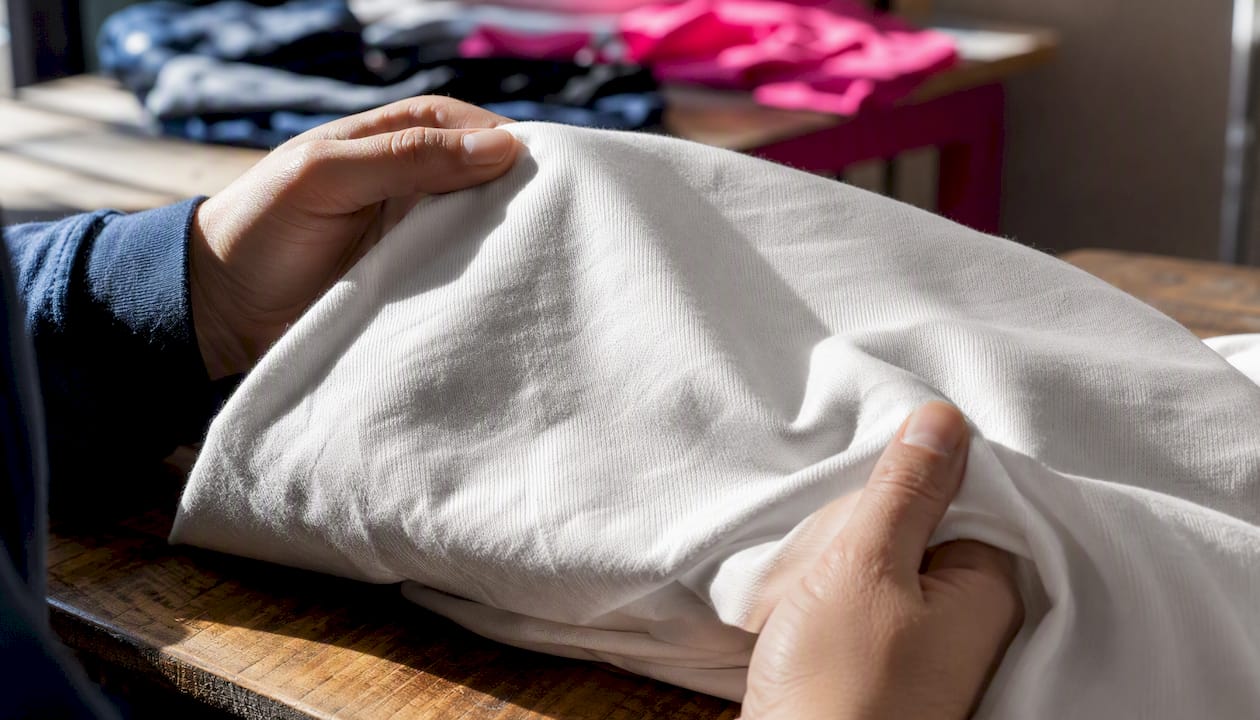
Black heavyweight tee. The white tee’s counterpart, and the piece that makes monochromatic dressing effortless. Worn alone with black denim, it reads as a composed tonal look; layered under a bomber, it disappears cleanly.
Graphic tee. Treat this as the capsule’s single personality piece — one graphic slot, not three. The graphic’s dominant color should echo somewhere else in your palette (a cap, a sneaker colorway, a jacket lining) so it reads as intentional composition rather than a random addition.
Long-sleeve tee or thermal. The transitional workhorse. Heather gray or olive reads as a neutral. Worn alone in mild weather, layered under a hoodie in fall, or peeking from beneath an overshirt with the sleeves pushed up — three distinct looks from one piece.
Quality hoodie. Minimalist streetwear favors heavyweight fleece with thick fabric weight typical of quality construction, and the reason is structural: heavier fabric holds a silhouette rather than collapsing into shapelessness. Choose a neutral — black, charcoal, or a muted earth tone — with minimal branding so it layers cleanly under outerwear.
Bottoms
Straight-leg or slim-straight jeans. Black denim is the most versatile choice because it reads as both casual and elevated depending on what sits above it. Indigo is a close second. Avoid distressing if you want maximum cross-compatibility; a clean leg works in more contexts.
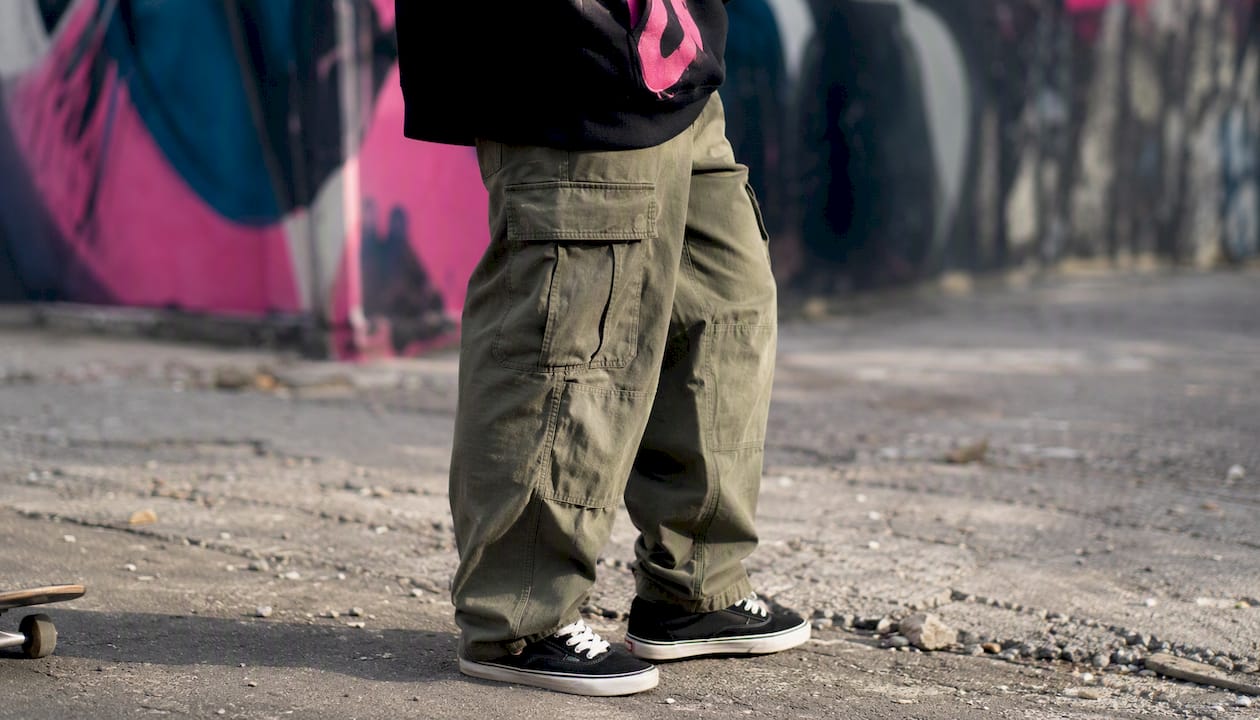
Cargo or track pants. This slot is where the streetwear capsule diverges most clearly from a general minimalist wardrobe. Olive cargo pants or charcoal track pants introduce a relaxed, utilitarian silhouette that pairs with the hoodie and overshirt in a way straight denim does not. They also function as the warm-weather alternative to heavier denim.
Shorts or relaxed chinos. The seasonal swap piece. In warmer months, this replaces the cargo pants or sits alongside the jeans as a third bottom. Neutral khaki or black keeps them compatible with the full top selection.
Outerwear
Overshirt or flannel. The most versatile layering piece in the collection. Worn open over a tee, it functions as a light jacket; buttoned up, it reads as a shirt. A neutral or muted plaid keeps it compatible with the palette without introducing a competing accent.
Bomber or shell jacket. The outerwear anchor. A black or olive bomber pairs with every bottom in the capsule and works across three seasons. A shell or technical jacket in the same colorway adds weather resistance without sacrificing the aesthetic.
Heavier coat or puffer (expansion piece). This is the fall/winter addition that pushes the capsule toward 16 pieces. An oversized puffer in black or charcoal layers over the hoodie and completes the cold-weather silhouette.
Footwear
Clean everyday sneaker. White or black, low-profile, minimal branding. This is the beater pair — worn daily, replaced when worn through. A quality hoodie, neutral tees, straight-leg jeans, and two footwear options form the core of maximum versatility, and the clean sneaker is one of those two.
Statement sneaker. The second footwear slot is where you invest in a silhouette with more visual weight — a chunky sole, a bolder colorway, or a collaborative design. This pair shifts the entire outfit’s register upward.
Accessories
Cap or beanie. Black, navy, or olive. A structured cap reads as more composed; a beanie reads as more relaxed. Owning one of each covers both registers without exceeding the accessory budget.
Functional bag. A crossbody or tote in black or a neutral canvas. The bag’s scale and material shift an outfit’s tone more than most people realize, which is covered in more depth in the accessories section below.
Simple jewelry or belt. A single chain, a ring, or a clean leather belt. One piece, worn consistently, becomes a signature rather than an afterthought.
Budget reference ranges
How do you choose a color palette that guarantees mixability?
The most reliable palette for a minimalist streetwear wardrobe starts with two or three neutrals and adds one accent color that repeats across one or two pieces. That repetition is the mechanism that makes a collection feel like a collection rather than a pile of individual garments.
A practical starting point: black, white, and gray as your neutrals, with olive or navy as a secondary neutral, and one muted accent — burgundy, slate blue, or a washed terracotta — appearing in the graphic tee’s print and echoed in the statement sneaker’s colorway or a cap. That single thread of color is what makes an outfit look composed rather than assembled.
What works:
- Tone-on-tone combinations (black tee + black denim + black sneaker) read as intentional and sophisticated
- Neutrals in different textures (matte cotton hoodie + slightly shiny nylon shell) add visual interest without color conflict
- One accent color repeated in two pieces creates a visual rhythm across the outfit
What to avoid:
- More than two accent colors in a single outfit — the eye has nowhere to rest
- Competing graphics (two printed pieces in one look dilutes both)
- Bright, saturated colors in multiple pieces simultaneously, unless the look is deliberately maximalist, which is a different aesthetic entirely
The graphic tee rule: treat the graphic’s dominant hue as an accent color and apply the same logic you would to any other accent. If the tee has a red graphic, the red should appear somewhere else in the look — a red tab on the sneaker, a red stripe on the cap — or the graphic reads as isolated. Starting with neutral anchors and adding one repeated accent color across one or two pieces maximizes mixability across the entire capsule.
What layering and proportion rules make streetwear look intentional?
Proportion is the grammar of streetwear. Without it, even expensive pieces look accidental. The foundational rule is simple: one oversized or relaxed piece paired with one more controlled piece. An oversized hoodie works with slim-straight jeans. A boxy tee works with tapered track pants. When both pieces are oversized simultaneously, the silhouette collapses into shapelessness; when both are fitted, the look loses the relaxed authority that defines the aesthetic.
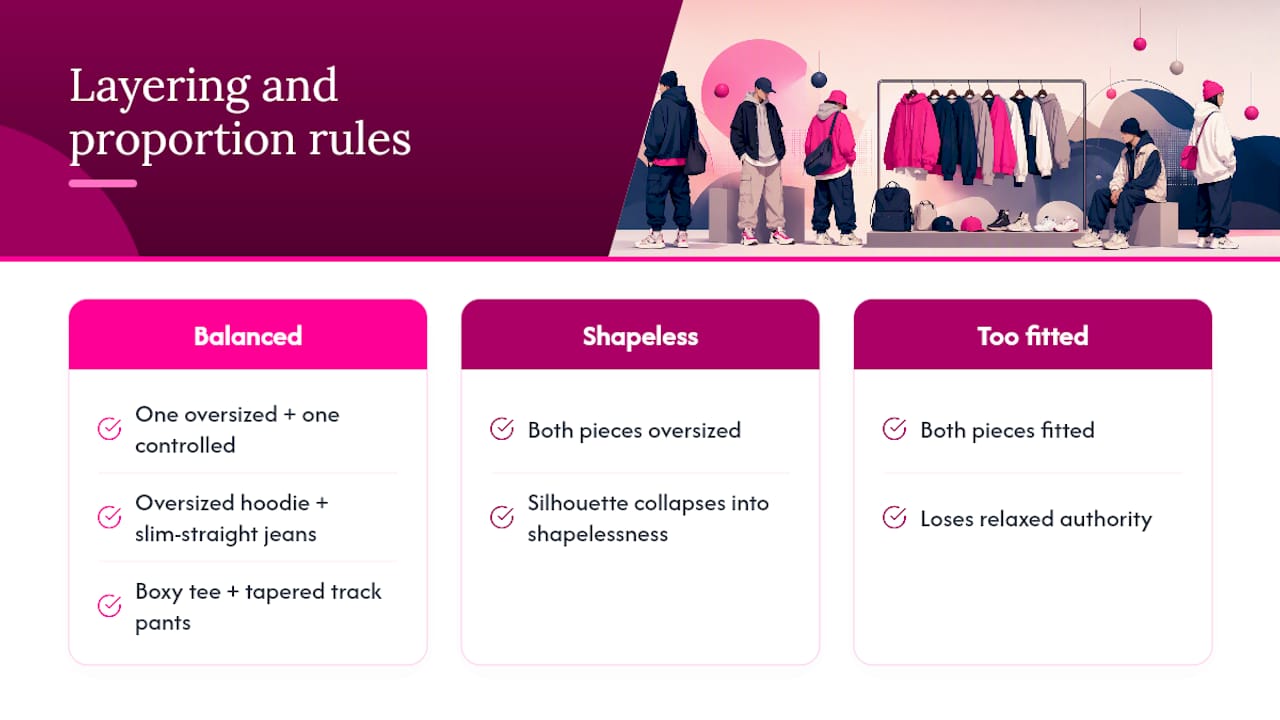
Layering order and silhouette logic
The standard layering sequence moves from fitted to relaxed as you add pieces outward:
- Base: fitted or slightly relaxed tee (tucked or half-tucked depending on the bottom)
- Mid-layer: hoodie or crew-neck sweatshirt (sits at or just below the hip)
- Outer layer: overshirt worn open, or a bomber/shell jacket (hits at the hip or just below)
- Shell: a puffer or heavier coat in cold weather (longer hem, worn over everything)
Each layer should be slightly longer or the same length as the one beneath it. A hoodie hem peeking below a bomber creates a layered composition; a hoodie that extends significantly past the jacket hem looks unintentional.
Specific proportion notes:
- Shoulder seams on an oversized piece should drop 1–2 inches past the natural shoulder, not 4–5 inches, which reads as ill-fitting rather than relaxed
- Sleeve length on a base layer should show slightly when the outer layer’s sleeves are pushed up — that detail signals intentionality
- Pant break: a slight break or a clean crop both work; a heavy stack of fabric at the ankle competes with the sneaker
For different body types: taller frames can carry longer hems and more dramatic drops without losing proportion. Shorter frames benefit from keeping the hem of the outer layer at or above the hip to preserve visual height. Wider frames often find that a slightly longer tee beneath a cropped jacket creates a cleaner line than a standard-length tee.
Three silhouette combinations worth studying:
- Oversized hoodie + slim-straight black jeans + clean white sneaker: the classic streetwear proportion, endlessly wearable
- Boxy tee + olive cargo pants + chunky statement sneaker: utilitarian and grounded, the silhouette reads wide-and-low in a deliberate way
- Long-sleeve thermal + overshirt worn open + track pants + low-profile sneaker: the layered casual look that works from a coffee shop to a skate session
Check out current streetwear silhouette trends to see how these proportion principles map to what is moving in the culture right now.
Eight outfit formulas that prove one capsule is enough
A 20-piece capsule can generate roughly 80–100 distinct outfit combinations when structured thoughtfully — and a modestly sized collection, chosen with cross-compatibility as the primary criterion, produces a similarly impressive range. These eight formulas use only pieces from the capsule above.
-
The casual default. White tee + black straight-leg jeans + clean white sneaker + black cap. The outfit that requires zero thought and always looks right. Swap the cap for a beanie in cooler weather.
-
The weekend elevated. Graphic tee + black jeans + statement sneaker + crossbody bag. The graphic tee does the work; everything else is neutral. The statement sneaker shifts the register from basic to considered.
-
The gorpcore-adjacent look. Long-sleeve thermal + shell jacket + olive cargo pants + clean sneaker + functional tote. Technical outerwear over a simple base layer with utility bottoms — the palette stays muted, the silhouette stays relaxed.
-
The smart-casual swap. Black tee + black jeans + bomber jacket + simple chain + clean black sneaker. Full tonal dressing in black reads as composed and slightly formal without leaving the streetwear vocabulary. The chain is the only detail that breaks the monochrome.
-
The travel uniform. Hoodie + track pants + clean sneaker + crossbody bag. Comfort-first, but the heavyweight hoodie and well-fitted track pants keep it from reading as airport loungewear. Swap the crossbody for a tote if you need more carry capacity.
-
The date-night variant. Graphic tee tucked into black straight-leg jeans + bomber jacket + statement sneaker + simple jewelry. The tuck introduces a more intentional silhouette; the bomber and statement sneaker do the rest. One accessory, worn with conviction, completes the look.
-
The rain-ready layered look. Long-sleeve thermal + hoodie + shell jacket + cargo pants + clean sneaker. Four layers, all from the capsule, all in neutrals. The shell jacket handles weather; the hoodie provides warmth; the thermal adds a visible base. This is the look that makes a capsule feel genuinely functional rather than aspirational.
-
The warm-weather simplified kit. Graphic tee + shorts or relaxed chinos + statement sneaker + cap. Three pieces, maximum ease. The graphic tee carries the personality; the cap ties the palette together. For a more polished version, swap the graphic tee for the black heavyweight tee and add the crossbody bag.
The single most impactful swap across all eight formulas: changing footwear. The clean white sneaker reads as casual and approachable; the statement sneaker reads as deliberate and fashion-forward. That one substitution shifts the register of any outfit in the list. For personalized outfit inspiration that goes beyond these formulas, Czt’s editorial archive offers concrete examples of how individual style choices transform a capsule.
How do you adapt a streetwear capsule across seasons?
The capsule’s seasonal intelligence comes from its swap slots — the two or three pieces that change with the climate while the core nine or ten pieces remain constant. Rather than building a separate wardrobe for each season, you rotate a small number of items in and out while the neutrals and the layering system hold.
The seasonal swap logic:
- Spring/Fall: the hoodie, overshirt, and bomber cover the full temperature range. Cargo pants replace shorts; the shell jacket replaces the puffer. The core tees and jeans stay in rotation year-round.
- Summer: shorts or relaxed chinos replace cargo pants. The hoodie moves to an evening layer. The shell jacket handles cool nights. The graphic tee and statement sneaker carry more visual weight when there are fewer layers to compete with them.
- Winter: the puffer or heavier coat enters the rotation. A beanie replaces the cap as the primary headwear. Heavier denim or lined track pants replace lighter bottoms. The thermal becomes a base layer rather than a standalone top.
Two capsule systems worth knowing:
The 3-3-3 method is a rotation exercise rather than a permanent capsule structure: choose 3 tops, 3 bottoms, and 3 accessories from your existing wardrobe and wear only those for a set period (typically a month). The purpose is to identify which pieces you actually reach for and which ones exist only in theory. It is a useful diagnostic tool before you invest in new pieces.
The 5-4-3-2-1 system describes a full capsule structure: 5 tops, 4 bottoms, 3 outerwear pieces, 2 footwear pairs, and 1 bag. This maps almost exactly onto the core capsule described in this guide and is a practical framework for anyone who wants a defined ceiling on piece count.
Practical seasonal checklist:
- Add: heavier outerwear, thermal base layer, beanie, weather-resistant sneaker (fall/winter)
- Remove: shorts, lightweight overshirt, cap as primary headwear
- Keep year-round: both tees, hoodie, straight-leg jeans, clean sneaker, statement sneaker, crossbody bag, graphic tee
Which accessories and footwear finish the capsule most effectively?
Accessories are where proportion and material choices have an outsized effect on how an outfit reads. A crossbody bag worn with a fitted bomber and slim jeans reads as composed and urban; the same outfit with a large tote reads as more relaxed and utilitarian. Neither is wrong, but the shift is significant enough to treat the bag as a deliberate style choice rather than a practical afterthought.
The accessory checklist and what each piece contributes:
- Cap (structured, 6-panel or 5-panel): adds a horizontal line across the silhouette that grounds the look. A black or olive cap in a neutral palette disappears into the composition; a cap in the accent color becomes a focal point.
- Beanie: the cold-weather alternative that reads as more relaxed and subcultural. A ribbed beanie in charcoal or black works with every outfit in the capsule.
- Belt: a clean leather or nylon belt in black or brown. Visible only when the tee is tucked or the jacket is open, but its absence is noticeable when it should be there.
- Simple jewelry: a single chain at collarbone length, a ring, or a small pendant. The rule is one piece worn consistently rather than multiple pieces worn occasionally. Consistency builds a signature; variety builds noise.
- Crossbody bag: the most versatile bag format for streetwear. A small crossbody in black nylon or canvas keeps the silhouette clean and the hands free. It works with every outfit formula in the list above.
- Tote: the high-capacity alternative. A canvas tote in black or natural reads as casual and relaxed; a structured leather tote reads as more elevated. For the travel uniform and the gorpcore-adjacent look, the tote is the better choice.
Footwear strategy in practice:
The everyday beater sneaker takes the most wear and should be replaced on a cycle rather than worn until they are visibly damaged. A clean white low-top or a black runner in good condition reads as intentional; the same shoe with yellowed soles and creased toe boxes reads as neglected, regardless of how considered the rest of the outfit is.
The statement sneaker is an investment piece. Neutral colorways with a distinctive silhouette — a chunky sole, an interesting material mix, a collaborative design — age better than trend-specific colorways that date quickly. Neutral-tone caps and clean sneakers are consistently recommended for capsule cohesion, and the same logic applies to the statement pair: a distinctive silhouette in a neutral or muted colorway outlasts a loud colorway in a generic silhouette.
A weather-appropriate third option — a waterproof boot or a trail-adjacent sneaker — is worth adding as a seasonal expansion piece rather than a core capsule slot.
Why do material choices and care matter for a sustainable capsule?
The durability of a capsule wardrobe is not an abstract virtue; it is the mechanism that makes the economics work. A $120 hoodie worn 200 times has a lower cost-per-wear than a $40 hoodie replaced three times in the same period. The material choices that drive that durability are specific and learnable.
Minimalist streetwear favors heavier fabric weights for a reason that is both aesthetic and practical: a 500–550 GSM hoodie holds its structure after repeated washing in a way that a 280 GSM fleece does not. A 220 GSM tee drapes with intention and resists the thin, translucent quality that lighter tees develop after a season of wear. Heavyweight denim at 14oz holds its shape and develops a patina rather than simply fading into formlessness. These are not luxury specifications; they are construction signals that indicate a garment was built to last.
What to look for when selecting pieces:
- Fabric weight listed on the product page (a brand that publishes GSM is signaling confidence in its construction)
- Reinforced seams at stress points (shoulders, crotch, pocket openings)
- Recycled or responsibly sourced content, which often correlates with more careful construction overall
- Colorfastness: turn the garment inside out and check the interior for dye transfer before buying
Czt’s approach to material innovation in streetwear centers on recycled materials — including the Botanic Camo collection, built from recycled content — that meet both the aesthetic and durability standards a capsule demands. The brand’s guidance on mixing sustainable pieces into stylish outfits offers practical selection and care advice grounded in real garment experience.
Care practices that extend capsule life:
- Wash in cold water on a gentle cycle; heat is the primary cause of fabric degradation and color loss
- Turn garments inside out before washing to protect surface fibers and graphics
- Air dry whenever possible; a dryer’s heat shrinks and weakens fabric over time
- Store hoodies and heavier knits folded rather than hung to prevent shoulder distortion
- Address small repairs (a loose seam, a missing button) immediately; a $3 repair prevents a $90 replacement
Pro Tip: Store your heavyweight hoodies and fleece pieces folded flat in a drawer rather than on a hanger. Hanging stretches the shoulder seams over time, and a distorted shoulder line is the single most visible sign of a garment that has been poorly cared for — it undermines the silhouette that makes the piece worth owning in the first place.
Czt’s examples of upcycled streetwear designs show what thoughtful material reuse looks like in practice, and the brand’s editorial work on responsible streetwear recycling offers a practical framework for what to do with pieces that have genuinely reached the end of their useful life.
How do you edit your capsule and shop it without impulse buying?
A capsule wardrobe is not a one-time purchase; it is a system that requires periodic maintenance. The editing process is as important as the initial build, because a capsule that accumulates pieces without removing others stops functioning as a capsule and becomes a wardrobe with a philosophy it no longer follows.
The editing process:
- Audit. Lay every piece out and ask two questions: Does it fit the current palette? Does it pair with at least two other pieces in the collection? Any piece that fails both questions is a candidate for removal.
- Keep. Pieces that pass the audit stay. Pieces that pass one question but not the other go into a probationary pile — wear them intentionally for two weeks before deciding.
- Mend or repair. A piece with a fixable flaw (a loose seam, a small hole, a broken zipper) gets repaired before it is evaluated for removal. Removing a piece because of a $5 repair is a false economy.
- Donate, sell, or recycle. Pieces that leave the capsule should leave the house. Keeping them “just in case” defeats the purpose of the system. Czt’s guidance on responsible streetwear recycling offers specific options for pieces that are too worn to donate.
The buying checklist (apply before every purchase):
- Does it fit the palette? (Can it pair with at least three pieces already in the capsule?)
- Is the fabric weight and construction appropriate for the price point?
- Does it fill a genuine gap, or does it duplicate a slot already occupied?
- Would you wear it at least 30 times in the next year?
Buying order for a first build: Start with the core four — white tee, black tee, black denim, clean white sneaker — before adding any other piece. These four items are the foundation that every subsequent purchase must work with. Add the hoodie and the overshirt next, then the statement sneaker, then the remaining accessories. This phased approach prevents the buyer’s remorse that comes from purchasing a statement piece before the foundation exists to support it.
Replacement guidelines by item type:
- Everyday sneakers: replace when the sole shows visible wear or the upper loses its structure (typically 12–18 months of daily wear)
- Tees: replace when the fabric thins, the neckline distorts, or the color fades significantly (a well-made heavyweight tee should last 2–3 years with proper care)
- Jeans: repair minor wear before replacing; quality denim can last 5+ years with occasional mending
- Outerwear: replace only when the construction fails (seam separation, zipper failure, insulation collapse) — a well-made bomber or shell jacket should last a decade
Why a sustainable capsule is the most honest form of streetwear
There is something worth saying plainly about the relationship between sustainability and streetwear, because the culture has not always been honest about it. Streetwear grew from scarcity and resourcefulness — from youth who made something aesthetically intriguing out of what they had, who understood that a single well-chosen piece carried more weight than a closet full of disposable trend items. The capsule wardrobe, at its core, is a return to that original sensibility.
We believe at Czt that the most authentic expression of streetwear culture is not the one that chases every drop and discards last season’s pieces without ceremony. It is the one that chooses deliberately, cares for what it owns, and builds a collection that reflects a genuine point of view rather than a series of purchasing decisions. Recycled materials are not a compromise in that context; they are a continuation of the culture’s original resourcefulness, applied to the present moment’s most pressing material reality.
The capsule format, built on pieces with real construction and real longevity, is the most honest version of this aesthetic we know how to make.
Czt makes it easier to build a capsule that actually lasts
The hardest part of building a sustainable streetwear capsule is not knowing what to buy — it is finding pieces that meet both the aesthetic and the construction standards the capsule demands, without compromising on either. Czt was built specifically to close that gap.
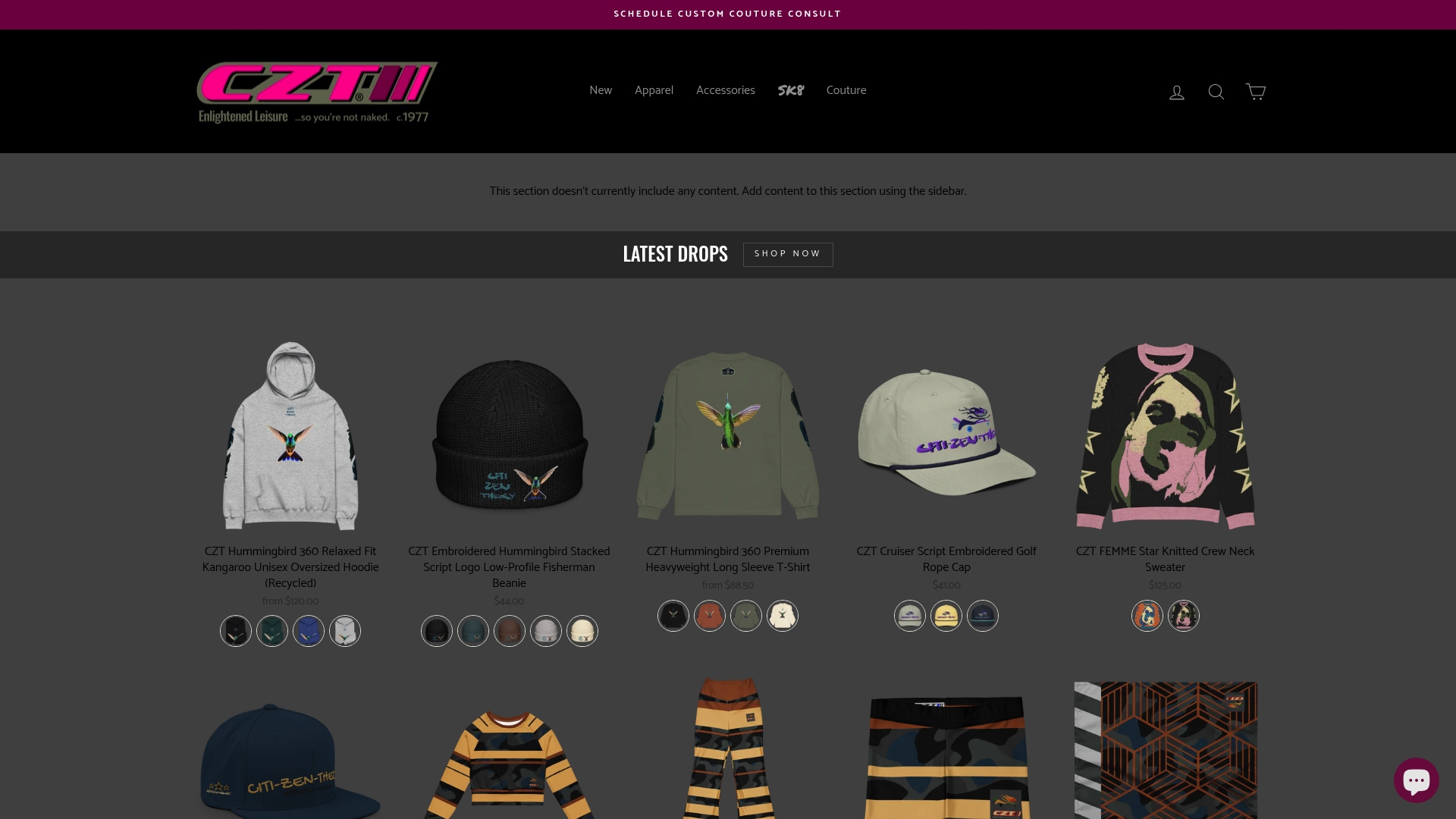
Czt’s collections, including the Botanic Camo line made from recycled materials, are designed with capsule compatibility in mind: neutral and muted palettes, silhouettes that layer cleanly, and construction standards that prioritize longevity over trend-cycle turnover. The brand’s custom couture design service goes further, allowing you to commission pieces built precisely to your palette and proportions — which means no compromises on fit, and no pieces that almost work but don’t quite integrate. For capsule-friendly basics with a gym-to-street sensibility, the HustleFuel gym-to-street capsule is worth exploring as a complement to Czt’s more design-forward pieces. Visit Czt to browse the current collection or book a couture consultation and start building a capsule that reflects your aesthetic with intention.
Sources
The following sources informed this guide and offer deeper reading on specific topics:
Recommended
- How to Mix Sustainable Pieces Into Stylish Outfits – CZT [CITI-ZEN-THEORY]
- Personalized Streetwear Looks: 9 Bold Style Examples – CZT [CITI-ZEN-THEORY]
- Stylish Sustainable Kids Outfits: 10 Looks to Copy Now – CZT [CITI-ZEN-THEORY]
- Skate Apparel Layering Techniques That Actually Work – CZT [CITI-ZEN-THEORY]