![CZT [CITI-ZEN-THEORY]](http://czt.rocks/cdn/shop/files/CZT_-_Brand_PINK_Label_1_330x.png?v=1774104725)
![CZT [CITI-ZEN-THEORY]](http://czt.rocks/cdn/shop/t/61/assets/CZT-Fast-Logo---Blue-Grey_330x.png?v=98224836737033641471695502660)
![CZT [CITI-ZEN-THEORY]](http://czt.rocks/cdn/shop/files/CZT_-_Brand_PINK_Label_1_170x.png?v=1774104725)
![CZT [CITI-ZEN-THEORY]](http://czt.rocks/cdn/shop/t/61/assets/CZT-Fast-Logo---Blue-Grey_170x.png?v=98224836737033641471695502660)
Why Organic Cotton Outperforms Synthetic Fabrics
Organic cotton is defined as cotton grown without synthetic pesticides, fertilizers, or genetically modified seeds, and it outperforms synthetic fabrics across every meaningful measure of sustainability and wearer comfort. The case for organic cotton rests on three pillars: agricultural practices that protect soil and water, fiber properties that deliver genuine comfort and durability, and an end-of-life story that synthetic materials simply cannot match. Certifications like GOTS (Global Organic Textile Standard) and OCS (Organic Content Standard) exist precisely because the gap between genuine organic cotton and conventional or synthetic alternatives is wide enough to warrant third-party verification. For anyone serious about eco-friendly fabric choices, understanding that gap is the foundation of every good purchasing decision.
Why organic cotton outperforms synthetic in environmental impact
Organic cotton farming produces a fundamentally different ecological footprint than synthetic fiber manufacturing. The most striking difference is water. Organic cotton reduces “blue water” consumption by up to 91% compared to conventional cotton, thanks to improved soil moisture retention from organic farming methods. That figure means organic fields draw far less from rivers, lakes, and aquifers, which matters enormously in water-stressed growing regions across India, Turkey, and the American Southwest.
Synthetic fibers carry a different kind of environmental debt. Polyester, nylon, and acrylic all derive from fossil fuels, and their production requires energy-intensive chemical processing before a single thread is spun. Organic cotton farming, by contrast, avoids synthetic pesticides and fertilizers entirely, protecting soil biology and the biodiversity of surrounding ecosystems.
There is one honest caveat worth naming. Organic cotton yields run 10–30% lower than conventional cotton yields, which means more land is needed to produce the same volume of fiber. That trade-off is real, and it influences both cost and land use calculations. The answer is not to dismiss organic cotton but to pair it with strong certification standards that verify genuine practice rather than marketing language.
Key environmental advantages of organic cotton farming over synthetic production:
- No synthetic pesticides or fertilizers, protecting soil microbiomes and local water sources
- Up to 91% less irrigation water drawn from natural sources
- No fossil fuel feedstocks required for raw fiber production
- Soil carbon sequestration supported by organic farming practices
- Biodiversity protection through chemical-free field management
The GOTS and OCS certifications provide the clearest signal that a brand’s organic claims reflect verified farming and processing standards, not just label copy. Regional practices vary considerably, and certification is the only reliable way to confirm that the environmental benefits described above actually apply to a specific garment.
Does organic cotton feel better and last longer than synthetics?
The short answer is yes, and the reason is structural. Organic cotton fibers retain their natural strength because they are never subjected to the harsh chemical treatments used in conventional cotton processing. Conventional cotton is routinely treated with chlorine bleaches, formaldehyde-based wrinkle-resistant finishes, and optical brighteners, all of which degrade fiber integrity over time. Organic cotton skips that entire chain of chemical intervention, which means the fiber that reaches your skin is softer, stronger, and more resilient from the start.
Breathability is the other major performance advantage. Organic cotton’s hollow fiber structure creates natural channels for airflow and moisture vapor to escape, preventing the overheating that synthetic fabrics routinely cause. Polyester and nylon trap heat against the skin by creating a microclimate effect, where moisture has nowhere to go. Cotton fibers allow continuous heat and vapor escape, which is why cotton has been the fabric of choice for warm-weather clothing across cultures for centuries.
Practical fiber performance comparison:
- Breathability: Organic cotton allows continuous airflow; synthetics trap heat and moisture
- Skin contact: Natural fibers are preferable for items worn directly against skin due to chemical safety advantages
- Durability: Organic cotton’s preserved fiber integrity resists breakdown better than chemically processed alternatives
- Odor: Synthetics may retain odors and require more frequent washing, increasing energy use over a garment’s life
- Texture: Organic cotton softens further with each wash rather than pilling or stiffening
Pro Tip: Wash organic cotton garments in cold water on a gentle cycle. This preserves fiber length and softness far longer than hot washes, extending the life of the garment significantly.
Synthetic fabrics do dry faster and wrinkle less, which matters in specific use cases. But for everyday wear, streetwear, and anything worn close to the body, organic cotton’s comfort profile is genuinely superior. The advantages of organic textiles in this category are not marginal. They are the direct result of fiber biology that no synthetic process has replicated.

How does end-of-life impact differ between organic cotton and synthetics?
This is where the cotton versus synthetic comparison becomes most urgent, and most lopsided. Organic cotton biodegrades within months under natural conditions, returning to the soil without leaving persistent chemical residues. A synthetic garment, by contrast, persists for centuries in landfill or ocean environments, slowly fragmenting into microplastics that enter food chains and water systems.
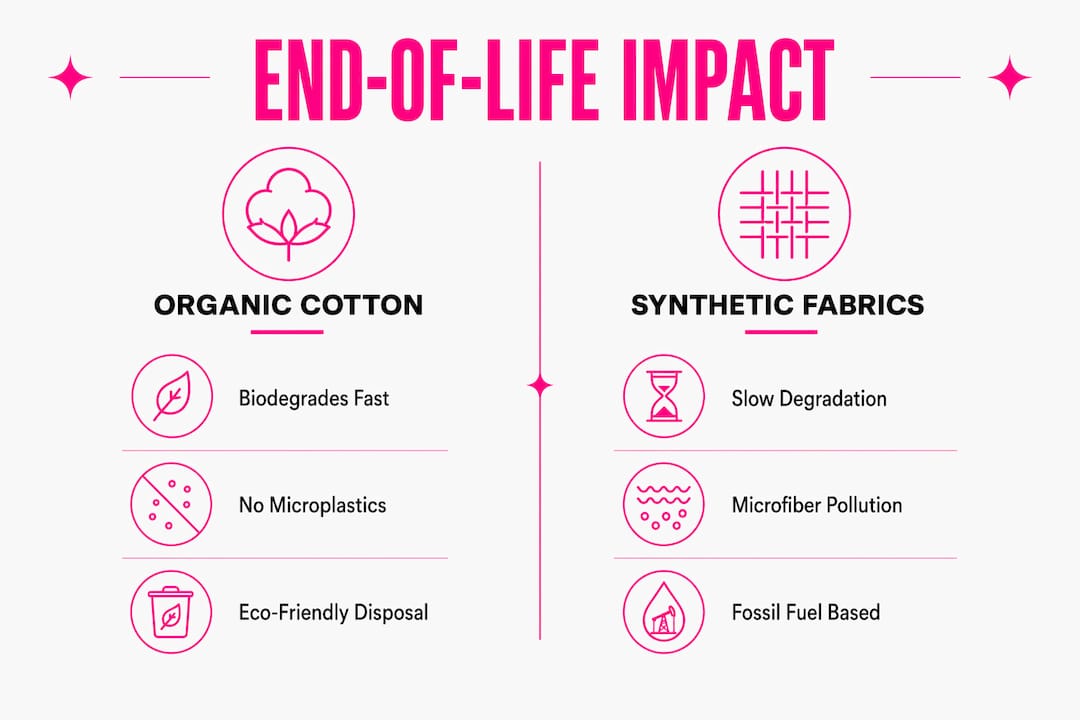
The microplastic problem is not abstract. Every time a synthetic garment is washed, it sheds microfibers into wastewater systems. Life Cycle Assessment research shows that synthetic microfiber emissions carry ecosystem quality impacts that are one to two orders of magnitude higher than cotton microfibers. That is not a small difference. It means synthetic fabric pollution is between 10 and 100 times more damaging to aquatic ecosystems than the equivalent cotton fiber release.
| End-of-life factor | Organic cotton | Synthetic fabrics |
|---|---|---|
| Biodegradation timeline | Months under natural conditions | Centuries in landfill or ocean |
| Microplastic shedding | Minimal; fibers are biodegradable | Significant with every wash cycle |
| Ecosystem quality impact | Low | One to two orders of magnitude higher |
| Marine environment persistence | Does not accumulate | Accumulates as persistent microplastics |
| Soil reintegration | Full and chemical-free | Not possible |
Care habits influence how much microfiber shedding occurs during a garment’s life. Washing at lower temperatures, using shorter cycles, and washing less frequently all reduce fiber release into water systems. These habits benefit both organic cotton and synthetic garments, but the baseline ecological risk of synthetic fiber shedding remains categorically higher regardless of care practices.
Pro Tip: If you own synthetic garments, use a microfiber-catching laundry bag like a Guppyfriend bag to capture shed fibers before they reach wastewater systems. It does not solve the structural problem, but it meaningfully reduces your individual contribution to microplastic pollution.
The biodegradation advantage of organic cotton is not just an end-of-life footnote. It reflects a fundamentally different relationship between the garment and the natural world, one where the fabric eventually returns to the earth rather than persisting as pollution. For anyone building a wardrobe with genuine sustainability in mind, this distinction carries real weight. You can also explore how recycled fabric clothing fits into a broader sustainable wardrobe strategy.
How do you choose genuinely eco-friendly organic cotton?
Not all organic cotton is equal, and that is the most important thing to understand before you spend more for a “sustainable” label. The word “organic” on a hangtag means nothing without third-party verification. GOTS and OCS certifications are the two most credible standards in the industry, and they verify both the farming practices and the processing chain, not just the raw fiber origin.
Here is what to look for when evaluating organic cotton garments:
- GOTS certification: Covers the entire supply chain from farm to finished garment, including chemical use in dyeing and finishing
- OCS certification: Verifies that the cotton content is genuinely organic at the fiber level, though it does not cover processing chemicals
- Country of origin transparency: Brands that name specific farms or regions demonstrate a deeper commitment than those offering vague “sustainably sourced” language
- Processing disclosures: Ask whether the brand uses low-impact dyes and avoids formaldehyde-based finishes, even on organic fiber
- Price context: Organic cotton costs more because yields are lower and certification carries overhead. A price point significantly below conventional cotton is a signal worth questioning.
The insight that “organic” is not a universal low-impact guarantee is one the industry itself acknowledges. Regional management practices, water availability, and processing methods all affect the actual sustainability outcome of a specific garment. Certification narrows that uncertainty considerably, but it does not eliminate the need for informed reading of labels.
A useful resource for building your evaluation framework is this sustainable fashion shopping checklist from Czt, which walks through the key questions to ask before purchasing any garment claiming environmental credentials. Understanding why sustainable fashion matters in 2026 also provides helpful context for placing these choices within the broader movement toward responsible consumption.
Key Takeaways
Organic cotton outperforms synthetic fabrics because its farming, fiber structure, and biodegradability each deliver measurable environmental and comfort advantages that synthetic materials cannot replicate.
| Point | Details |
|---|---|
| Water savings in farming | Organic cotton uses up to 91% less irrigation water than conventional cotton production. |
| Superior fiber comfort | Hollow fiber structure promotes breathability and moisture escape that synthetic fabrics block. |
| Microplastic pollution gap | Synthetic microfibers cause ecosystem damage one to two orders of magnitude higher than cotton fibers. |
| Certification is non-negotiable | GOTS and OCS are the only reliable ways to verify that “organic” claims reflect actual practice. |
| End-of-life advantage | Organic cotton biodegrades within months; synthetic fabrics persist for centuries as environmental pollutants. |
The fabric question is also a values question
We have spent years at Czt thinking about what it means to build clothing that carries genuine integrity, not just aesthetic integrity, but material integrity. The streetwear world we grew up in was not always asking these questions. Youth frolicking dangerously to the soundtrack of a culture that celebrated the new, the fast, and the disposable. We were part of that world, and we loved it. But the more we understood about what our clothes were actually made of, the harder it became to separate the art of the garment from the story of its fiber.
Organic cotton is not a perfect solution. The yield gap is real. The cost premium is real. And the sustainability outcome of any specific garment depends on where it was grown, how it was processed, and how it was cared for. We do not believe in pretending otherwise. What we do believe is that certified organic cotton, sourced with transparency and worn with intention, represents the most honest choice available to consumers who care about both how they look and what their choices leave behind.
Synthetic fabrics have a role in performance applications where no natural fiber currently competes. We recognize that. But for everyday wear, for the pieces that live closest to your skin and carry the most personal meaning, organic cotton’s combination of comfort, safety, and ecological responsibility is the standard worth holding to. The role of natural fibers in sustainable fashion is not nostalgic. It is forward-looking, grounded in evidence, and worth the extra attention it demands.
— Czt
Czt’s approach to fabric that means something
At Czt, the conversation about sustainable materials is not a marketing exercise. It is the foundation of how we design, source, and build every piece in our catalog.

Our Botanic Camo collection uses recycled materials as a direct response to the waste problem that synthetic fast fashion created. We also offer custom couture design services for customers who want to go further, choosing their own materials, cuts, and compositions with full transparency about what goes into the garment. Whether you are new to eco-conscious shopping or already deep into the practice, our sustainable streetwear collections are built to meet you where you are. Fabric choices carry weight. We think yours should too.
FAQ
What makes organic cotton more sustainable than polyester?
Organic cotton is grown without synthetic pesticides or fossil fuel inputs and biodegrades within months. Polyester is derived from petroleum and sheds microplastics with every wash, causing ecosystem damage one to two orders of magnitude higher than cotton fibers.
Is organic cotton actually better for your skin?
Natural fibers like organic cotton are preferable for items worn directly against skin because they avoid the chemical residues left by conventional processing and allow continuous airflow that prevents heat buildup.
How do I know if organic cotton is genuinely certified?
Look for GOTS or OCS certification marks on the label or brand website. GOTS covers the full supply chain including processing; OCS verifies organic fiber content at the raw material level.
Does organic cotton last as long as synthetic fabric?
Organic cotton fibers retain natural strength because they skip the harsh chemical treatments that degrade conventional cotton. With proper care, organic cotton garments hold their softness and structure longer than chemically processed alternatives.
Why does organic cotton cost more than synthetic fabrics?
Organic cotton yields run 10–30% lower than conventional cotton, which means more land and labor per unit of fiber. Certification overhead adds further cost. The price premium reflects genuine production differences, not just branding.