![CZT [CITI-ZEN-THEORY]](http://czt.rocks/cdn/shop/files/CZT_-_Brand_PINK_Label_1_330x.png?v=1774104725)
![CZT [CITI-ZEN-THEORY]](http://czt.rocks/cdn/shop/t/61/assets/CZT-Fast-Logo---Blue-Grey_330x.png?v=98224836737033641471695502660)
![CZT [CITI-ZEN-THEORY]](http://czt.rocks/cdn/shop/files/CZT_-_Brand_PINK_Label_1_170x.png?v=1774104725)
![CZT [CITI-ZEN-THEORY]](http://czt.rocks/cdn/shop/t/61/assets/CZT-Fast-Logo---Blue-Grey_170x.png?v=98224836737033641471695502660)
5 Pet Friendly Fabrics That Last in Homes, Including Recycled Options
For homes with dogs and cats, the fabric families worth your money are performance microfiber, leather or faux leather, and solution-dyed indoor-outdoor weave. Each one earns its place through a tight weave that keeps hair on the surface instead of buried in the fibers, resistance to abrasion, and a construction that shrugs off soap and water. Everything below explains when to pick each one and how to keep it looking new for years, not months.
TL;DR:
- Microfiber, leather, and solution-dyed outdoor-weave fabrics resist pet hair and stains better than open-weave, high-pile velvet, silk, linen, or bonded leather.
- Choosing fabrics with a tight weave, high abrasion rating, and solution-dyed color enhances durability and stain resistance for pets that shed, scratch, or track in mud.
- Regular cleaning, including vacuuming and prompt blotting, along with testing cleaning products, is essential to maintain pet-friendly upholstery.
- Leather and faux leather are easiest to clean and resistant to scratching but perform better with pigmented, protected finishes than natural or high-pile options.
- Eco-friendly fabrics like recycled polyester can match synthetic durability if they are properly maintained and care instructions are followed.
Table of Contents
- The Best Pet-Friendly Fabrics for Home Furniture
- How Do You Pick the Right Fabric for Your Pet?
- How Do You Clean and Maintain Pet-Friendly Upholstery?
- Sustainable Materials That Hold Up to Pets
- Why Czt Cares About Fabric That Actually Survives a Household
- A Sustainable Option for Pet-Ready Home Textiles
- Sources
The Best Pet-Friendly Fabrics for Home Furniture
Every fabric family below solves a different problem. The trick is matching the material to what your pet actually does to your furniture, not just picking whatever looks softest in the showroom.
Performance microfiber sits at the top of most upholsterers’ lists for a reason. Its dense, tight weave means hair and dander stay on top of the fabric rather than working into the base cloth, and a damp cloth usually handles the aftermath of a muddy paw print. Microfiber and other smooth synthetics consistently rank as the top choices for resisting pet hair and cleaning up fast.
Leather and faux leather offer a different kind of convenience. Hair wipes off in seconds, and there’s no fabric nap for claws to snag. The catch: pigmented, protected leathers hold up far better against active pets than pure aniline leather, which scratches and stains more easily. Faux leather sidesteps that issue but runs hot and cold with room temperature, something worth testing before committing a whole sectional to it. An indoor artificial leather option like the Torino collection shows the range of finishes now available in this category.
Solution-dyed indoor-outdoor weaves, made from acrylics or olefins, were built for porches and patios but have quietly taken over family rooms. The color is locked into the fiber itself rather than sprayed on the surface, so many of these fabrics tolerate diluted bleach without fading. That makes them a strong pick for messy, multi-pet households where wine spills and dog vomit are just part of the deal.
Performance velvet and other woven fabrics can work, but only with caveats. A short, dense pile behaves differently than the plush, deep-pile velvet you’d find on a formal armchair. If you love the look, look specifically for “performance velvet” labeling and confirm the pile height before buying.
Canvas and heavy cotton-denim blends deliver rugged durability at a lower price point than performance synthetics, making them a fair budget option for casual households without heavy staining concerns.
Steer clear of these fabric types in pet homes:
- Open-weave fabrics and boucle, where loops snag claws and trap embedded hair
- Pure silk or linen, both of which show stains and wear almost immediately
- High-pile velvet, which traps hair deep in the fibers and mats down fast
- Thin or bonded leather, which cracks and peels under regular scratching
How Do You Pick the Right Fabric for Your Pet?
The right fabric depends less on your decorating style and more on your pet’s specific habits. Upholstery professionals generally advise identifying the actual problem, shedding, scratching, or staining, since no single fabric solves all three equally well.
Walk through this checklist before you buy:
- Check the weave tightness. A loose, open weave will always trap more hair and fur than a dense one.
- Ask for the abrasion rating. Retailers can often provide Wyzenbeek or Martindale double-rub scores, and 50,000 double rubs or higher is a solid benchmark for heavy residential use.
- Confirm solution-dyed versus surface-dyed. Solution-dyed fibers hold color through cleaning; surface-dyed ones fade with repeated scrubbing.
- Match the pile to your pet’s coat. Low-pile or no-pile surfaces work best for shedders; nap-free leather works best for scratchers.
- Ask about the cushion and backing construction. A removable, washable cover adds years to a piece that sees daily pet traffic.
For heavy shedders, prioritize tight weaves and low static. For scratchers, skip anything with loose loops and lean toward leather or dense woven synthetics. For chewers, avoid delicate trims and exposed piping they can grab. For pets that track in mud, solution-dyed weaves with bleach tolerance will save you the most frustration.
Before you buy, ask the retailer directly: Is it bleach-safe? What cleaners does the manufacturer recommend? What does the warranty actually cover? Has the fabric been tested or treated with PFAS or PFCs, and can they document it?
Pro Tip: Always ask for the double-rub number in writing, not just a verbal “it’s durable.” Some sellers use the term loosely, and the actual rating on the spec sheet can tell a very different story.
Red flags worth walking away from: loose or open weaves, pure aniline leather, high-pile velvet marketed as “family friendly” without a performance label, and any natural fiber sold as delicate or dry-clean only.
How Do You Clean and Maintain Pet-Friendly Upholstery?
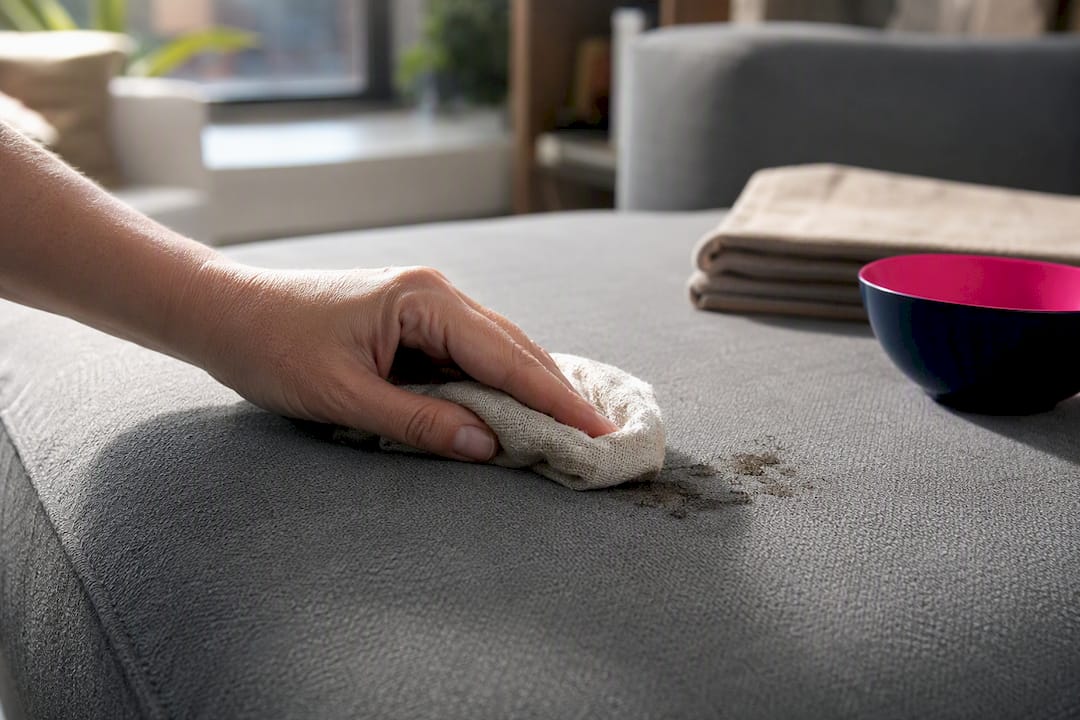
Fast action matters more than the product you grab. When an accident happens, blot first, don’t rub. Rubbing pushes the stain deeper into the weave and can damage the fibers. For urine, vomit, or other protein-based messes, an enzyme cleaner breaks down the organic matter that causes lingering odor, rather than just masking it. Always test any cleaner on a hidden seam first.
Ongoing maintenance is where most of the real work happens:
- Vacuum weekly with an upholstery attachment to lift surface hair before it settles in
- Run a rubber pet-hair brush or damp squeegee over the fabric between vacuuming sessions
- Keep a lint roller within reach for quick touch-ups before guests arrive
- Schedule a hot-water extraction or steam clean every few months for high-traffic pieces
Odor is a separate battle from staining. Antimicrobial finishes can slow bacterial growth on the fabric surface, but they don’t replace actual cleaning; they’re a supplement, not a substitute. For a deeper look at how these finishes work, Czt’s guide to odor-resistant fabrics breaks down what these treatments can and can’t do.
Bleach tolerance varies enormously by fabric family. Solution-dyed synthetics generally handle diluted bleach without color loss, since the pigment is baked into the fiber itself rather than applied to the surface. Leather, suede, and most natural fibers absolutely do not tolerate bleach and will discolor or degrade on contact.
Sustainable Materials That Hold Up to Pets
Recycled polyester, known as rPET, has become one of the more interesting materials in pet-friendly upholstery. Spun from reclaimed plastic and engineered with a tight, solution-dyed weave, it can match or beat virgin synthetic performance fabrics on stain resistance and durability, without asking you to trade sustainability for practicality.
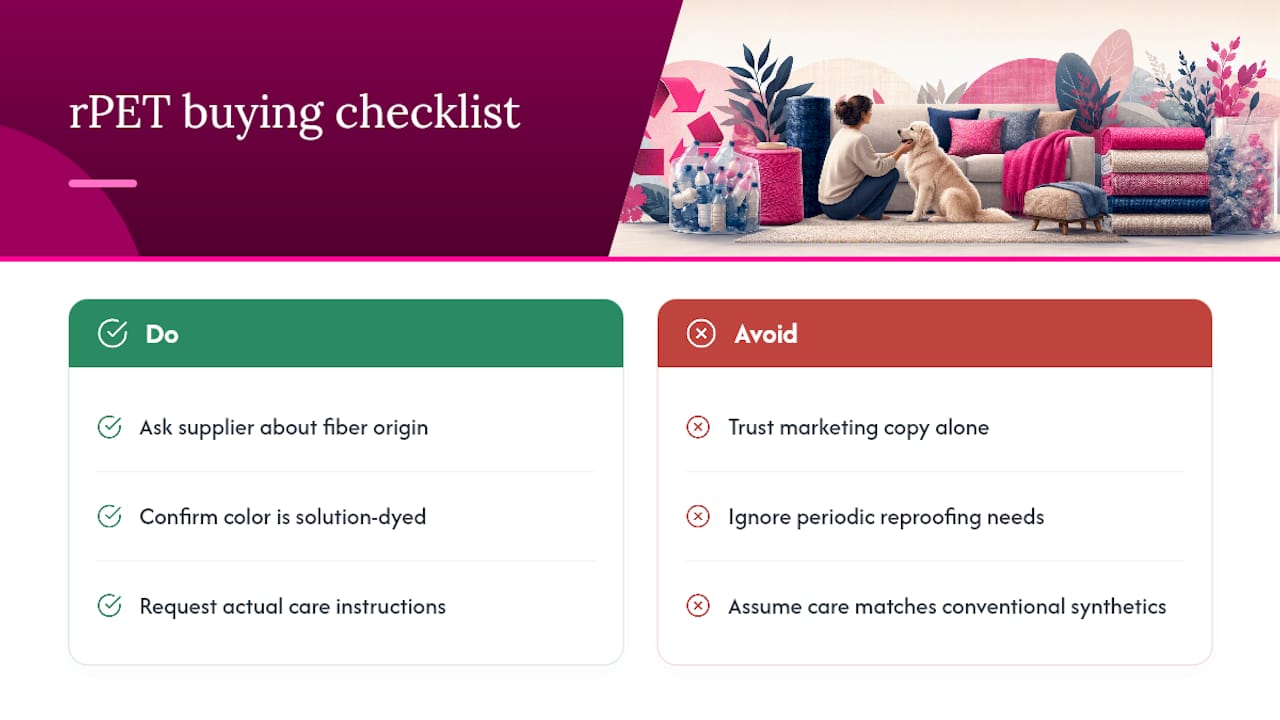
There are trade-offs worth knowing before you commit. Some eco-conscious finishes need periodic reproofing to maintain their water and stain resistance, and care instructions can differ from what you’d expect on a conventional synthetic. Czt’s breakdown of rPET fabric sourcing walks through how these fibers are verified, and the guide to durable fabrics for active households covers testing standards worth understanding before you buy.
The takeaway: ask any supplier about fiber origin, whether the color is solution-dyed, and what the actual care instructions require, not just what the marketing copy promises.
Why Czt Cares About Fabric That Actually Survives a Household
Durability is a key consideration when making clothes and gear meant to survive skate parks, backyard sessions, and the general chaos of daily life. That same instinct carries into how one might think about home textiles: sustainability and toughness aren’t opposing goals, they’re the same design problem seen from two angles. Work on recycled fiber sourcing and fabric performance reflects a commitment to understanding how materials behave under real pressure, pet claws included.
— CZT
A Sustainable Option for Pet-Ready Home Textiles
Some companies build collections and broader home goods lines around the principle that recycled materials can perform as hard as they look good.
 For homeowners who want fabric choices that align with an eco-conscious lifestyle without sacrificing the practical demands of living with pets, Czt’s approach to recycled fiber sourcing offers a different route than shopping big-box upholstery showrooms one swatch at a time. Every material decision starts from the same question this guide keeps circling back to: how does it perform once a real pet, and a real household, get their hands (or paws) on it. If you’re weighing a custom piece or want to talk through fabric options for your space, visit the Czt landing page to start that conversation with the team.
Sources
- Best Couch Material for Dogs: A Fabric Pro’s 2026 Guide – Midwest Fabrics
- Best pet hair-resistant couch fabrics for homes with pets – Mamma Mia Covers