![CZT [CITI-ZEN-THEORY]](http://czt.rocks/cdn/shop/files/CZT_-_Brand_PINK_Label_1_330x.png?v=1774104725)
![CZT [CITI-ZEN-THEORY]](http://czt.rocks/cdn/shop/t/61/assets/CZT-Fast-Logo---Blue-Grey_330x.png?v=98224836737033641471695502660)
![CZT [CITI-ZEN-THEORY]](http://czt.rocks/cdn/shop/files/CZT_-_Brand_PINK_Label_1_170x.png?v=1774104725)
![CZT [CITI-ZEN-THEORY]](http://czt.rocks/cdn/shop/t/61/assets/CZT-Fast-Logo---Blue-Grey_170x.png?v=98224836737033641471695502660)
How to Avoid Greenwashing in Fashion: A Buyer's Guide
The single most effective way to avoid greenwashing in fashion is to demand measurable proof before you buy: a published supplier list, a documented percentage of recycled content, a third-party audit report, or a science-based Scope 3 climate target. If a brand cannot produce at least one of these, the “eco” label is decoration, not evidence.
Three signals worth checking at the point of sale:
- A named, independent certification body (not a self-created badge) with a verifiable certificate number
- A specific recycled or organic content percentage tied to a named material, not a vague “made with sustainable fibers” claim
- A life-cycle assessment (LCA) or product footprint published on the brand’s own site, not buried in a press release
The immediate action you can take right now: search the brand’s website for the word “supplier” or “factory list.” If nothing surfaces in thirty seconds, that absence is itself a data point. As Scientific American notes, buying less, repairing, and choosing durable or secondhand garments often do more for your environmental footprint than any single purchasing decision.
Key Takeaways
Greenwashing in fashion is widespread, but verifiable proof — third-party audits, supplier lists, specific material percentages, and Scope 3 targets — separates genuine sustainability from marketing performance.
| Point | Details |
|---|---|
| Demand specific proof | Ask for supplier lists, recycled content percentages, LCAs, and third-party audit reports before buying. |
| 59% of green claims mislead | A market analysis of 4,000+ products found most green claims were unsubstantiated per CMA guidance. |
| Certifications have gaps | No single label covers the full lifecycle; verify certificate numbers directly on the certifying body’s database. |
| Buy less, wear longer | Garment longevity reduces impact more reliably than any single material swap or certification. |
| Czt publishes its sourcing | Czt uses post-consumer recycled materials and welcomes documentation requests for any product. |
Table of Contents
- How to spot greenwashing in fashion: the red flags that matter
- How do you verify a brand’s sustainability claims quickly?
- What do common certifications actually cover, and where do they fall short?
- A practical shopping checklist: questions to ask before you buy
- What should you do if you suspect a brand is greenwashing?
- Why Czt publishes this guide — and how to use it
- What does greenwashing in fashion actually mean?
- Why lifecycle transparency goes far beyond a factory list
- Real examples of greenwashing in fashion and what they reveal
- Which apps and tools help you identify genuinely sustainable brands?
- The conventional wisdom on sustainable fashion gets one thing badly wrong
- Czt’s approach to verified sustainable streetwear
- Sources
How to spot greenwashing in fashion: the red flags that matter
Greenwashing in fashion rarely announces itself. It arrives dressed in earthy tones, botanical imagery, and words like “conscious,” “green,” or “planet-friendly” — language that sounds meaningful but carries no legal definition and no enforceable standard in the United States.
The most common red flags:
- Vague environmental claims: “Eco-friendly,” “natural,” “sustainable,” or “responsible” with no supporting data
- Nature-themed aesthetics: Leaf motifs, forest photography, and muted earth palettes used as visual shorthand for low impact, even when the production model is fast-fashion volume
- Single-issue halos: A jacket marketed as “made with recycled polyester” while the brand’s overall virgin polyester use, water consumption, and labor conditions go unaddressed
- Selective disclosure: Highlighting one certified facility while the rest of the supply chain remains opaque
- Tokenized “circular” programs: Takeback schemes with no public data on what percentage of collected garments are actually recycled versus landfilled
Consumer Reports identifies the most prevalent form of greenwashing as asserting environmental benefits without documentation or credible third-party accreditation — and notes that vague terminology is common precisely because it is rarely legally enforced.
A 2021–2022 market analysis of more than 4,000 products across twelve online shops found that 59% of green claims were misleading or unsubstantiated when assessed against UK Competition and Markets Authority guidance — a figure that reflects the scale of the problem across the global apparel market.
Pro Tip: When you see vintage-inspired aesthetics or pastoral imagery on a brand’s homepage, cross-check their annual production volume. Visual storytelling about craft and heritage is not the same as evidence of low environmental impact.
How do you verify a brand’s sustainability claims quickly?
A five-minute check on any product page can reveal more than a brand’s entire marketing campaign. Work through these steps in order:
- Search for a supplier or factory list. Brands with genuine transparency publish named factories with addresses. A vague “we work with ethical partners” statement is not a supplier list.
- Look for a specific recycled or organic content percentage. “Contains recycled materials” means nothing without a number. “72% post-consumer recycled polyester” is a verifiable claim.
- Find the third-party audit. Check whether the certification number on the label can be verified on the certifying body’s own database (GOTS, OEKO-TEX, and B Corp all maintain public registries).
- Search for an LCA or product footprint. A life-cycle assessment quantifies impact from fiber to retail. Its absence does not prove wrongdoing, but its presence is a strong signal of rigor.
- Check for Scope 3 climate targets. Brands with science-based targets registered through the Science Based Targets initiative (SBTi) have made a public, third-party-reviewed commitment covering their full supply chain emissions.
Trusted tools for verification:
- Good On You rates brands on people, planet, and animals using publicly available data and direct brand surveys
- Fashion Revolution’s Fashion Transparency Index scores major brands on disclosure across their supply chains
- Textile Exchange publishes standards and preferred fiber data that help contextualize material claims
- The Rainforest Alliance’s consumer guidance offers a plain-language breakdown of red flags and how to check them
Social-media research published in Sustainability (MDPI) shows that consumers increasingly share peer-verified strategies, including checking certification databases and asking brands directly using the hashtag #whomademyclothes — a practice that has measurably raised brand accountability on public platforms.
What do common certifications actually cover, and where do they fall short?
Certifications are useful, but none of them covers the full lifecycle of a garment. Understanding what each one actually audits — and what it deliberately leaves out — is the difference between informed trust and misplaced confidence.
| Certification / Initiative | Scope covered | Key limitation | Common marketing misuse |
|---|---|---|---|
| GOTS (Global Organic Textile Standard) | Fiber to finished product, including social criteria | Covers organic fiber only; excludes synthetic blends | Used on one product line while rest of range is conventional |
| OEKO-TEX | Chemical safety of finished textile | Tests the product, not the production process or labor | Implies full sustainability when it only certifies chemical limits |
| Higg Index (Higg MSI) | Material-level environmental impact | Industry-developed; criticized for methodology favoring synthetics over natural fibers | Cited as proof of low impact when it measures only one material stage |
| Better Cotton Initiative (BCI) | Farm-level cotton practices | Mass-balance system means certified cotton is not traceable to the garment | “Better Cotton” label does not mean the cotton in your garment is certified |
| Textile Exchange | Fiber and material standards (e.g., RCS, GRS) | Standard-setting body, not a product certifier; brands self-select participation | Membership cited as certification when it is a commitment, not an audit |
| Ellen MacArthur Foundation | Circular economy frameworks and research | Advisory/advocacy body, not a certifier; no product-level auditing | Brand “partnership” used to imply circular credentials |
| ZDHC (Zero Discharge of Hazardous Chemicals) | Chemical management in wet processing | Voluntary; compliance depends on brand enforcement down the supply chain | Membership cited without evidence of supplier-level implementation |
| Cradle to Cradle (C2C) | Full product lifecycle, material health, recyclability | Expensive to certify; few garments achieve higher tiers | Lower-tier certification marketed as full circularity |
The Licence to Greenwash report documents that many certification schemes focus on limited lifecycle stages, lack enforcement mechanisms, and can be deployed in marketing as proxy-certification without driving systemic change. The same report notes the doubling of global virgin polyester since 2000 — a structural problem that most voluntary schemes do not require brands to address.
The lifecycle gap is the core issue. A garment certified at the fiber stage may still be dyed with hazardous chemicals, sewn in an unaudited factory, shipped across three continents, and designed to last eighteen months. Single-stage certification cannot speak to any of that. For a deeper look at how recycled materials in fashion interact with these tradeoffs, the nuances are worth understanding before you trust a label.
A practical shopping checklist: questions to ask before you buy
Before committing to a purchase, run through this sequence. It takes under five minutes and works equally well on a product page or in a brand’s customer chat.
Questions to ask the brand directly:
- Can you share your supplier or factory list, including addresses?
- What percentage of this specific product is made from recycled or certified organic material?
- Do you have a published LCA or product footprint for this item?
- When was your most recent third-party factory audit, and who conducted it?
- Has your brand set a Scope 3 emissions target through SBTi?
Buy / hold / skip signals:
- Buy when you get specific, documented answers to at least three of the five questions above
- Hold when the brand acknowledges the questions but says documentation is “in progress” — follow up in thirty days
- Skip when the response is a marketing paragraph with no data, or when the brand deflects to vague values language
Pro Tip: Prioritize durability over material claims if your primary concern is climate impact. A well-made garment worn 200 times outperforms a “sustainable” one worn 20 times, regardless of fiber composition. The longevity of a garment is one of the highest-impact variables in its lifecycle.
Consumers who prefer meaningful over trendy fashion consistently report higher satisfaction with purchases made using criteria-based checklists rather than marketing-driven impulse decisions.
What should you do if you suspect a brand is greenwashing?
Suspicion without documentation is just frustration. Here is how to turn an observation into a record that can actually create pressure.
- Screenshot everything. Capture the product page, the sustainability claims, the certification logos, and any email responses — with URLs and timestamps visible.
- Verify the certification claim. Go directly to the certifying body’s public registry and search the brand or product. A certificate that cannot be found there does not exist for practical purposes.
- File an FTC complaint. The Federal Trade Commission’s Green Guides set the U.S. standard for environmental marketing claims. File a report at ftc.gov/complaint — the FTC uses complaint volume to prioritize investigations.
- Contact your state attorney general. Many states have consumer protection divisions that act faster than federal agencies on local advertising fraud.
- Report on the brand’s social channels. Public, factual posts citing specific discrepancies (with screenshots) create accountability that internal complaint systems do not.
- Submit to Fashion Revolution. Fashion Revolution’s annual transparency campaign accepts consumer-submitted evidence and amplifies it through their global network.
Advocacy actions that compound over time:
- Leave a detailed, factual public review on Google or Trustpilot citing the specific missing documentation
- Support organizations like Fashion Revolution and the Ellen MacArthur Foundation through their advocacy campaigns
- Share verified brand ratings from Good On You with your network — peer-shared information is among the most effective tools for shifting purchasing behavior, as MDPI research confirms
Why Czt publishes this guide — and how to use it
At Czt, we publish this guide because we believe the culture of streetwear and skate deserves better than marketing theater. The communities we grew from — the youth frolicking dangerously to the soundtrack of concrete and creativity — have always valued authenticity over performance. Greenwashing is the antithesis of that ethos.
This guide is evidence-based and built to help you make a buy or skip decision at the point of sale, not to replace a professional audit or regulatory enforcement. We encourage you to apply the checklist to every brand you consider, including Czt. Our commitment to recycled materials, including the post-consumer content in collections like Botanic Camo, is documented and available for review. We welcome questions about our sourcing, material percentages, and supplier relationships.
- This guide draws on FTC Green Guides, peer-reviewed academic research, and NGO analysis
- The checklist is a consumer tool, not a substitute for independent auditing
- For sourcing questions or custom couture inquiries, reach out through our site
What does greenwashing in fashion actually mean?
Greenwashing in fashion is the practice of making environmental claims — in marketing, labeling, or public communications — that are misleading, unverifiable, or disproportionate to a brand’s actual environmental performance. The term borrows from “whitewashing”: covering over a damaging reality with a surface-level narrative.
The stakes are real. When consumers pay a premium for what they believe is a responsibly made garment, and that belief is manufactured rather than earned, the financial harm is direct. The environmental harm is compounding: spending that could have supported genuinely lower-impact production instead subsidizes the status quo while giving it a green veneer. The FTC’s Green Guides exist precisely because this gap between claim and reality is widespread enough to require federal guidance.
Why lifecycle transparency goes far beyond a factory list
A factory list is a starting point, not a destination. Full lifecycle transparency traces a garment from fiber cultivation or polymer production, through spinning, weaving or knitting, dyeing and finishing, cut-and-sew, packaging, shipping, retail, consumer use, and end-of-life processing. Each stage carries distinct environmental and social impacts that a factory address cannot capture.
Fiber sourcing alone involves questions of land use, water consumption, pesticide application, and carbon sequestration. Dyeing and finishing — the wet-processing stage — accounts for a significant share of the fashion industry’s water pollution and chemical discharge, which is precisely why ZDHC exists as a framework. Understanding how eco-friendly sourcing works across the supply chain reveals how many decision points exist between a raw material and a finished garment. A brand that publishes only a factory list is showing you one frame of a very long film.
Real examples of greenwashing in fashion and what they reveal
Several well-documented cases illustrate how greenwashing operates in practice, without naming brands that compete with Czt’s category.
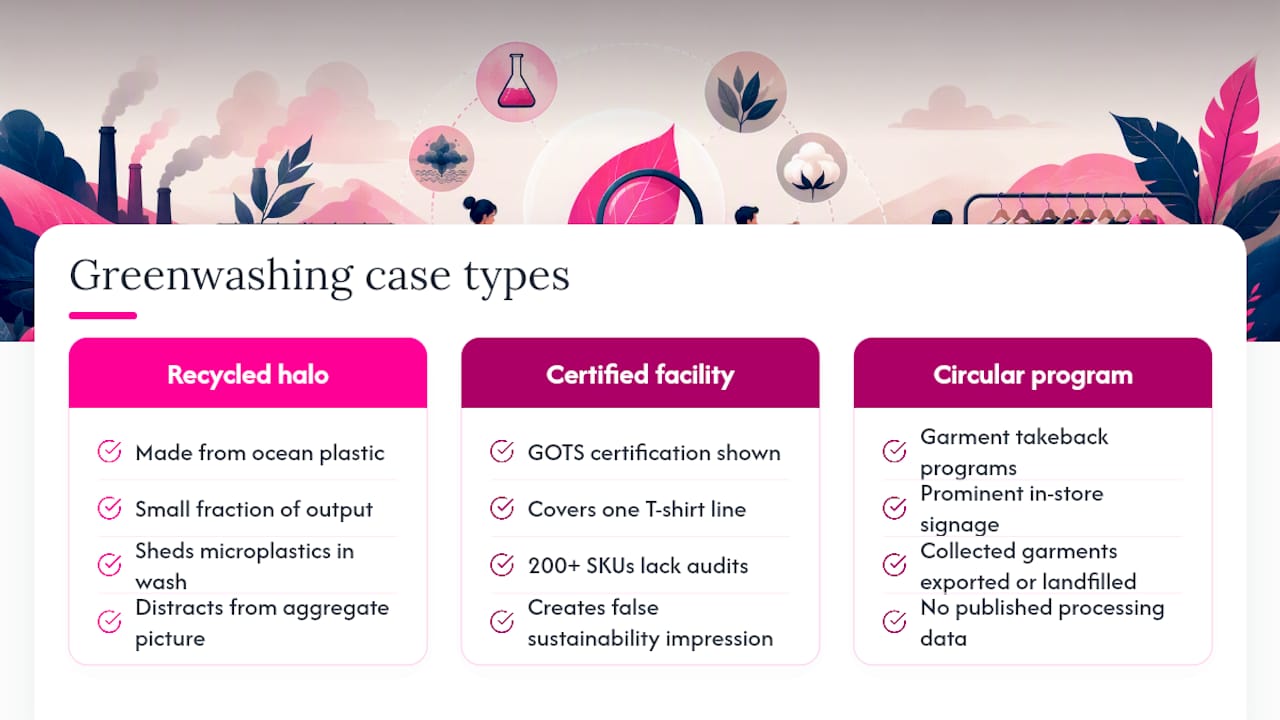
The recycled polyester halo. A major sportswear line launched a collection marketed as “made from ocean plastic,” generating significant press coverage. What the campaign omitted: recycled polyester still sheds microplastics with every wash, the collection represented a small fraction of the brand’s total output, and the brand’s overall virgin polyester use continued to grow. The single-material claim functioned as a distraction from the aggregate picture — exactly the pattern Andreas Rasche describes in CNN’s analysis.
The certified facility, uncertified supply chain. A mid-market retailer prominently displayed GOTS certification on its website. The certification applied to one organic cotton T-shirt line. The brand’s other 200+ SKUs were produced in facilities with no disclosed audit history. The certification was real; the impression it created — that the brand operated sustainably — was not.
The circular program with no data. Several fast-fashion retailers launched garment takeback programs with prominent in-store signage. Independent investigations found that a substantial portion of collected garments were exported to secondary markets or landfilled rather than recycled. Without published data on processing outcomes, “circular” is a promise, not a practice.
Which apps and tools help you identify genuinely sustainable brands?
Technology has made verification faster, though no single app replaces the five-question checklist above.
Good On You is the most comprehensive consumer-facing rating tool for fashion brands in the U.S. market. It aggregates publicly available data, brand surveys, and third-party reports into a five-point scale covering people, planet, and animals. The app is free and covers thousands of brands.
Fashion Revolution’s Fashion Transparency Index is published annually and scores the world’s largest fashion brands on disclosure across their supply chains. It does not rate small or independent brands, but it is the most rigorous public benchmark for major retailers.
DoneGood is a U.S.-focused browser extension and app that flags ethical alternatives when you shop online, drawing on B Corp status, Fair Trade certification, and similar markers.
For technical verification, the OEKO-TEX certificate check and GOTS public database allow you to confirm whether a specific certificate number is valid and current — a thirty-second check that catches a surprising number of fraudulent or expired claims. For brands making claims about eco-friendly fabric printing and processing, technical verification of those process claims requires looking at the specific chemistry and certifications behind the printing method, not just the finished product label.
The conventional wisdom on sustainable fashion gets one thing badly wrong
Most guides to avoiding greenwashing in fashion focus almost entirely on what to look for on a label. That framing, however well-intentioned, subtly reinforces the idea that the solution to fashion’s environmental crisis is smarter shopping rather than less shopping.
The evidence points in a different direction. Clothing production has roughly doubled over the past two decades while the number of wears per garment has dropped significantly, as Scientific American documents. No certification scheme addresses overproduction. No app can make a garment you buy but rarely wear sustainable. The most powerful consumer action available is buying fewer, better pieces and wearing them longer — a conclusion that is inconvenient for the fashion industry but well-supported by lifecycle data.
Certifications matter, but they are a floor, not a ceiling. A brand that holds GOTS certification and produces 50 million units annually is still part of a volume problem that no organic cotton label can resolve. The checklist in this guide is a tool for making better individual decisions within a system that needs structural change. Use it, but hold it in perspective: the sustainable fashion shopping checklist is most powerful when paired with a genuine commitment to buying less overall.
Czt’s approach to verified sustainable streetwear
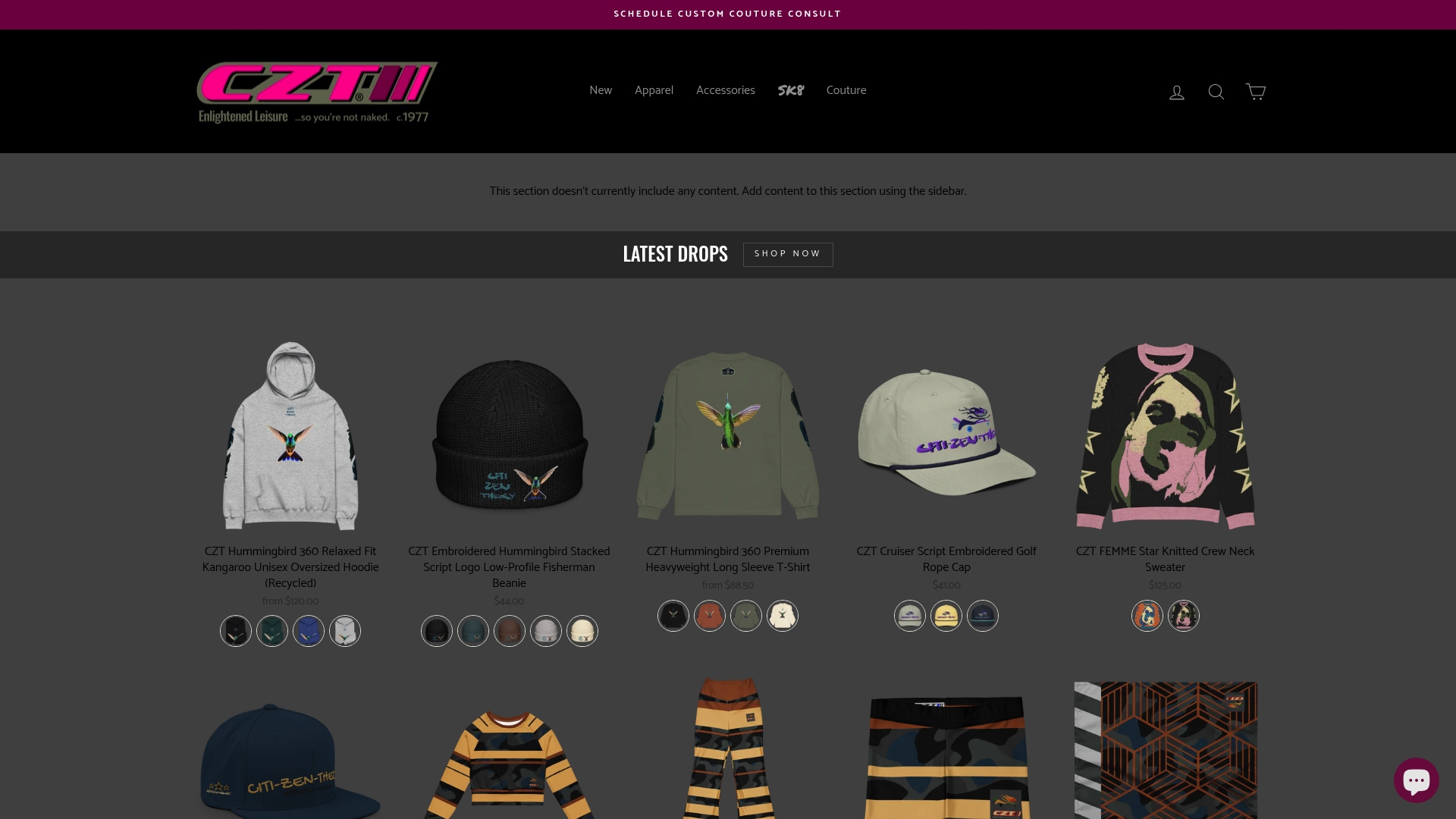
Czt was built on the conviction that streetwear and sustainability are not opposing forces — they are, at their best, the same impulse toward craft, longevity, and meaning. Collections like Botanic Camo use post-consumer recycled materials, and our custom couture service is designed so that what you commission is made to last, not to trend.
We apply the same checklist we publish here to our own sourcing decisions. If you want to see documentation, ask us. If you want a piece built to your specifications from verified materials, our custom couture design service is where that conversation starts. This checklist is a consumer tool, not a regulatory audit — but we believe transparency begins with the willingness to answer the questions it raises.
Sources
- Licence to greenwash (full report)
- Consumers’ guide to greenwashing (Consumer Reports)
- How to spot greenwashing red flags (Rainforest Alliance)
Recommended
- How to Compare Sustainable Streetwear Brands Methodically – CZT [CITI-ZEN-THEORY]
- How to Source Eco-Friendly Streetwear Pieces Globally – CZT [CITI-ZEN-THEORY]
- Sustainable Fashion Shopping Checklist for 2026 – CZT [CITI-ZEN-THEORY]
- Why Sustainable Custom Fashion Matters for Real Change – CZT [CITI-ZEN-THEORY]