![CZT [CITI-ZEN-THEORY]](http://czt.rocks/cdn/shop/files/CZT_-_Brand_PINK_Label_1_330x.png?v=1774104725)
![CZT [CITI-ZEN-THEORY]](http://czt.rocks/cdn/shop/t/61/assets/CZT-Fast-Logo---Blue-Grey_330x.png?v=98224836737033641471695502660)
![CZT [CITI-ZEN-THEORY]](http://czt.rocks/cdn/shop/files/CZT_-_Brand_PINK_Label_1_170x.png?v=1774104725)
![CZT [CITI-ZEN-THEORY]](http://czt.rocks/cdn/shop/t/61/assets/CZT-Fast-Logo---Blue-Grey_170x.png?v=98224836737033641471695502660)
Demand Yarn Level Thermoregulating Streetwear and Transparency
Phase change microcapsules, emissive coatings, and active mineral particles each earn their place in a hoodie or tee, but none of them work miracles. The honest verdict: expect a real, measurable, modest thermal buffer, not a personal climate system, and expect that buffer to depend heavily on how the technology gets built into the garment. Czt weighs those trade-offs against durability and sustainability before any fabric makes it into a collection.
TL;DR:
- Thermoregulating fabrics provide only modest thermal benefits of about 2.3°F to 2.6°F in durability tests, not big temperature swings.
- Embedding tech at the yarn level extends garment lifespan better through repeated washings, compared to surface-applied treatments.
- Performance relies heavily on garment fit, layering, and how close the fabric is to the skin, not just the fabric technology itself.
- Sustainability claims are often vague; recycled materials and clear production methods matter more than marketing hype about “bamboo” or unspecified percentages.
- Combining layered design with technically integrated and durable fabrics offers the most consistent thermoregulating effect for streetwear use.
Table of Contents
- How Thermoregulating Fabrics Work
- Reading the Big Names: 37.5, Outlast, and Emissive Coatings
- Bringing Thermoregulation Into Streetwear Design
- How to Choose Thermoregulating Fabrics for Everyday Wear
- How Czt Builds Thermoregulation Into Sustainable Streetwear
- The Gap Between Lab Claims and Closet Reality
- Shop Thermoregulating Streetwear or Build Something Custom
- Sources
- FAQ
How Thermoregulating Fabrics Work
Every thermoregulating textile is solving one of three physics problems: storing heat, redirecting it, or moving moisture off your skin faster. Understanding which one a garment tackles tells you what to actually expect when you wear it.
Phase change materials (PCMs) work through latent heat. As your body warms up, microcapsules embedded in the fiber melt slightly and absorb that heat; as you cool down, the material solidifies again and releases it back. It’s the same principle that keeps an ice pack cold, just tuned to a comfort range near skin temperature.
Emissivity-based fabrics take a different approach entirely. Rather than storing heat, they change how much infrared energy your body radiates away or reflects back. This lineage traces to a NASA-developed coating originally built for spacecraft thermal control, later adapted into apparel.
Active particle technologies focus on vapor, not heat storage. Minerals and carbon particles embedded in the yarn speed up moisture evaporation, which cools skin faster during activity.
Traditional insulators like wool, waffle knit, and power-grid fleece rely on trapped air rather than any of these mechanisms, a distinction worth knowing before comparing performance claims, as Trail Runner Magazine explains:
- Wool traps air in its crimped fiber structure and manages moisture through natural wicking.
- Waffle and power-grid knits create dead air pockets through their raised texture.
- PCM fabrics actively absorb and release heat rather than just trapping it.
- Emissive fabrics change radiant heat transfer instead of relying on insulation alone.
Reading the Big Names: 37.5, Outlast, and Emissive Coatings
Three commercial technologies dominate the thermoregulating conversation, and each makes a different kind of promise worth translating before you buy.
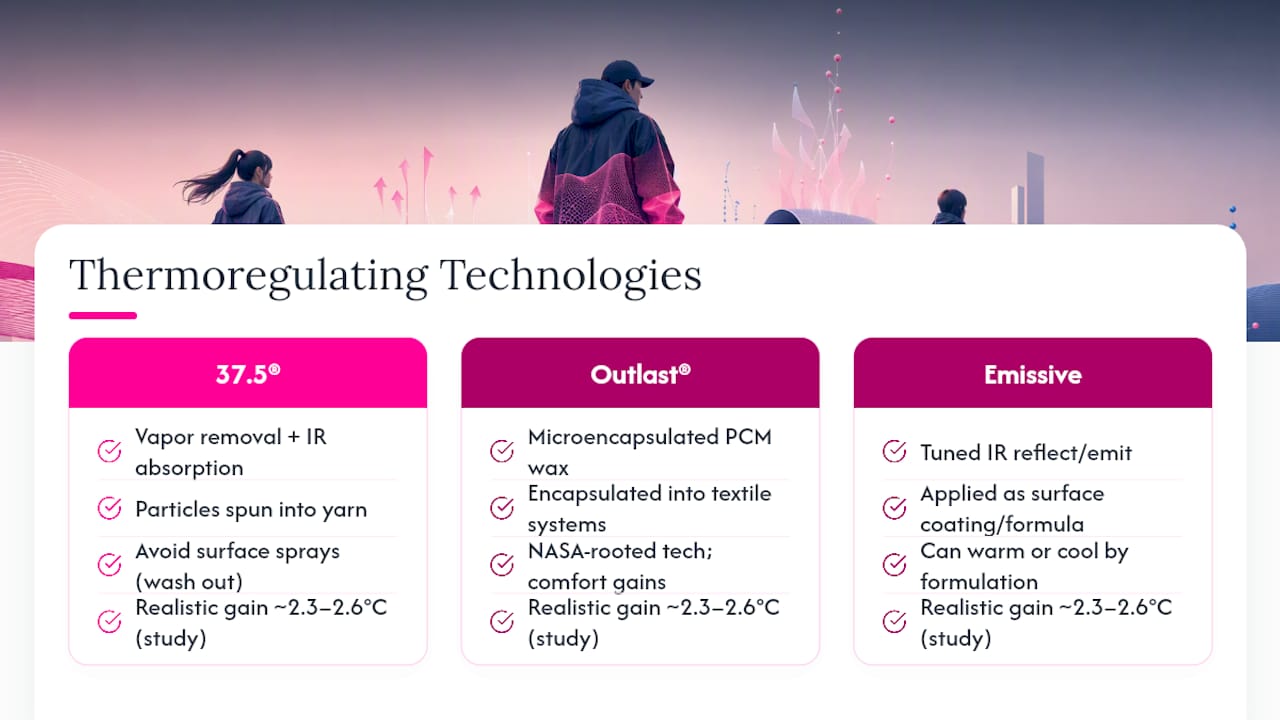
37.5® Technology uses active particles derived from volcanic minerals and activated carbon, embedded directly into the fiber. The manufacturer’s own materials describe the mechanism as accelerated vapor removal paired with infrared energy absorption, which speeds evaporative cooling next to skin. The real-world signal to look for isn’t a marketing percentage. It’s whether the particles are spun into the yarn itself rather than sprayed onto the surface, since surface treatments wash out.
Outlast® built its reputation on microencapsulated PCM wax, a technology with roots in NASA-funded thermal research. The vendor reports reduced sweating and improved comfort in testing. Treat any specific sweat-reduction percentage as a lab condition, not a guarantee for a humid subway platform in August.
Emissive coatings, including formulations like Trizar built on the NASA coating lineage, work by tuning how much infrared radiation the fabric reflects or emits. Depending on formulation, the same underlying science can warm a wearer in cold conditions or help shed heat in warm ones.
For interpreting lab numbers, a useful benchmark comes from a 2025 Nature Communications study on a durable bi-directional thermoregulation fabric, which held its performance through 50 wash cycles and 500 rub cycles while producing thermal differences of roughly 2.3°C to 2.6°C in heating and cooling tests. That’s the realistic scale of gains you should expect from any credible thermoregulating claim, not the 10 or 15 degree swings some marketing copy implies.
Bringing Thermoregulation Into Streetwear Design
Thermoregulating tech earns its keep in specific garment types, not everything in a closet, as highlighted in the recent sustainable fishing apparel collaboration that blends technical performance with eco-conscious design. Liners, midweight jackets, hoodies, and technical tees see the most benefit because they sit close enough to skin for heat exchange or vapor transport to matter.
- Base and mid layers benefit most. PCM and active-particle fabrics work through skin contact, so a liner or fitted tee captures more of the effect than a loose outer shell.
- Fit and layering still govern outcomes. Air pockets at the collar and cuffs, mesh venting at the underarms, and seam placement that avoids chafing all matter as much as the fiber technology itself.
- Durability depends on construction method. Fabrics with tech integrated at the yarn level hold up through repeated washing far better than surface-applied treatments, echoing the Bi-DTF durability findings.
- Sustainability claims need scrutiny. Recycled polyester and closed-loop lyocell carry clearer environmental credentials than vague “bamboo” labeling, since most soft bamboo garments are actually chemically processed viscose or rayon.
Layering strategy matters just as much as fabric choice when you’re building a cold-weather fit around these materials, something worth reading up on before your next skate session.
How to Choose Thermoregulating Fabrics for Everyday Wear
Start with your actual comfort goal, not the fabric with the flashiest name. Someone chasing sweat management during an active skate session needs a different solution than someone who just wants a hoodie that doesn’t feel clammy on a commute.
Run through this before checking out:
- Define whether you need heat storage (PCM), radiant control (emissive), or moisture speed (active particles).
- Check whether the technology is embedded in the yarn or applied as a surface finish. Yarn-level integration lasts longer.
- Look for a stated wash-cycle durability claim. Fifty cycles with retained performance, as shown in the Nature Communications testing, is a realistic bar.
- Ask whether “bamboo” on the tag means mechanically processed linen or chemically processed viscose. The production method determines the environmental impact, not the plant itself.
- Be skeptical of any unsupported percentage claim with no test method attached.
Testing across the industry shows a consistent pattern: thermoregulating benefits are real but modest in daily wear, and how much you feel them depends on your activity level and whether the tech sits at the fiber level or the surface. That single fact should anchor every buying decision you make here.
Pro Tip: If you wash a garment more than once a week, prioritize yarn-level integration over surface coatings. Surface treatments degrade fastest exactly where you need them most, at the seams and high-friction zones.
How Czt Builds Thermoregulation Into Sustainable Streetwear
The approach to material selection starts with the question every eco-conscious shopper should ask: does this fabric perform, and can we account for where it came from? For example, some collections are built from recycled materials chosen as much for their end-of-life impact as their next-to-skin feel. Our advocacy for hemp as a streetwear fiber comes from the same instinct that drives our take on thermoregulating tech: durability and transparency matter more than a flashy claim on a hangtag. We write about material innovation because we believe shoppers deserve to understand what they’re buying, not just how it’s marketed.
The Gap Between Lab Claims and Closet Reality
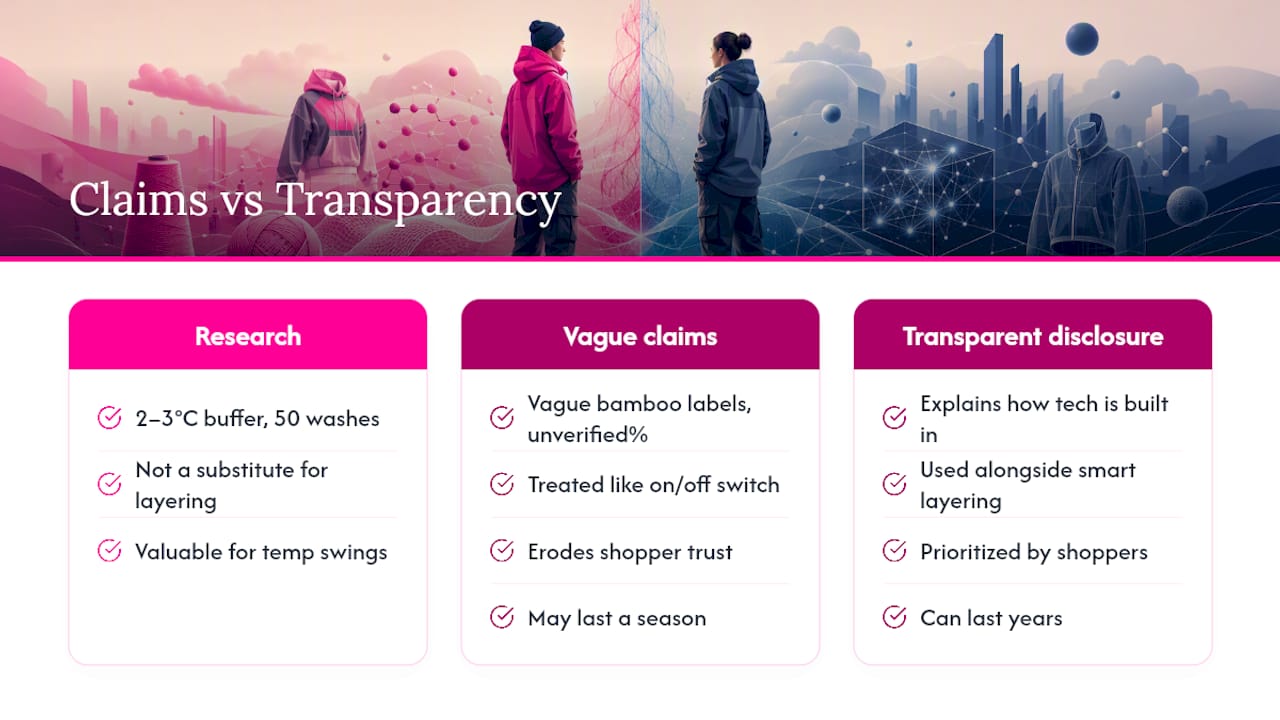
Here’s what the conventional pitch gets wrong: it treats thermoregulating fabric like a switch, on or off, hot or cold, solved. The research tells a more useful story. A two or three degree thermal buffer, sustained through fifty wash cycles, is genuinely valuable for someone skating through a temperature swing or layering for an unpredictable commute. It is not a substitute for smart layering, breathable cuts, or honest fabric sourcing.
The industry’s bigger failure is transparency, not physics. Vague bamboo labeling and unverified percentage claims do more damage to shopper trust than any actual limitation of PCM or active-particle technology. If you take one thing from this, prioritize garments that disclose how the tech is built into the fabric over garments that simply claim it works. That distinction separates a fabric that lasts a season from one that lasts years.
— CZT
Shop Thermoregulating Streetwear or Build Something Custom
If the science above left you wanting a wardrobe that actually reflects it, there are two direct paths: shop pieces built with recycled, thermoregulating-informed materials, or seek custom couture design to create something engineered around personal comfort needs and climate. Unlike chasing down individual technology licenses from separate outdoor brands, some designers integrate sustainability research and fabric science into the design process from the first sketch.

Browse the current collection or book a custom couture consultation directly at Czt and tell us what you need your next piece to do, whether that’s surviving fifty wash cycles on a skate deck or handling a variable-weather commute without a fabric change.
Sources
- NASA — Temperature‑regulating clothing additive heats up
- Nature Communications — Sustainable bi‑directional thermoregulation fabric for clothing microclimate
- FTC — Bamboo fabrics: what you should know
- 37.5 Technology — temperature regulating apparel
FAQ
What is the most temperature-regulating fabric?
No single fabric wins outright. Bi-directional thermoregulation fabrics tested in Nature Communications delivered roughly 2.3°F to 2.6°F thermal shifts while surviving 50 wash cycles, which represents a realistic performance ceiling for durable smart textiles today.
What is the best fabric for streetwear?
The best choice depends on your climate and activity level. Recycled polyester blends and closed-loop lyocell, the kind Czt favors in collections like Botanic Camo, combine durability and lower environmental impact better than most conventional cotton or synthetic options.
Which fabric is best for thermal layers?
Microencapsulated PCM fabrics like Outlast® work well for thermal base layers because they store and release body heat directly against skin, while active-particle fabrics like 37.5® suit high-output activity where sweat management matters more than heat retention.
What fabric is the most insulating?
Wool and power-grid fleece remain the most insulating through trapped air alone, while emissive coatings derived from NASA’s PCCM research add a second layer of warmth by radiating body heat back toward the wearer instead of just blocking airflow.