![CZT [CITI-ZEN-THEORY]](http://czt.rocks/cdn/shop/files/CZT_-_Brand_PINK_Label_1_330x.png?v=1774104725)
![CZT [CITI-ZEN-THEORY]](http://czt.rocks/cdn/shop/t/61/assets/CZT-Fast-Logo---Blue-Grey_330x.png?v=98224836737033641471695502660)
![CZT [CITI-ZEN-THEORY]](http://czt.rocks/cdn/shop/files/CZT_-_Brand_PINK_Label_1_170x.png?v=1774104725)
![CZT [CITI-ZEN-THEORY]](http://czt.rocks/cdn/shop/t/61/assets/CZT-Fast-Logo---Blue-Grey_170x.png?v=98224836737033641471695502660)
Verify Recycled Nylon Fabric Claims: Ask for GRS and LCA
Recycled nylon fabric is a polyamide textile rebuilt from waste nylon, whether fishing nets, carpet scraps, or fabric offcuts, through mechanical remelting or chemical regeneration. Chemically regenerated nylon like ECONYL® can rival virgin-grade performance, but it tends to cost more and typically moves through a thinner supply chain than recycled polyester. Look for Global Recycled Standard verification before you trust any claim on the swing tag.
TL;DR:
- Chemically regenerated nylon, like ECONYL®, offers performance comparable to virgin nylon but comes at a higher cost and has a thinner supply chain than recycled polyester.
- Mechanical recycling shortens fiber strength with each cycle, leading to more variation, while chemical regeneration can produce nearly limitless high-quality nylon from waste.
- Recycled nylon excels in abrasion resistance, elasticity, and durability for heavy-use products, but degrades faster under sun and chlorine exposure compared to polyester.
- Certification standards such as GRS verify actual recycled content, but environmental benefits require considering full life cycle emissions beyond recycled percentage claims.
- Proper care, including cold washing and microfiber catching, extends recycled nylon garments’ lifespan and reduces microfiber pollution.
Table of Contents
- What Recycled Nylon Fabric Actually Is
- How Recycled Nylon Is Made: Mechanical Remelting vs. Chemical Regeneration
- Material Properties and Performance You Should Expect
- Sustainability Impact and What the Certifications Actually Verify
- Where Recycled Nylon Fabric Performs Best
- Care Instructions That Extend Life and Cut Microfiber Shedding
- Where Recycled Nylon Falls Short
- Why Czt Chooses Recycled Nylon Where It Counts
- Find Recycled Nylon Pieces Built to Last
- Sources
What Recycled Nylon Fabric Actually Is
The technical name for recycled nylon is recycled polyamide, or rPA, and the distinction between how it’s made matters more than most shoppers realize. Mechanical recycling grinds and remelts nylon waste directly into new fiber. Chemical regeneration breaks the polymer all the way down to its monomer, caprolactam, then rebuilds it, which is a fundamentally different process with different results.
Feedstocks vary by producer, but three sources dominate the category:
- Discarded fishing nets and industrial rope pulled from oceans and ports
- Old carpet tile and flooring waste from commercial strip-outs
- Pre- and post-consumer textile scraps from garment manufacturing
That third category, garment scraps, is where a brand’s own production waste can loop back into new fabric instead of a landfill.
How Recycled Nylon Is Made: Mechanical Remelting vs. Chemical Regeneration
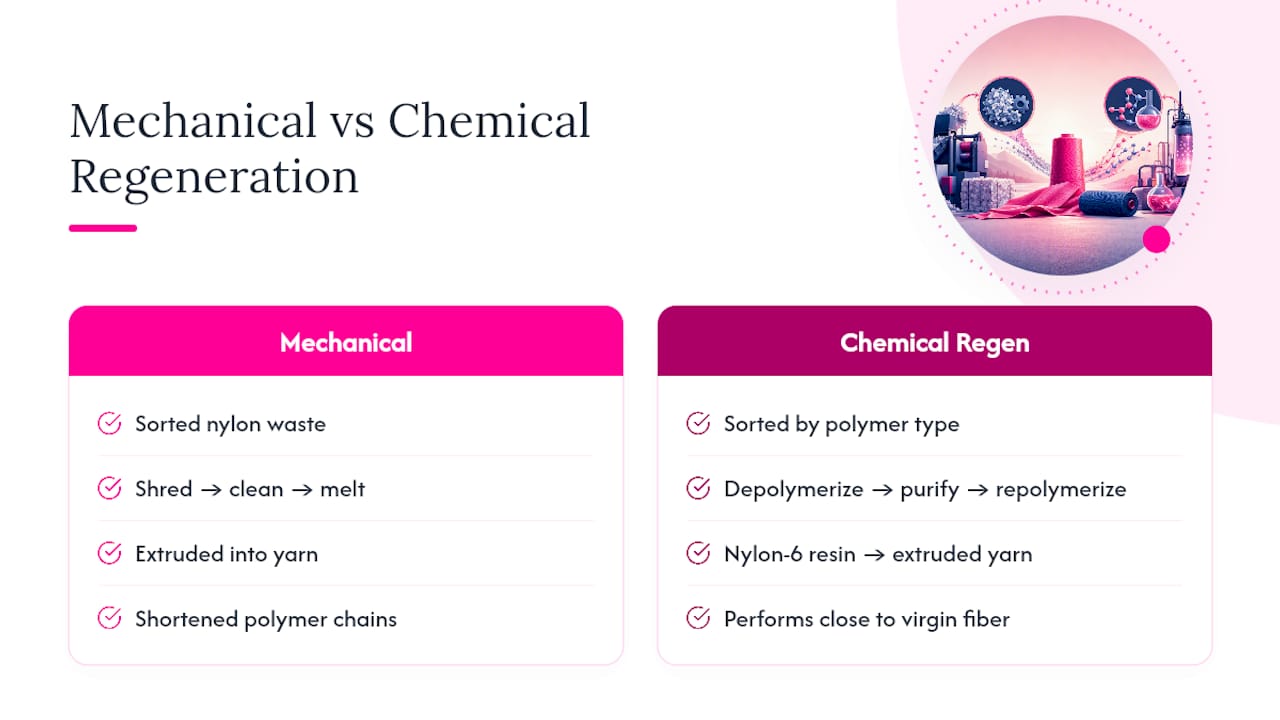
Mechanical recycling is the older, cheaper route. Sorted nylon waste gets shredded, cleaned, and melted down for extrusion into new fiber. The catch is that heat and mechanical stress shorten polymer chains each time, which is why mechanically recycled nylon can show more batch-to-batch variation in strength and dye uptake.
Chemical regeneration works differently. ECONYL® depolymerizes nylon waste back to caprolactam, purifies it, then repolymerizes it into nylon-6 that performs close to virgin fiber. NUREL’s Reco Nylon line takes a related approach with pre-consumer and post-industrial waste streams, backing its output with life cycle analysis data showing meaningfully lower CO2 output than standard nylon production.
Broken into stages, the regeneration path includes collection and sorting of nylon waste by polymer type, depolymerization into caprolactam monomer, purification to remove dyes, additives, and contaminants, repolymerization into nylon-6 resin, and extrusion into new yarn ready for knitting or weaving. The core distinction is that regeneration can theoretically repeat indefinitely without quality loss, whereas mechanical remelting eventually degrades the fiber quality after multiple reprocessings.
Material Properties and Performance You Should Expect
Recycled nylon, done right, holds its own against virgin fiber and often outperforms recycled polyester on the metrics that matter for hard-use gear.
- Abrasion resistance: nylon’s molecular structure gives it a natural edge over rPET in high-friction applications like backpacks and board bags.
- Elasticity and recovery: nylon fibers snap back to shape better than polyester, which is why it dominates in swimwear and compression wear.
- Moisture behavior: nylon absorbs slightly more water than polyester, which affects drying time and can encourage odor buildup if garments sit damp.
- UV and chlorine resistance: nylon degrades faster under sun and pool chemicals than polyester, a real consideration for swimwear meant to last multiple seasons.
- Dye consistency: chemically regenerated yarn dyes more predictably batch to batch than mechanically recycled fiber, since the polymer itself is more uniform.
Pro Tip: If you’re specifying linings or laminated panels, ask your mill whether the base yarn is regenerated or mechanically recycled. Regenerated yarn takes dye more evenly, which matters enormously when you’re matching colors across a production run.
Sustainability Impact and What the Certifications Actually Verify
Recycled nylon reduces dependence on virgin petrochemical feedstock, but it isn’t a zero-impact material. Depolymerization and repolymerization still require energy, and transporting waste nylon (often fishing nets from remote coastal regions) to processing facilities carries its own footprint. No credible producer claims otherwise.
Two verification systems do most of the heavy lifting for buyers trying to separate substance from marketing:
- Global Recycled Standard (GRS) verifies actual recycled content and tracks chain of custody from waste stream to finished fabric.
- OEKO-TEX certifies that the finished textile is free of harmful substance levels, which matters separately from recycled content claims.
Textile Exchange maintains a public list of GRS-certified companies, which is worth checking before you take any supplier’s word on recycled percentage.
Certifications like GRS confirm what went into a fabric. They don’t tell you how that fabric compares environmentally to alternatives. Comparative environmental performance requires actual life cycle analysis data, not just a recycled-content percentage on a label.
NUREL backs its Reco Nylon range with LCA figures showing reduced emissions against standard production, and ECONYL® markets its regeneration loop as functionally endless for that polymer stream. Ask any supplier for the LCA behind the claim, not just the certificate.
Where Recycled Nylon Fabric Performs Best
Match the fiber to the demand, not the marketing story. Recycled nylon shows up most often in swimwear, technical outerwear, luggage, and heavy-use bags, the categories where its abrasion resistance and recovery actually earn their premium.
- Swimwear and activewear: elasticity and chlorine tolerance make regenerated nylon a strong technical fit.
- Technical outerwear and gear: abrasion resistance and tear strength hold up under repeated flexing and friction.
- Bags and luggage: high-wear zones benefit from nylon’s toughness over lighter recycled polyester.
- Everyday apparel and accessories: here the sustainability story often outweighs the need for maximum abrasion resistance, so blends make economic sense.
Blending a nylon base with rPET panels is a common pragmatic move. It keeps cost in check on lower-stress panels while reserving full-strength nylon for the zones that actually take the abuse.
Care Instructions That Extend Life and Cut Microfiber Shedding
Recycled nylon still sheds microfibers in the wash, same as virgin nylon, so how you care for it affects both garment lifespan and what ends up in wastewater.
To care for recycled nylon and reduce microfiber shedding:
- Wash in cold water on a gentle cycle using mild detergent; avoid hot water.
- Air dry in the shade; do not use dryers or wring the fabric.
- Wash less frequently and spot-clean stains when possible.
- Use a microfiber-catching laundry bag to capture fibers before they enter wastewater.
Additionally, zip up hardware and turn garments inside out before washing, as friction from zippers and seams contributes to pilling and fiber loss.
Czt’s full care breakdown for recycled-material garments goes deeper on wash bag options and stain-specific treatment if you want the longer version.
Where Recycled Nylon Falls Short
Recycled nylon isn’t the automatic right answer for every product, and pretending otherwise does readers a disservice.
Recycled nylon has some limitations:
- It is generally more expensive than recycled polyester, with a thinner supply chain, potentially restricting availability for smaller brands.
- Nylon tends to degrade faster under prolonged sun exposure than polyester, which is important for outdoor products.
- Claims of “recycled nylon” are only verifiable with documented chain-of-custody and certifications like GRS.
- Combining nylon and rPET in blends often yields a cost-effective and performance-balanced material rather than relying solely on nylon.
Why Czt Chooses Recycled Nylon Where It Counts
We’ve spent enough time on cutting tables and in sample rooms to know that sustainability claims fall apart fast under real wear testing, which is exactly why Czt treats fiber selection as a craft decision grounded in sustainability, not a checkbox. When a piece from our Botanic Camo collection needs to survive a skate session, a downpour, and a dozen wash cycles without losing its shape, we lean toward regenerated nylon over a straight recycled polyester swap. Where the product calls for lighter structure or a softer hand, we blend.
Our breakdown of how recycled fibers perform in everyday wear walks through more of that reasoning, piece by piece.
— CZT
Find Recycled Nylon Pieces Built to Last
Czt builds streetwear, accessories, and even pet and home goods from recycled fibers precisely because durability and sustainability shouldn’t be a trade-off you accept quietly. Our collection draws on regenerated and recycled materials chosen for the wear they’re actually built to survive, backed by the same care guidance we’ve walked through above.
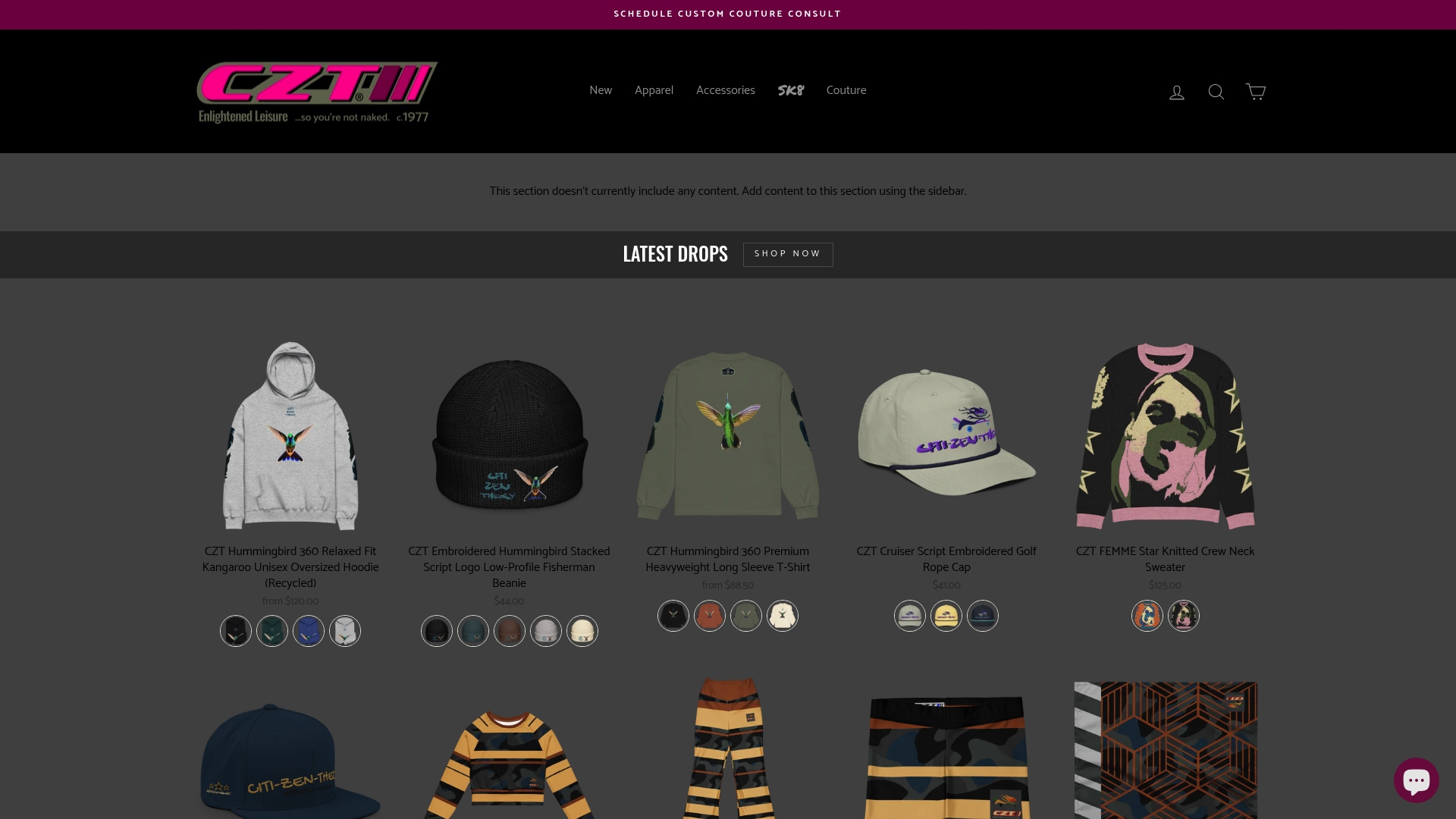
If you’re custom-fitting a piece through a couture design service or just browsing what’s currently in stock, visit the product pages to see the current lineup and start a design conversation. For the fiber-care side of ownership, our guide to keeping recycled fabrics in shape is worth a read before your first wash.