![CZT [CITI-ZEN-THEORY]](http://czt.rocks/cdn/shop/files/CZT_-_Brand_PINK_Label_1_330x.png?v=1774104725)
![CZT [CITI-ZEN-THEORY]](http://czt.rocks/cdn/shop/t/61/assets/CZT-Fast-Logo---Blue-Grey_330x.png?v=98224836737033641471695502660)
![CZT [CITI-ZEN-THEORY]](http://czt.rocks/cdn/shop/files/CZT_-_Brand_PINK_Label_1_170x.png?v=1774104725)
![CZT [CITI-ZEN-THEORY]](http://czt.rocks/cdn/shop/t/61/assets/CZT-Fast-Logo---Blue-Grey_170x.png?v=98224836737033641471695502660)
How to Specify Fit Preferences for Custom Garments
Specifying fit preferences for a custom garment is the process of clearly communicating your body measurements, comfort desires, and style choices so a tailor or custom clothier can build a piece uniquely for you. At Czt, we see this process as the foundation of every garment we craft, because a piece that fits your body and your life is the only piece worth wearing. Experts recommend preparing 12–22 measurement points alongside 3–5 specific fit rules before any consultation. Those fit rules, not just the numbers, are what separate a garment that fits from one that feels like yours.
How to specify fit preferences for a custom garment
Before you walk into a fitting room or open a digital tailoring app like Stylistiq, you need a clear picture of what you want. Fit preferences fall into two categories: technical measurements and subjective comfort rules. Technical measurements cover chest, waist, hips, inseam, and shoulders. Comfort rules cover how the garment should behave when you move, sit, or reach, and these are the details most people forget to mention.
The final garment silhouette reflects intended use, not just raw numbers. A suit built for boardroom presentations needs different ease allowances than a jacket built for skating. Knowing your use case before the consultation shapes every decision your tailor makes.

What do you need to prepare before specifying fit?
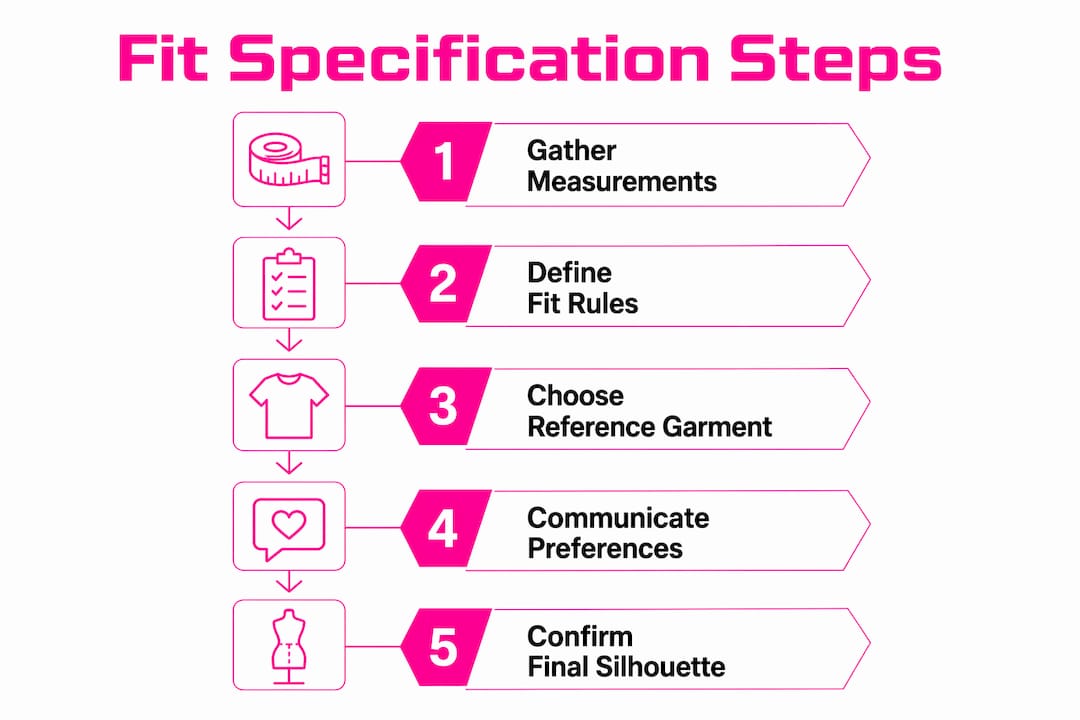
Preparation is the difference between a garment that fits and one that fits perfectly. Gather the following before any consultation, whether in person or through a digital platform.
Essential measurements to collect:
- Chest circumference (measured at the fullest point)
- Natural waist and hip circumference
- Shoulder width (seam to seam)
- Sleeve length (shoulder to wrist)
- Inseam and outseam for trousers
- Neck circumference for shirts
- Back length (nape to waist)
Fit rules to define in plain language:
- Waistband behavior: “No digging when I sit for two hours”
- Sleeve length: “Watch clearance on the left wrist”
- Armhole: “Enough room to raise my arms without pulling”
- Chest: “Flat across the front, no pulling at the buttons”
| Preparation Item | Why It Matters |
|---|---|
| Measurements (12–22 points) | Gives the tailor a technical baseline for pattern drafting |
| Fit rules (3–5 specific) | Defines comfort and movement expectations beyond numbers |
| Inspiration photos | Communicates silhouette and aesthetic intent visually |
| Lifestyle context | Informs ease allowances and fabric choices |
| Intended shoes and undergarments | Affects posture, hemline, and overall drape |
Wearing your intended shoes and undergarments during measurement affects posture and garment drape significantly. A two-inch heel changes your stance, which changes where a hem falls and how a jacket sits across your shoulders. Bring the shoes you plan to wear with the finished piece.
Pro Tip: Bring one garment you already love the fit of. Show it to your tailor and say, “This is my reference.” A physical example communicates silhouette faster and more accurately than any description.
How do you communicate fit preferences to a tailor?
Clear communication is the craft behind the craft. Even the most skilled tailor cannot read your mind, and vague instructions produce vague results. Follow this sequence to articulate your needs with precision.
- Define your fit identity first. Using plain language like “close-to-body performance fit” or “relaxed street fit” reduces misinterpretation. Say it out loud before the consultation so it feels natural.
- Describe your posture and movement patterns. Do you sit at a desk for eight hours? Do you skate, stretch, or carry a bag on one shoulder? These details shape where the tailor adds ease.
- State your usage scenario. A garment worn for a photo shoot has different requirements than one worn every day for six months. Tell your tailor which scenario applies.
- Bring visual references. Inspiration photos from brands like Czt, editorial shoots, or your own wardrobe give your tailor a visual language to work from.
- Ask process questions upfront. Clients should prepare questions about timing, fabrics, and pricing before the first consultation. Transparent communication sets realistic expectations.
- Confirm understanding before work begins. Ask your tailor to repeat your fit rules back to you. If something is lost in translation, catch it now, not at the first fitting.
Digital platforms like Stylistiq require the same level of input. AI-based measurement systems need accurate fit preference data as much as body measurements. Without ease or comfort inputs, a garment may be technically accurate but uncomfortable in practice. Fill every field and add notes wherever the platform allows.
Pro Tip: Record a short voice memo describing your fit preferences before the consultation. Listening back helps you catch vague language before it reaches your tailor.
Measurements vs. fit rules: what is the difference?
Most people understand that tailors take measurements. Fewer people understand that measurements alone do not guarantee a good fit. The industry distinguishes between two sets of data, and both are non-negotiable.
Technical measurements are objective numbers: chest, waist, inseam, shoulder width, back length, and neck circumference. These numbers define the geometry of the pattern. A tailor uses them to draft the base shape of your garment.
Fit rules are functional specifications. They define how the garment should behave on your body during real life. Fit rules such as waistband behavior when seated and armhole clearance are critical for comfort beyond standard measurements. Tailors adjust patterns based on both to produce wearability and style together.
| Category | Examples | Role in Tailoring |
|---|---|---|
| Technical measurements | Chest 42", waist 34", inseam 30" | Defines base pattern geometry |
| Fit rules | “No pulling at shoulders when reaching” | Guides ease and structural adjustments |
| Lifestyle inputs | Daily commuter, skateboarder, office worker | Informs fabric weight and construction |
| Aesthetic preferences | Slim silhouette, dropped shoulder, cropped length | Shapes final visual composition |
The interaction between these two categories is where fit consultation becomes holistic. A tailor who only has your measurements is working with half the picture. The other half is the story of how you live in your clothes.
What are the most common fit specification mistakes?
Even well-prepared clients make predictable errors. Recognizing these patterns before your consultation saves time, money, and frustration.
- Ignoring posture. Most people measure themselves standing perfectly straight. Real posture, the slight forward lean, the uneven shoulders, the dominant arm, changes how a garment sits. Tell your tailor how you actually stand.
- Skipping the lifestyle context. A garment built for aesthetics alone will fail the moment you actually wear it. Describe your daily movement patterns with the same care you give your measurements.
- Using vague fit language. “Not too tight” means nothing. “One inch of ease across the chest” means everything. Translate feelings into specifics wherever possible.
- Forgetting to ask about turnaround time. AI and remote services deliver in 7–10 days; bespoke tailoring takes 3–4 weeks or longer. Know the timeline before you commit, especially if the garment is for an event.
- Skipping follow-up fittings. A first fitting reveals what the measurements could not predict. Attend every fitting scheduled and bring your fit rules list so you can check each one against the actual garment.
“The garment that fits your measurements is made by a machine. The garment that fits your life is made by a tailor who listened.”
Custom clothing prices start from $225 for shirts and exceed $1,100 for suits. That investment deserves the same preparation you would give any significant purchase. Arrive ready, and the process rewards you.
Key takeaways
Specifying fit preferences for a custom garment requires both precise measurements and clearly stated fit rules, because numbers alone cannot capture how a garment must perform on your body.
| Point | Details |
|---|---|
| Prepare measurements and fit rules | Collect 12–22 measurements and define 3–5 fit rules before any consultation. |
| Define your fit identity | Use plain language like “relaxed street fit” to reduce tailor misinterpretation. |
| Bring physical references | A beloved garment or inspiration photo communicates silhouette faster than words. |
| Wear the right shoes and undergarments | Intended footwear and undergarments alter posture and affect final hemlines. |
| Ask process questions upfront | Clarify turnaround time, fabric options, and pricing before work begins. |
What we have learned about fit at Czt
We have spent years watching clients arrive at consultations with measurements in hand and leave disappointed, not because the numbers were wrong, but because the conversation never happened. The measurement is the skeleton. The fit dialogue is the flesh.
At Czt, we believe your fit identity is as personal as your aesthetic identity. When we work on custom apparel designs, we ask clients not just for their chest measurement but for the story of the garment. Where will you wear it? What does it need to do? What does it need to say? Those answers shape the composition of the piece in ways no tape measure can.
The clients who walk away with pieces they love are the ones who came prepared to have a real conversation. They brought references. They described their posture. They said things like, “I need the sleeve to clear my watch” and “I sit on a board for three hours at a time.” That specificity is not pedantic. It is the difference between a garment that lives in your closet and one that lives on your body.
We also see people over-rely on digital tools without filling in the preference fields. An app that knows your chest measurement but not your ease preference will produce something technically correct and personally wrong. The technology is only as good as the human input behind it. Treat every field as a conversation, not a formality.
Our advice: define your fit identity in plain language before you speak to anyone. Write it down. Say it out loud. Then bring it to the table with the same confidence you bring to choosing your colorways and your cuts.
— Czt
Discover your custom fit at Czt
Czt builds garments around the person wearing them, not around a size chart. Our custom couture design services let you specify every dimension of your fit, from silhouette to sleeve length, using recycled materials that carry both style and conscience.
Whether you are drawn to the bold composition of our streetwear or the considered craft of our sustainable fashion shirts, every piece starts with your preferences. We work with eco-conscious consumers, skateboarders, and families who want clothing that performs as well as it looks. Explore what custom fit clothing means when it is built around your life, and start the conversation with Czt today.
FAQ
What does it mean to specify fit preferences for a custom garment?
Specifying fit preferences means communicating your body measurements, comfort rules, and style choices to a tailor or custom clothier so the garment is built around your specific needs. It goes beyond size numbers to include how the garment should feel and perform during real use.
How many measurements do i need for a custom garment?
Experts recommend preparing 12–22 measurement points depending on the garment type, covering areas like chest, waist, inseam, shoulders, and sleeve length. Pair those with 3–5 fit rules for the most complete specification.
What is a fit rule and why does it matter?
A fit rule is a functional specification that describes how a garment should behave on your body, such as “no waistband digging when seated.” Fit rules guide pattern adjustments that measurements alone cannot capture, making them critical for comfort and wearability.
How long does a custom garment take to complete?
Turnaround time depends on the method: AI and remote tailoring services typically deliver in 7–10 days, while bespoke tailoring requires 3–4 weeks or more. Ask about timelines before your first consultation.
Can i specify fit preferences using a digital tailoring app?
Yes, but the quality of the result depends on the completeness of your inputs. AI-based tailoring platforms require accurate fit preference data alongside body measurements. Incomplete comfort or ease inputs produce garments that are technically sized correctly but feel wrong in practice.