![CZT [CITI-ZEN-THEORY]](http://czt.rocks/cdn/shop/files/CZT_-_Brand_PINK_Label_1_330x.png?v=1774104725)
![CZT [CITI-ZEN-THEORY]](http://czt.rocks/cdn/shop/t/61/assets/CZT-Fast-Logo---Blue-Grey_330x.png?v=98224836737033641471695502660)
![CZT [CITI-ZEN-THEORY]](http://czt.rocks/cdn/shop/files/CZT_-_Brand_PINK_Label_1_170x.png?v=1774104725)
![CZT [CITI-ZEN-THEORY]](http://czt.rocks/cdn/shop/t/61/assets/CZT-Fast-Logo---Blue-Grey_170x.png?v=98224836737033641471695502660)
What Does Custom Fit Clothing Mean for You
You have heard the phrase “custom fit” on everything from dress shirts to streetwear hoodies, yet what does custom fit clothing mean in any precise, useful sense? The term gets stretched across retail tags, tailor shop windows, and brand lookbooks until it loses almost all meaning. True custom fit clothing, known in the industry as bespoke or made-to-measure tailoring, sits on a spectrum that ranges from minor off-the-rack adjustments all the way to garments drafted entirely from your body’s unique geometry. This article pulls that spectrum apart, names every level clearly, and gives you the knowledge to make genuinely informed choices.
Table of Contents
- Key Takeaways
- What custom fit clothing really means
- Benefits of custom fit clothes
- Style labels vs. true tailoring
- How the custom fit process works
- How to choose the right custom fit option
- My honest take on fit as the foundation of style
- Wear what was made for you
- FAQ
Key Takeaways
| Point | Details |
|---|---|
| Custom fit is a spectrum | The term covers off-the-rack alterations, made-to-measure, and full bespoke tailoring. |
| Bespoke vs. made-to-measure | Bespoke uses a unique pattern per client; made-to-measure adjusts an existing standard pattern. |
| Retail “custom fit” can mislead | Some brands use the phrase to describe a slimmer silhouette, not actual handcrafted tailoring. |
| Fit outperforms fabric | A well-fitted garment in modest fabric will look and feel better than a poorly fitted luxury one. |
| Ask before you commit | Always ask a tailor or brand what level of customization you are actually receiving. |
What custom fit clothing really means
The phrase “custom fit clothing” is, technically, an umbrella term rather than a single defined category. At its broadest, the custom fit clothing explanation is this: garments are adjusted or constructed to reflect an individual’s specific measurements and preferences rather than conforming to mass-produced standard sizes. That definition, however, contains multitudes.
Three distinct tiers live under this umbrella, and confusing them costs people both money and disappointment.
Off-the-rack with alterations is the entry point. A garment is produced in standard sizes and then adjusted by a tailor after purchase. Hemming trousers, taking in a waist, or shortening sleeves all fall here. The underlying pattern never changes. You are working around the garment’s original architecture, not rewriting it.
Made-to-measure moves meaningfully further. A tailor begins with a standardized base pattern and modifies it according to your hand measurements before cutting the fabric. The result fits considerably better than off-the-rack because the construction accounts for your proportions from the start. Made-to-measure provides a practical balance of improved fit and turnaround time, though some compromises remain because the pattern’s foundational geometry is still borrowed from a standard template.
Bespoke is the apex. A master cutter drafts an entirely new pattern from scratch, built only from your measurements, posture analysis, and movement. Bespoke pattern drafting can include up to 40 individual measurements and detailed posture analysis, producing a paper pattern that has never existed before and belongs to you alone.
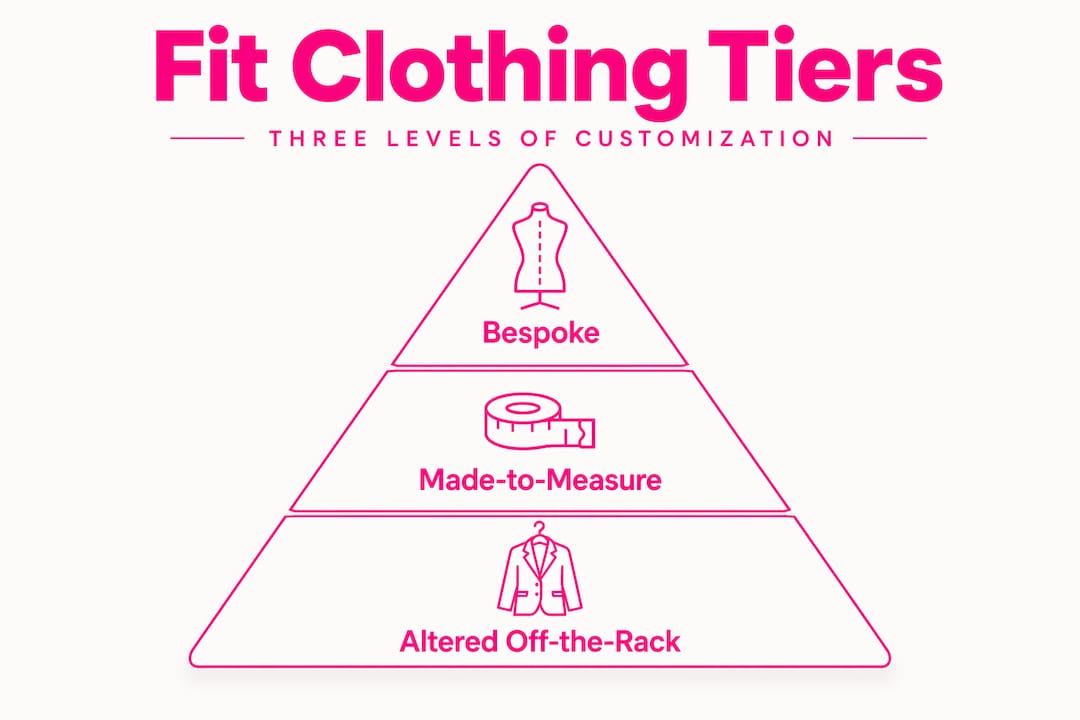
Here is a quick comparison to anchor these distinctions:
| Category | Pattern origin | Fittings required | Typical lead time |
|---|---|---|---|
| Off-the-rack alteration | Standard, unchanged | 1 | Days |
| Made-to-measure | Standard, modified | 1 to 2 | 2 to 8 weeks |
| Bespoke | Unique, drafted from scratch | 3 to 5 or more | 8 to 12+ weeks |
The marketing ambiguity compounds the confusion. Brands sometimes label a product “custom fit” simply because it runs slimmer through the chest and arms than their classic silhouette. That is a style descriptor, not a tailoring designation, and the distinction matters enormously when you are deciding where to spend your money.
Benefits of custom fit clothes
The practical advantages of wearing clothing built to your body are more layered than most people expect. The most immediate gain is physical comfort. Custom fit clothing eliminates the pulling, bunching, and awkward tension lines that plague standard sizing, because the garment moves with your body rather than against it. That difference is felt within the first hour of wear.
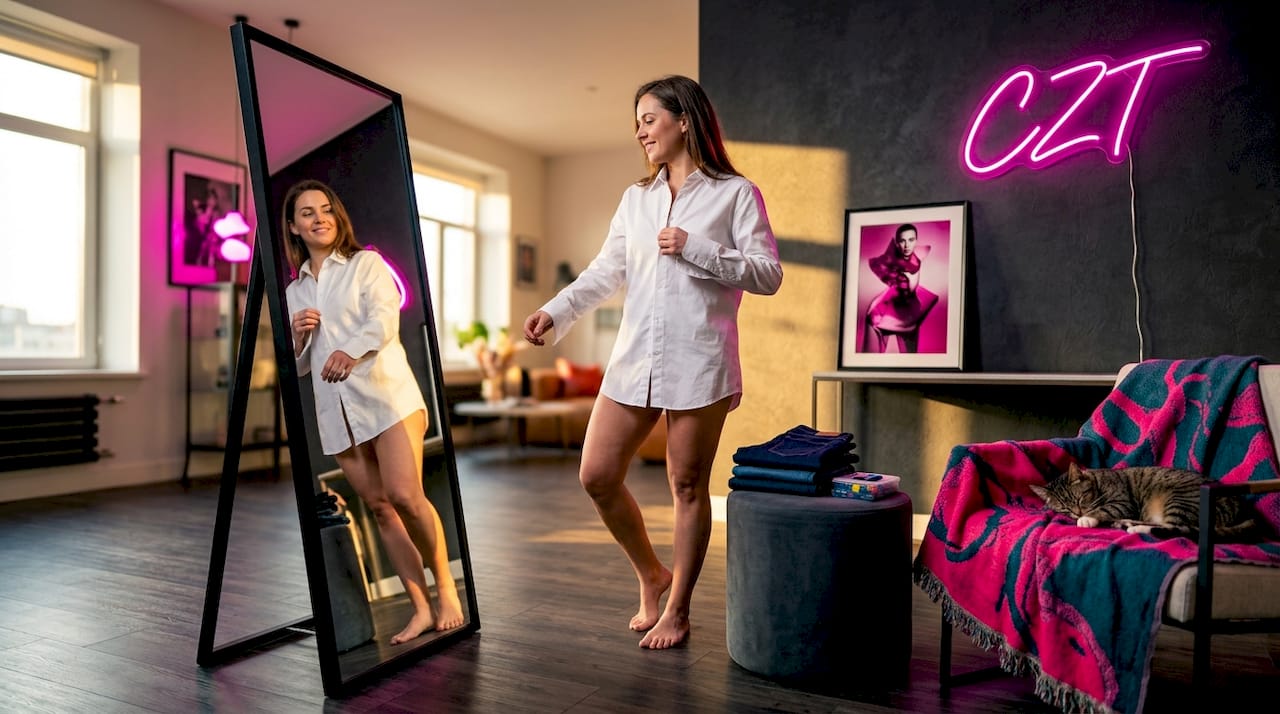
Beyond comfort, the aesthetic payoff is considerable. A garment cut to your silhouette reads as more polished and intentional, regardless of how casual the fabric or style might be. This is why a well-fitted cotton tee can look more composed on a person than a poorly fitted silk shirt.
There are subtler gains worth naming too:
- Posture and asymmetry accommodation. Most human bodies are asymmetric. One shoulder sits higher, one hip tilts forward. Off-the-rack patterns are designed for an idealized symmetrical body, so they inevitably fight against your actual structure. Bespoke tailoring maps those asymmetries and builds them into the pattern.
- Psychological confidence. Wearing something that fits precisely changes how you carry yourself. The garment stops being a distraction and becomes an extension of your presence.
- Longevity. Clothes that fit correctly experience less stress at seams and stress points, which means they last longer with proper care.
Pro Tip: Before investing in made-to-measure or bespoke, have a skilled tailor assess your posture and note any asymmetries. That conversation will save you from fit surprises later and help you communicate your needs clearly.
Style labels vs. true tailoring
This is where a great deal of consumer confusion originates, and it deserves direct attention. Retail fit terminology, such as “slim fit,” “classic fit,” “tailored fit,” and “custom fit,” describes the shape of a garment relative to the brand’s own sizing scale. These are style designations, not tailoring designations.
Consider how this plays out in practice:
- A “slim fit” shirt from a mass retailer is cut narrower through the torso and sleeves than the same brand’s “classic fit.” Both are still produced in standard sizes on identical production lines.
- A “tailored fit” blazer typically falls between slim and classic in silhouette. The word “tailored” here signals a shape, not a process.
- A “custom fit” polo from a major retailer may be closer through the chest and arms than the classic version, but it is a style label applied to a mass-produced garment, not evidence of individual measurement or handcraft.
- A genuinely bespoke jacket, by contrast, carries no standard size label at all. It exists only in your measurements.
The term “tailored” varies widely, from minor off-the-rack alterations to full bespoke construction, and consumers should always ask what level of customization they are actually receiving. When a brand uses “custom fit” as a product name, your first question should be: custom compared to what?
Understanding this distinction protects you from paying a premium for what is, in reality, just a different size curve on a standard production run.
How the custom fit process works
Knowing what the process looks like in practice removes much of the intimidation that keeps people from exploring made-to-measure or bespoke for the first time. The experience differs meaningfully depending on the tier you choose.
For made-to-measure, the process typically unfolds like this:
- An initial consultation covers your lifestyle, how you intend to wear the garment, fabric preferences, and any specific fit concerns you have experienced with standard sizing.
- A tailor takes hand measurements, usually 15 to 25 points across the body, before any cutting begins.
- The adjusted pattern is cut and the garment is constructed, often requiring one to two fittings to refine the result.
- Lead time runs roughly two to eight weeks depending on the workshop and complexity.
Bespoke is a longer, more intimate collaboration. Consultations in custom menswear often span two hours for the initial appointment, covering fabric selection, fit preferences, lifestyle needs, and posture analysis in depth. The cutter then drafts your unique pattern, constructs a rough “baste” fitting garment, and refines through three to five or more fittings over an eight to twelve week period. Each session progressively balances the garment against your body’s specific geometry.
One detail that separates bespoke construction from everything below it: hand-stitching and floating canvases allow the garment to adapt and conform as you move, unlike the fused canvases used in most made-to-measure and all off-the-rack production. That structural difference is why a bespoke jacket feels like it belongs to your body in a way nothing else quite replicates.
Pro Tip: Bring a well-fitting reference garment to your first consultation. Showing a tailor what works on your body communicates more clearly than describing it in words, and it shortens the fitting process considerably.
How to choose the right custom fit option
Choosing between these tiers is less about aspiration and more about honest self-assessment. A few questions will clarify the decision quickly.
- How often will you wear this garment? Daily wear or high-stakes occasions justify greater investment. A suit worn twice a year may not warrant bespoke pricing.
- What is your body’s relationship with standard sizing? If you consistently find that off-the-rack fits well in one area and poorly in another, made-to-measure addresses that gap efficiently. If standard sizing fails you across the board, bespoke is worth the investment.
- What is your actual budget, including fittings and time? Made-to-measure typically costs two to four times the price of a comparable off-the-rack garment. Bespoke can run five to ten times that figure or more, depending on the workshop.
- Could skilled alterations solve your problem? For many people, a $40 alteration on an $80 shirt produces a result indistinguishable from made-to-measure. Honest tailors will tell you this.
- What questions should you ask? When approaching any tailor or brand, ask: Is this pattern made from my measurements or adjusted from a standard? How many fittings are included? What happens if the fit is wrong after delivery?
Customers value the personal consultation aspect of custom fits as much as the garment itself. That relationship, the feeling of being genuinely heard and measured, shapes satisfaction in ways that the finished product alone cannot fully explain.
My honest take on fit as the foundation of style
I have spent years watching people invest in fabric, brand names, and trend cycles while ignoring the single variable that determines whether clothing actually works: fit. What I have learned, sometimes uncomfortably, is that the fashion industry profits from that misdirection. A poorly fitted garment in expensive fabric still looks unresolved. A well-fitted garment in modest fabric looks intentional, composed, and alive.
What I find most revealing is how rarely people ask what level of customization they are actually receiving. They see the word “custom” and assume craft. They see a price tag and assume quality. Neither assumption holds without asking direct questions and understanding the spectrum we have laid out here.
My experience with the culture and craft behind clothing, the same culture that shapes everything we do at Czt, has taught me that fit is not a luxury add-on. It is the foundation. Everything else, fabric weight, color composition, graphic placement, sits on top of that foundation. Get the fit wrong and the rest collapses. Get it right and even the simplest piece carries authority.
Start with fit. Everything else follows.
— Czt
Wear what was made for you
At Czt, we approach every piece with the same philosophy this article describes: clothing should work with your body, your culture, and your values, not against them. Our designs are built with intentional silhouettes, quality construction, and the kind of thoughtful detail that makes the difference between a garment you reach for and one that sits in the back of the closet. Whether you are looking for a premium streetwear tee that sits right without a tailor’s intervention, or a cozy zip-up hoodie built for real movement and real life, Czt pieces are designed to feel like they belong to you from the first wear.
FAQ
What does custom fit clothing mean exactly?
Custom fit clothing refers to garments made or adjusted to an individual’s specific measurements rather than standard sizes. The term covers a spectrum from off-the-rack alterations to fully bespoke tailoring.
What is the difference between made-to-measure and bespoke?
Made-to-measure adjusts a standard pattern using your measurements, while bespoke drafts an entirely new pattern from scratch. Bespoke requires more fittings and a longer lead time but accounts for posture, asymmetry, and movement in ways made-to-measure cannot fully replicate.
Is “custom fit” on a retail label the same as tailored clothing?
Not necessarily. Some brands use “custom fit” to describe a slimmer silhouette rather than actual handcrafted tailoring. Always ask whether the garment was constructed from your measurements or simply cut in a closer style.
How many fittings does custom fit clothing require?
Made-to-measure typically requires one to two fittings over two to eight weeks. Bespoke usually involves three to five or more fittings across an eight to twelve week period, with each session refining the garment’s balance and proportion.
When should I choose alterations over made-to-measure?
If standard sizing fits you well in most areas with only one or two specific issues, skilled alterations to an off-the-rack garment will often produce results comparable to made-to-measure at a fraction of the cost.
Recommended
- CZT Active Endurance High-Waisted Pocket Capri Leggings for Ultimate Comfort – CZT [CITI-ZEN-THEORY]
- CZT Active Endurance Sports Bra for High-Performance Athletes - Shop Now – CZT [CITI-ZEN-THEORY]
- CZT FEATHER n CAMO Earthtone Classic Casual Slip-Ons - Comfortable Canvas Shoes – CZT [CITI-ZEN-THEORY]
- CZT Graf Hoodie - Soft Comfy Custom Pullover for Street Art Fans – CZT [CITI-ZEN-THEORY]