![CZT [CITI-ZEN-THEORY]](http://czt.rocks/cdn/shop/files/CZT_-_Brand_PINK_Label_1_330x.png?v=1774104725)
![CZT [CITI-ZEN-THEORY]](http://czt.rocks/cdn/shop/t/61/assets/CZT-Fast-Logo---Blue-Grey_330x.png?v=98224836737033641471695502660)
![CZT [CITI-ZEN-THEORY]](http://czt.rocks/cdn/shop/files/CZT_-_Brand_PINK_Label_1_170x.png?v=1774104725)
![CZT [CITI-ZEN-THEORY]](http://czt.rocks/cdn/shop/t/61/assets/CZT-Fast-Logo---Blue-Grey_170x.png?v=98224836737033641471695502660)
How to Incorporate Personal Artwork into Clothing
Incorporating personal artwork into clothing is defined as the practice of transferring original visual compositions onto fabric to create wearable, one-of-a-kind pieces. This craft sits at the intersection of fine art and fashion, and it has grown far beyond novelty into a recognized form of self-expression embraced by artists, skaters, and eco-conscious creators alike. The industry term for this practice is “custom apparel decoration,” and it spans techniques from digital-to-garment printing to hand-painting and embroidery. Whether you are placing a child’s drawing on a tee or translating a graffiti-inspired composition onto a jacket, the method you choose determines everything from color fidelity to how long the piece survives the wash cycle.
How to incorporate personal artwork into clothing: artwork preparation
The quality of your final garment lives or dies in the preparation stage. Artwork files should meet at least 1500x1500 pixels resolution to produce sharp, clean prints on fabric. Anything below that threshold tends to pixelate when scaled to a full chest print, which is a disappointment no amount of good fabric can fix.
Beyond resolution, the composition itself shapes the outcome. Bold lines and high contrast consistently outperform complex shaded photographs in print clarity and visual impact. That means a stark black-and-white line drawing will read more powerfully on a shirt than a photorealistic portrait with subtle gradients. This is not a limitation of the medium. It is an invitation to think like a graphic artist rather than a painter.
File format matters too. Most professional printing services accept PNG files with transparent backgrounds, as well as high-resolution PDF and TIFF formats. Avoid JPEG for artwork with fine detail, since JPEG compression introduces artifacts that become visible at print scale.
- Resolution: 1500x1500 pixels minimum; 300 DPI at print size is the professional standard
- Color mode: RGB for digital printing; CMYK for screen printing
- File format: PNG (transparent background preferred), PDF, or TIFF
- Design style: Bold outlines, flat color fills, and high-contrast compositions
- Avoid: Complex photographic shading, thin hairlines under 2pt, and very light colors on white fabric
Pro Tip: Zoom your artwork to 100% on screen before uploading. If it looks blurry at that scale, it will print blurry on fabric.
Which customization methods let you put art on clothing?
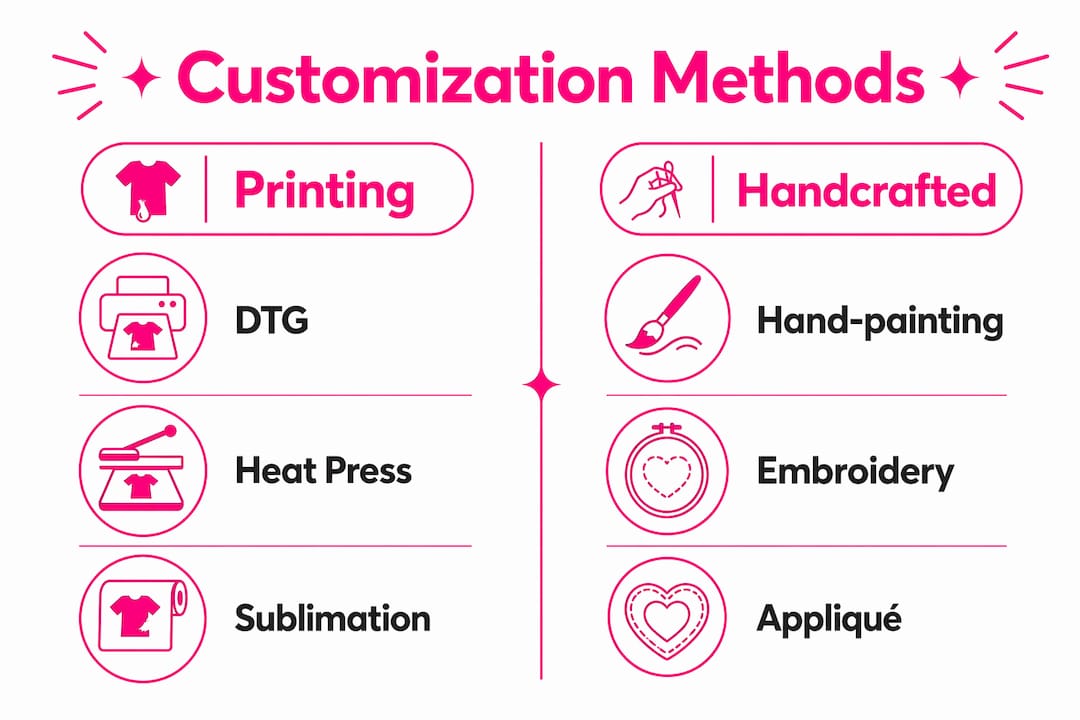
Three primary methods define the custom art clothing space: digital-to-garment printing, hand-painting, and embroidery. Each carries a distinct character, cost profile, and durability story.
Digital-to-garment printing
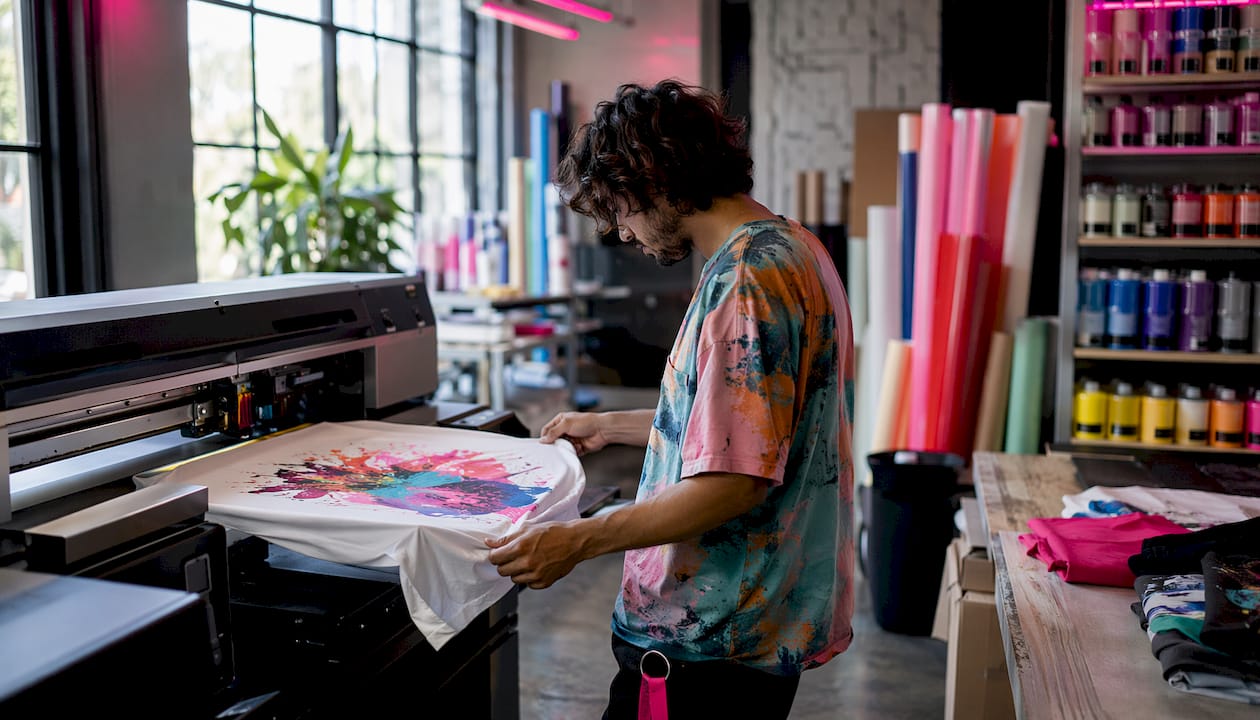
Digital-to-garment printing, known as DTG, uses inkjet technology to apply ink directly onto fabric fibers. DTG printing offers a nearly unlimited color palette and works especially well on soft, ring-spun cotton. Production turnaround runs 2–4 business days with no minimum order, which makes it the most accessible entry point for artists printing a single piece. The trade-off is that DTG performs best on light-colored garments; dark fabrics require a white underbase layer that can slightly mute vibrancy.
Hand-painting
Hand-painted clothing carries an artisanal weight that no printer can replicate. Each brushstroke is a decision, and the result is genuinely singular. The cost is time: hand-painted custom pieces carry lead times of 7 business days to 3 weeks, depending on complexity. That timeline reflects the labor of craft, and for many wearers, that story is part of the garment’s value. Hand-painted clothing also aligns with slow fashion principles, making it a natural fit for eco-conscious creators who want their wardrobe to mean something beyond aesthetics.
Embroidery
Embroidery translates artwork into thread, producing a textured, dimensional result that ages beautifully. It suits bold, simplified designs rather than photographic detail. Durability is exceptional. Embroidered pieces withstand repeated washing without fading, which is a meaningful advantage over ink-based methods. The cost per piece is higher than DTG, and the color range is limited by available thread colors, but the tactile quality is unmatched.
| Method | Turnaround | Cost range | Durability | Best for |
|---|---|---|---|---|
| DTG printing | 2–4 business days | Low to mid | Good | Full-color, detailed art |
| Hand-painting | 7 days to 3 weeks | Mid to high | Very good | One-of-a-kind, artisanal pieces |
| Embroidery | 5–10 business days | Mid to high | Excellent | Bold logos, text, simple icons |
Pro Tip: For personalized fashion designs that combine visual impact with longevity, pair DTG printing for the main artwork with embroidered accents for brand marks or initials.
How do you execute the transfer of art onto a garment?
Execution is where preparation meets fabric, and the sequence of steps determines whether your vision lands cleanly or requires a costly redo.
- Finalize your artwork file. Confirm resolution, color mode, and file format before uploading or handing off to a service.
- Select your garment base. Ring-spun cotton absorbs DTG ink most evenly. Polyester blends suit sublimation printing. Avoid heavily textured fabrics for fine-detail work.
- Request a digital proof. Design proofing before production is the single most critical step in the entire process. A proof lets you verify color accuracy, placement, and scale before ink touches fabric.
- Review the proof carefully. Check that colors match your original artwork, that the design is centered or placed as intended, and that text reads correctly.
- Approve and submit for production. Once approved, most DTG services move immediately into the print queue.
- Inspect the finished garment. Check edges, color saturation, and any areas of fine detail before wearing or gifting.
Without a digital proof, the risk of receiving a garment that does not match your intended color or layout is high. Reviewing a proof before production is not optional. It is the confirmation that your creative vision and the final product are aligned.
The choice of base fabric deserves more attention than most guides give it. A 100% ring-spun cotton tee at 180–200 GSM (grams per square meter) provides the ideal surface for DTG. Lighter fabrics can feel insubstantial and may show ink bleed. Heavier fabrics hold structure better and give the print a more premium feel.
For DIY creators working with heat-press transfers, the process follows a similar logic. Print your design onto transfer paper, preheat your garment to remove moisture, apply the transfer at the correct temperature and pressure, and peel the backing only after the recommended cooling period. Rushing the peel is the most common cause of incomplete transfers.
| Step | Key action | Common pitfall |
|---|---|---|
| Artwork finalization | Confirm 1500px minimum, PNG format | Uploading low-res JPEG files |
| Garment selection | Choose 100% ring-spun cotton for DTG | Using polyester for ink-based printing |
| Proofing | Review digital proof for color and placement | Skipping proof to save time |
| Production | Submit approved file only | Approving without checking text orientation |
| Inspection | Check edges and color saturation | Accepting poor quality without follow-up |
For creative inspiration before you commit to a design, one-of-a-kind apparel examples from Czt show how artists and streetwear creators have translated personal compositions into finished garments with real visual authority.
What care practices preserve custom art on clothing?
Customized garments require more deliberate care than standard apparel. The print, paint, or thread is the most vulnerable part of the piece, and how you wash and store it determines how long it stays vivid.
- Wash inside out at 30°C (86°F). Washing inside out at low temperature protects the printed surface from friction and heat degradation.
- Use a gentle cycle. High-speed spin cycles stress the fabric and the print layer simultaneously.
- Avoid tumble drying. Heat from dryers accelerates ink breakdown. Air dry flat or on a hanger away from direct sunlight.
- Never iron directly on a print. If ironing is necessary, turn the garment inside out and use a pressing cloth between the iron and the fabric.
- Store folded, not compressed. Stacking heavy items on top of printed garments can crack the ink layer over time.
Care differences exist across methods. Embroidered pieces are the most forgiving and can tolerate standard machine washing at low temperatures without significant degradation. Hand-painted garments are the most sensitive. Acrylic-based fabric paints benefit from a heat-setting step (ironing on the reverse side before first wash) to bond the paint to the fibers permanently. DTG prints fall in between: durable when cared for correctly, but prone to fading if exposed to hot water or high dryer heat repeatedly.
Pro Tip: Turn your garment inside out before every wash, not just the first one. This single habit extends print life more than any specialty detergent.
Key Takeaways
Incorporating personal artwork into clothing produces the most durable, vivid results when artwork is prepared at 1500 pixels minimum, a digital proof is reviewed before production, and the finished garment is washed inside out at low temperature.
| Point | Details |
|---|---|
| Artwork resolution matters | Files must be at least 1500x1500 pixels to avoid pixelation at print scale. |
| Method shapes the result | DTG suits full-color detail; hand-painting suits one-of-a-kind artisanal work; embroidery suits bold, durable designs. |
| Proofing prevents errors | Reviewing a digital proof before production is the single most effective way to avoid costly remakes. |
| Fabric choice affects quality | Ring-spun cotton at 180–200 GSM delivers the best surface for DTG ink adhesion and print clarity. |
| Care extends garment life | Washing inside out at 30°C and air drying preserves print vibrancy far longer than standard machine washing. |
Why personal artwork on clothing is worth the effort
We have spent years watching people treat clothing as disposable, cycling through fast fashion with the same casual indifference one might apply to paper cups. What we have come to believe, deeply and without reservation, is that a garment carrying your own composition changes your relationship to what you wear. You do not leave it on the floor. You do not donate it after one season. You keep it, care for it, and wear it with the kind of quiet pride that only comes from making something real.
The sustainability benefits of customization are not incidental to this practice. They are central to it. When you invest creative energy into a single piece, you are opting out of the cycle of overproduction that defines mass-market apparel. Hand-painted clothing, in particular, embodies this philosophy with every brushstroke. It is slow fashion in the most literal sense: one artist, one garment, one deliberate act of creation.
We also want to say something about imperfection. The slight irregularity in a hand-painted line, the minor color shift between your screen and the finished print, these are not failures. They are evidence of process. The most aesthetically intriguing pieces we have encountered carry some mark of their making. Embrace that. It is what separates wearable art from mass-produced graphics.
For those drawn to streetwear aesthetics and the cultural energy that surrounds them, personal artwork on clothing is not a trend. It is a continuation of a tradition that runs from graffiti murals to skate decks to the back of a denim jacket worn by someone who made it mean something.
— Czt
Czt’s custom couture: where your art becomes apparel
Czt was built on the belief that clothing should carry meaning, not just cover skin. Our custom couture design services guide you from raw artwork file to finished garment, with expert review at every stage and a digital proof before a single thread or drop of ink is committed.
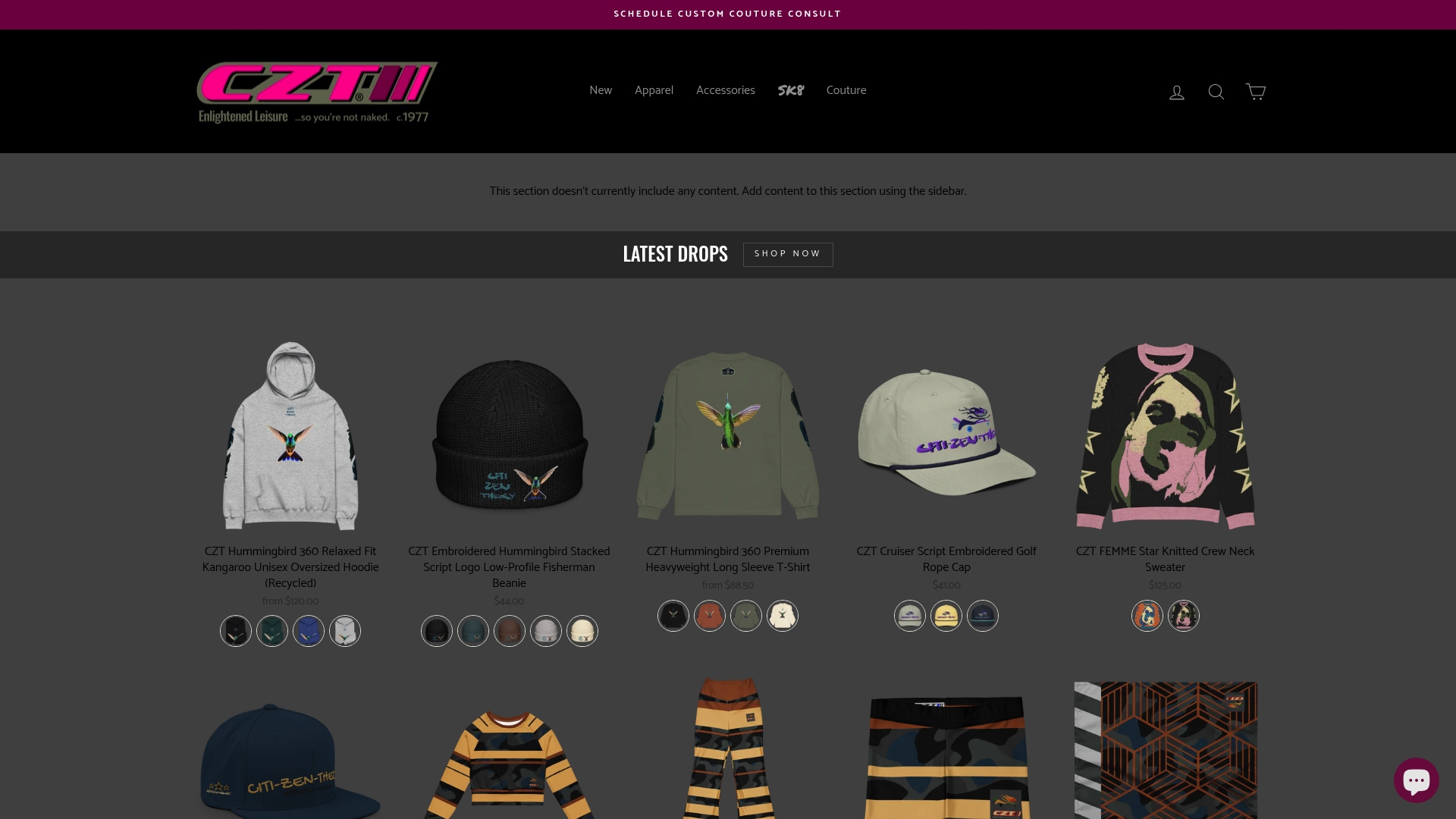
We work with eco-conscious materials, including recycled fabrics featured in collections like the Botanic Camo line, because the garment’s story should not begin with waste. Our apparel selection spans tees, jackets, and streetwear staples, all available for full personalization. Whether your artwork is a child’s drawing, a graffiti composition, or an original illustration, we have the method and the materials to realize it with integrity. Visit Czt to start the conversation and see your vision take shape.
FAQ
What resolution does artwork need for clothing prints?
Artwork files should be at least 1500x1500 pixels to produce sharp, clear prints on fabric. Lower resolution files pixelate when scaled to full garment size.
How long does custom art clothing take to produce?
DTG printing typically takes 2–4 business days, while hand-painted pieces require 7 business days to 3 weeks depending on design complexity.
Why is a design proof important before printing?
A digital proof lets you verify color and layout before production begins, preventing costly errors and ensuring the finished garment matches your original vision.
What is the best fabric for digital-to-garment printing?
Ring-spun cotton absorbs DTG ink most evenly and produces the sharpest color output. Polyester blends are better suited to sublimation printing rather than standard DTG.
How do you wash clothing with personal artwork on it?
Wash the garment inside out at 30°C, use a gentle cycle, and air dry away from direct sunlight. Avoid tumble drying and never iron directly on the printed surface.
Recommended
- Examples of One-of-a-Kind Apparel Designs to Inspire You – CZT [CITI-ZEN-THEORY]
- Types of Custom Clothing Personalization Options Explained – CZT [CITI-ZEN-THEORY]
- Personalized Streetwear Looks: 9 Bold Style Examples – CZT [CITI-ZEN-THEORY]
- Why Custom Clothing Beats Mass Production in 2026 – CZT [CITI-ZEN-THEORY]