![CZT [CITI-ZEN-THEORY]](http://czt.rocks/cdn/shop/files/CZT_-_Brand_PINK_Label_1_330x.png?v=1774104725)
![CZT [CITI-ZEN-THEORY]](http://czt.rocks/cdn/shop/t/61/assets/CZT-Fast-Logo---Blue-Grey_330x.png?v=98224836737033641471695502660)
![CZT [CITI-ZEN-THEORY]](http://czt.rocks/cdn/shop/files/CZT_-_Brand_PINK_Label_1_170x.png?v=1774104725)
![CZT [CITI-ZEN-THEORY]](http://czt.rocks/cdn/shop/t/61/assets/CZT-Fast-Logo---Blue-Grey_170x.png?v=98224836737033641471695502660)
How Fashion Waste Impacts Oceans and Marine Life
Synthetic fashion waste sheds microfibers and chemical residues that travel from washing machines and factory floors straight into rivers and, eventually, the sea, where they lodge in the tissue of marine organisms and disrupt the food web that sustains them. That is the plain verdict, and it is not a fringe claim. Textiles are a major source of global microplastic pollution, more than any other single source, according to Fashion Revolution.
Three things matter most as you keep reading:
- The pathways are mundane. Washing machines, wastewater plants, and mismanaged garment disposal, not some exotic industrial accident, move fibers into waterways.
- The harm is biological, not just aesthetic. Ingestion, gut retention, and toxicant transfer damage marine organisms from plankton to sea turtles.
- The fixes are already known. Washing less, demanding in-line filters, and pushing for Extended Producer Responsibility laws would cut the flow meaningfully.
Key Takeaways
Fashion waste damages oceans primarily through microfibers shed in laundry and manufacturing, which marine organisms ingest and retain longer than other plastic forms, compounding physical and chemical harm.

| Point | Details |
|---|---|
| Textiles lead microplastic pollution | Textiles account for 34.8% of global microplastic pollution, more than any other source. |
| Fiber shape drives retention | Microfibers’ elongated shape makes them harder for marine organisms to excrete than rounded plastic particles. |
| Sludge is a hidden pathway | Treatment plants trap fibers in sludge at concentrations up to 1.4 million particles per kilogram, which can reenter land and water. |
| Apparel leakage is measured in millions of tonnes | The apparel sector leaked an estimated 8.3 million tonnes of plastic in 2019 alone. |
| Durability beats material swaps | Choosing durable, recycled-material garments like Czt’s reduces total consumption more reliably than switching fabric types. |
Table of Contents
- How Does Fashion Waste Reach the Ocean?
- Why Are Microfibers So Harmful to Marine Life?
- How Much Plastic Does Fashion Actually Send to the Ocean?
- What Chemicals in Clothing End Up in the Water?
- What Systemic Changes Would Cut Textile Pollution?
- What Can You Personally Do to Reduce Ocean Impact?
- Is Cotton Really Better Than Synthetic Fabric for the Ocean?
- Choose Clothing That Sheds Less Waste, Not More
- Where to Read More on Fashion and Ocean Pollution
- Frequently Asked Questions
- Sources
How Does Fashion Waste Reach the Ocean?
A single load of laundry can shed hundreds of thousands of microfibers, and Fashion Revolution’s synthesis of industry research puts that number in the range of 700,000 fibers per wash. Those fibers exit through the drain, travel to a wastewater treatment plant, and from there follow one of two roads. Most get captured in sludge rather than water, but that is not the relief it sounds like: research published by the Royal Society of Chemistry found textile-related sludge can carry microplastic concentrations as high as over one million particles per kilogram, and conventional treatment plants were never engineered to filter fibers this fine. When that sludge gets applied to farmland as fertilizer, the fibers do not disappear. They just change zip codes, waiting for the next hard rain to wash them into a stream.
Industrial dye houses and finishing plants add a second stream entirely, discharging effluent laden with fibers and chemical residues near production hubs, often in regions with looser wastewater oversight; exploring sustainable packaging for aquatic nutrition products reveals broader strategies related to reducing aquatic pollution through packaging and product design. Fast fashion’s breakneck production pace compounds this: a systematic review in the journal Water documents how the industry’s ballooning water use and wastewater output track directly with rising order volumes, meaning the pipeline gets busier every year, not steadier.
The main entry points break down into four categories:
- Consumer laundry, the single largest and most distributed source, repeated in millions of homes daily.
- Industrial dyeing and finishing effluent, concentrated near manufacturing hubs.
- Garment disposal and mismanaged secondhand exports, where discarded clothing degrades in landfills or open dumps near coastlines.
- Atmospheric deposition and dryer vents, an overlooked route where airborne fibers settle into waterways far from any factory.
Why Are Microfibers So Harmful to Marine Life?
A microfiber is not just a small piece of plastic. Its shape is the problem. Unlike a rounded microplastic bead or fragment, a fiber is long, thin, and prone to tangling inside an organism’s digestive tract, and that geometry makes it far harder to excrete once ingested. A peer-reviewed review compiled on NCBI documents tissue damage, immune disruption, and metabolic stress across multiple species exposed to microfibers and microplastics, effects that go well beyond simple gut blockage.
The organisms affected span the entire marine food web:
- Filter feeders like mussels and oysters pull fibers directly from the water column while feeding, with no way to distinguish plankton from plastic.
- Fish that ingest fibers show reduced feeding efficiency and gut inflammation.
- Seabirds and sea turtles accumulate fibers alongside larger debris, compounding physical stress.
Marine researchers publishing in Science Advances found that fiber shape specifically increases retention time in guts and tissues, which raises both physical and toxicological risk compared with other microplastic forms.
That retention matters because a fiber sitting in tissue longer has more time to leach the chemicals coating it, turning a physical irritant into a chemical delivery vehicle, as marine biologists note.
How Much Plastic Does Fashion Actually Send to the Ocean?
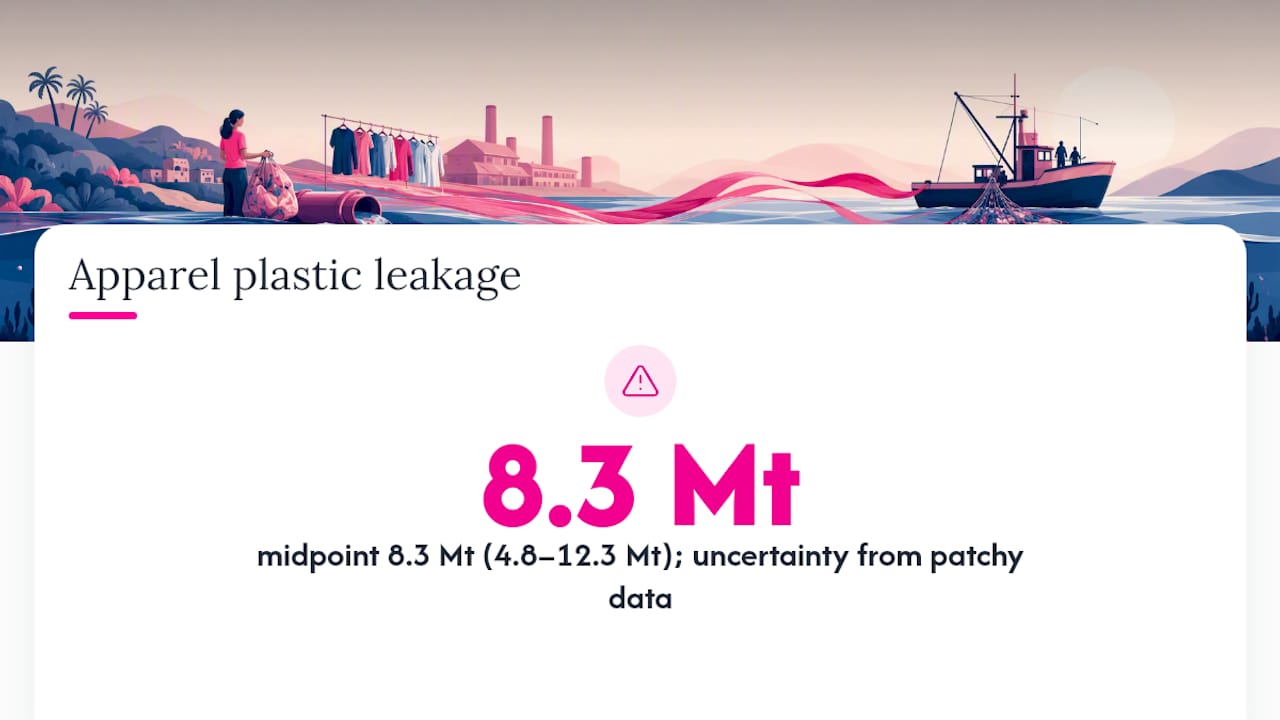
The most cited mass estimate comes from a Nature Communications analysis putting apparel-sector plastic leakage at roughly 8.3 million tonnes in 2019, a midpoint within a wide 4.8 to 12.3 million tonne range. That range itself tells you something: modeling apparel leakage globally means reconciling patchy data on informal waste economies, secondhand export flows, and regional treatment infrastructure, so precision beyond the midpoint is genuinely hard to claim.
Measured fiber counts and modeled mass estimates answer different questions. Surface water sampling, sediment cores, and sludge testing each capture a different slice of the problem, and a number drawn from one context should not be quoted as though it applies everywhere. By particle count, microfibers dominate; by total mass, they are a smaller share of overall plastic leakage, though their ecological effect per particle can run disproportionately high.
What Chemicals in Clothing End Up in the Water?
Textile finishing relies on a chemical toolkit most shoppers never see: PFAS for water resistance, azo dyes for color, nonylphenol ethoxylates as surfactants, and brominated flame retardants for safety compliance. Each carries its own environmental profile, and several are linked to endocrine disruption or long-term bioaccumulation in aquatic organisms.
These chemicals travel two main routes. Direct effluent discharge sends them straight into rivers near production facilities, while sludge captured at treatment plants can carry adsorbed contaminants onto farmland, where they can migrate back into waterways through runoff. A serious caveat belongs here: toxicity data for many textile-specific chemical mixtures remains thin, and lab studies rarely test the real-world cocktail of dyes, finishes, and microfibers arriving together. Treat single-chemical findings as a floor for concern, not a ceiling.
- PFAS (water and stain repellents), persistent and mobile in water systems.
- Azo dyes, some of which break down into compounds flagged as carcinogenic.
- Nonylphenol ethoxylates, surfactants known to disrupt hormone signaling in fish.
- Brominated flame retardants, prone to bioaccumulation up the food chain.
What Systemic Changes Would Cut Textile Pollution?
Individual habits help, but the leakage numbers above are a manufacturing and policy problem first. Extended Producer Responsibility laws, which make brands financially accountable for a garment’s full lifecycle, are gaining traction in several markets and would force exactly the kind of design-for-durability thinking the industry has avoided for decades. Mandatory microfiber disclosure, tertiary wastewater treatment upgrades, and in-line filtration at both washing machine and factory level round out the toolkit.
- Extended Producer Responsibility (EPR) to shift disposal costs and incentives onto brands.
- Mandatory reporting on microfiber shedding and chemical inputs.
- Washing-machine filter mandates, already advancing in parts of Europe.
- Tertiary treatment upgrades at wastewater plants to catch what current systems miss.
- Sludge management protocols that prevent land-applied fibers from reentering waterways.
- Design for durability, favoring tighter weaves and high-twist yarns that shed less over a garment’s life.
Pro Tip: When you email a brand about sustainability, ask for a specific, timebound number, like a percentage reduction in microfiber shedding by a named year, rather than a general commitment. Vague pledges are easy to make and impossible to audit.
What Can You Personally Do to Reduce Ocean Impact?
Buying less and choosing well beats any single laundry hack, but the laundry hacks still matter. Wash full loads instead of small ones, since fewer, fuller cycles reduce total fiber shedding across a week. Skip the tumble dryer when you can; Ocean Conservancy’s research found tumble drying can raise shedding significantly compared to air drying alone.
- Buy fewer, better-made pieces and repair what you already own instead of replacing it.
- Use a laundry filter bag or install an in-line filter on your machine.
- Wash on cold, on shorter cycles, and skip the dryer when weather allows.
- Donate and recycle responsibly through verified take-back programs, not casual drop-offs.
- Ask elected officials to support microfiber filtration mandates and EPR legislation.
Is Cotton Really Better Than Synthetic Fabric for the Ocean?
Not automatically, and this is where a lot of well-meaning advice oversimplifies. Recycled polyester cuts emissions relative to virgin polyester, but it still sheds microfibers at rates comparable to virgin synthetics. Cotton, meanwhile, can drive up water use and nutrient runoff in cultivation hotspots, trading one environmental burden for another rather than eliminating it.
The evidence-backed priority is circularity and durability first, material choice second. A well-made recycled-fiber garment worn for years outperforms a “natural fiber” piece replaced every season, regardless of what either is made from.
A Maker’s Note on Fewer, Better Garments
We build with recycled materials and offer custom couture precisely because a piece made to fit and last replaces three that would otherwise end up shedding fibers and then landfill. That is fewer garments cycling through wardrobes and, eventually, waterways.
Choose Clothing That Sheds Less Waste, Not More
Every recommendation above points to the same underlying lever: fewer garments, made better, worn longer. Czt’s Botanic Camo collection and custom couture service exist because of that math, using recycled materials to lower virgin plastic input while building pieces designed to outlast a trend cycle rather than feed one.
A custom-fit piece does not get donated after two wears the way an ill-fitting fast-fashion impulse buy often does, and that alone keeps fibers out of the wash cycle longer. If you are ready to own fewer things that actually fit your life, explore Czt’s recycled streetwear and custom design services and start building a wardrobe that does not need replacing every season.
Where to Read More on Fashion and Ocean Pollution
- NOAA’s microplastics overview for definitions and baseline pathway science.
- Fashion Revolution’s ocean impact explainer for headline statistics.
- RSC’s review of textile-sector microcontaminants for treatment-plant and sludge data.
- Nature Communications’ apparel leakage analysis for mass-scale estimates.
- NCBI’s ecotoxicology review for organism-level effects.
- Just One Ocean’s fashion industry summary for a broader lifecycle framing.
Frequently Asked Questions
Does fast fashion actually make ocean pollution worse than slower production models? Yes. Higher production volume means more wash cycles, more effluent, and more discarded garments entering waste streams, and a systematic review in the journal Water ties rising output directly to increased wastewater burden.
Can washing machine filters really stop microfiber pollution? They reduce it substantially at the point of release, though they do not address industrial effluent or landfill leakage, so filters work best alongside policy measures like EPR and treatment plant upgrades.
Is recycled polyester actually better for the ocean than virgin polyester? It lowers emissions and reduces demand for new petroleum-based fiber, but it sheds microfibers at similar rates to virgin polyester, so durability and reduced consumption matter more than the recycled label alone.
How do I know if a clothing donation actually gets reused instead of dumped? Look for verified take-back programs with published downstream reporting rather than generic donation bins, since mismanaged secondhand exports are one of the pathways feeding ocean waste.
Sources
- What’s In Our Clothes and How Does it Affect the Oceans?
- Microcontaminants and microplastics originating from the textile sector (RSC, 2025)
- Microplastics (NOAA)
- Science Advances — microfiber ecological impacts
Recommended
- Recycled Materials in Fashion: Benefits and Impact – CZT [CITI-ZEN-THEORY]
- Reduce Textile Waste With a Wardrobe Overhaul in 2026 – CZT [CITI-ZEN-THEORY]
- Regenerative Fashion Collections: 8 Inspiring Examples – CZT [CITI-ZEN-THEORY]
- Why Sustainable Custom Fashion Matters for Real Change – CZT [CITI-ZEN-THEORY]