![CZT [CITI-ZEN-THEORY]](http://czt.rocks/cdn/shop/files/CZT_-_Brand_PINK_Label_1_330x.png?v=1774104725)
![CZT [CITI-ZEN-THEORY]](http://czt.rocks/cdn/shop/t/61/assets/CZT-Fast-Logo---Blue-Grey_330x.png?v=98224836737033641471695502660)
![CZT [CITI-ZEN-THEORY]](http://czt.rocks/cdn/shop/files/CZT_-_Brand_PINK_Label_1_170x.png?v=1774104725)
![CZT [CITI-ZEN-THEORY]](http://czt.rocks/cdn/shop/t/61/assets/CZT-Fast-Logo---Blue-Grey_170x.png?v=98224836737033641471695502660)
Make Four Way Stretch Shirts Last Five Years With the 4 Inch Test
Yes. Four way stretch clothing is the right call for men who want a dress shirt that moves through a full workday without surrendering its shape by lunch. The same principle that keeps a rider’s knee bend clean keeps a collar crisp: mobility plus recovery equals a shirt that fits the same at 5 p.m. as it did at 8 a.m. The checklist further down tells you exactly what to look for on a hangtag before you buy.
TL;DR:
- True four way stretch fabric must recover instantly after stretching at both axes, with a 4-inch stretch snapping back within 0 to 2 percent of original length.
- A low to moderate spandex percentage, combined with high-quality knit construction and internal stabilizers, ensures the shirt maintains its shape and structure through multiple washes.
- Durability and environmental impact depend on fabric quality and lifespan; a well-constructed stretch shirt that lasts five years is more sustainable than cheaper options failing in a year.
- Checking recovery through the 4-inch rule, reading actual fiber blends, and inspecting collar and cuff stabilization are essential steps for verifying fabric quality before purchase.
- Recycled content blended with performance fibers can provide both environmental benefits and lasting recovery, especially when care instructions favor gentle washing and air drying.
Table of Contents
- What Is Four Way Stretch Fabric, Really?
- Why Four Way Stretch Matters for a Dress Shirt
- How Do You Test if Stretch Fabric Is Actually Good?
- Your Buying Checklist for a Four Way Stretch Dress Shirt
- Sustainable Stretch: How Czt Builds Performance Without the Waste
- Beyond the Dress Shirt: Where Four Way Stretch Earns Its Keep
- The Trade-Offs Nobody Puts on the Product Page
- Elastane and the Environment: What Sustainability-Minded Buyers Should Know
- Spotting Real Four-Way Stretch vs. a Marketing Buzzword
- Our Take: Spec Sheets Beat Slogans Every Time
- Shop Sustainable Stretch Shirts or Book a Custom Fit With Czt
- Sources
What Is Four Way Stretch Fabric, Really?
Four way stretch fabric stretches and recovers in both the crosswise and lengthwise directions, which is the technical distinction that separates it from ordinary stretch fabric. A two-way stretch fabric gives in one direction, usually side to side, the way an old cotton twill T-shirt loosens across the chest but never lengthens through the torso. Four directional stretch moves with you when you reach overhead, twist at your desk, or crouch to tie your shoes, because the fabric flexes on both axes at once.
The fiber doing the real work is almost always spandex, elastane, or a branded version like Lycra, blended into a knit or woven base. But the fiber percentage only tells half the story. Construction, meaning how tightly the yarns are knitted and how the fabric is finished, determines whether that elasticity actually holds up over hundreds of wears.
A few practical distinctions worth knowing before you shop:
- Two-way stretch works well in jeans, structured jackets, and outerwear where you want give but not distortion.
- Four-way stretch suits shirts, activewear, and anything that demands range of motion in more than one plane.
- Recovery is the fabric’s ability to snap back to its original shape after stretching, and it matters more than raw stretch percentage.
- Blend composition (poly-spandex, nylon-spandex, cotton-spandex) changes how the fabric breathes, drapes, and holds a press.
Why Four Way Stretch Matters for a Dress Shirt
A dress shirt spends its day fighting gravity, car seats, and the reach across a conference table. Multidirectional stretch means the fabric gives when your shoulders roll forward or your arm extends, instead of pulling tight across the back seam or popping a button at the placket. Recovery is what keeps that same shirt from bagging out at the elbows and lower back by 3 p.m., the classic tell of a cheap stretch blend that stretched once and never came back.
Some performance stretch shirts pair the elastane with moisture-wicking or quick-dry finishes, useful if your day runs from a morning commute to an evening dinner without a wardrobe change. The trade-off shows up at the collar. A floppy, unstabilized collar undercuts the entire tailored look a dress shirt is supposed to deliver, which is why better construction adds interfacing or internal stays specifically to counter the softness that spandex introduces.
- Stretch prevents pulling and gapping during normal movement, not just athletic movement.
- Recovery is what protects the silhouette over a full wear cycle.
- Structural stabilizers offset spandex softness in collars and cuffs.
- Under a blazer, a well-stabilized stretch shirt reads identically to a rigid one.
Pro Tip: Press your finger into the collar stand before buying. If it collapses instead of holding a slight stiffness, the shirt was built for comfort alone, not for a tailored look under a jacket.
How Do You Test if Stretch Fabric Is Actually Good?
Marketing copy loves the phrase “four way stretch,” but plenty of shirts wearing that label recover poorly after a handful of washes. You don’t need a lab to catch the difference. Here’s a sequence you can run in a fitting room or on a fabric swatch at home.
- Run the 4-inch rule. Mark a 4-inch section of fabric, stretch it to 6 inches, hold for a few seconds, then release. A genuinely high-recovery fabric snaps back to that original 4-inch mark almost instantly. Quality control testing in manufacturing looks for a return within about 0 to 2% of the original measurement, essentially immediate.
- Check the elastane percentage. Dress shirts generally perform well with a low to moderate spandex content for comfort stretch without destabilizing the collar. Activewear and high-movement garments typically use higher spandex content to achieve the recovery needed for heavy motion.
- Run an opacity check. Hold the fabric to light or do a light squat test in the fitting room. If the weave goes see-through or the knit gaps visibly under tension, the fabric is too thin for the amount of spandex it claims.
- Read the blend, not just the buzzword. Trust labels that state the actual composition, such as “95% cotton, 5% elastane,” over vague claims like “stretch fabric” with no blend listed anywhere on the tag.
The percentage matters, but construction and knit density decide whether that percentage ever shows up in real-world recovery, since blend and build together determine performance, not the spandex number alone.
Your Buying Checklist for a Four Way Stretch Dress Shirt
Stretch fabric changes how a shirt should fit, which trips up a lot of buyers who size the way they always have. Because the fabric already gives, you often want your true measured size rather than sizing down for a snugger look, unless the brand has explicitly built the cut for negative ease. Sizing down on a stretch shirt just because it “has give” usually backfires into a shirt that looks fine standing still and pulls everywhere the moment you move.
Run through this before you check out:
- Blend and percentage. Look for a stated spandex or elastane percentage, not just the words “stretch fabric.”
- Recovery language on the tag or product page. Terms like “high recovery” or “shape retention” are good signs; total silence on recovery is a yellow flag.
- Collar and cuff stabilization. Interfacing or reinforced stitching at these points protects the tailored look you’re paying for.
- Stitch quality at stress points. Check underarms and side seams, the first places a weak stretch blend fails.
- Wash and dry instructions. Cold water and air drying protect elastane; high heat breaks it down faster than almost anything else you’ll do to the shirt.
- Return policy. A brand confident in its fabric usually backs it with a reasonable return window, since recovery problems often only show up after the first wash.
Pro Tip: Skim the product reviews for the words “after washing” or “months later.” That’s where buyers report whether the recovery held up, and it’s the detail most product photos can’t show you.
For fit questions specific to your build, a guide to relaxed fit clothing breaks down how stretch and cut interact, useful reading before you commit to a size.
Sustainable Stretch: How Czt Builds Performance Without the Waste
The stretch pieces are cut starting from recycled material and working backward to performance, not the other way around. A recycled-content blend can still carry the recovery a moving body demands, whether that body is skating a rail or sitting through back-to-back meetings.
The harder design problem is always the collar. Spandex softens a fabric’s hand, which is exactly what a tailored collar resists. We reinforce collar stands and cuff points with internal stabilizers so the stretch lives where you need mobility and the structure lives where you need shape. That balance is also why we offer custom couture sizing: a shirt built to your actual measurements needs less negative ease to feel right, which means less strain on the elastane over its lifespan.
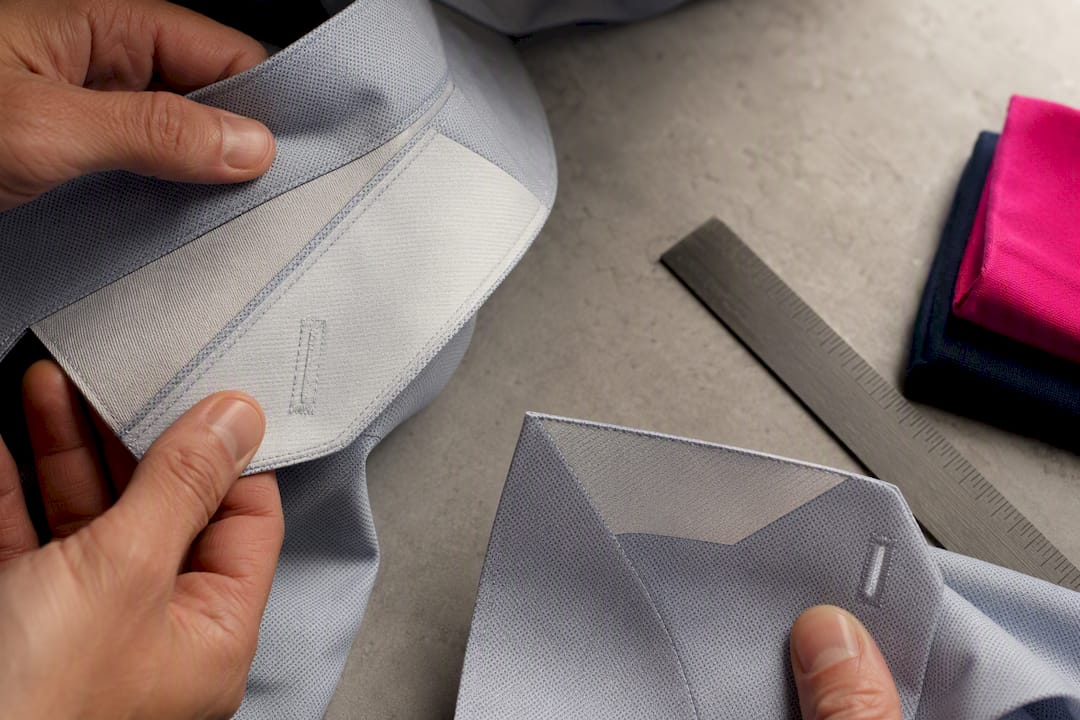
Wash cold, skip the high-heat dryer cycle, and the recovery you paid for lasts years instead of months.
Beyond the Dress Shirt: Where Four Way Stretch Earns Its Keep
Dress shirts get the attention, but four way stretch changes the calculus everywhere motion matters. Activewear was the original use case, and it’s still the clearest one: a fabric that flexes in two directions at once lets a runner’s stride, a skater’s crouch, or a lifter’s overhead press happen without the garment fighting back. That same multidirectional give shows up in everyday casual wear too, in joggers, henleys, and outerwear built for a body that bends more than it stands still.
The comfort case is straightforward. Stretchy activewear reduces the micro-fatigue of clothing that resists your movement all day, the kind of low-grade friction most people never consciously notice until they put on a rigid pair of jeans after a week in stretch pants. Four way stretch pants in particular have become a default in categories like travel wear and work-from-anywhere basics, precisely because they handle sitting, walking, and stair climbing without the knee-bag or waistband dig that rigid wovens develop.
There’s also a quiet functional benefit in layering. A stretch base layer or shirt moves independently under a jacket or hoodie, which matters for skateboarders and anyone else whose sport involves sudden, asymmetric motion. The fabric doesn’t just tolerate movement, it accommodates the unpredictable kind, which is a different and harder engineering target than the steady, repetitive motion a treadmill run demands.
The Trade-Offs Nobody Puts on the Product Page
Four way stretch fabric isn’t a free upgrade, and pretending otherwise sets buyers up for disappointment. Elastane-rich blends require different sewing techniques and tighter manufacturing tolerances than a plain woven cotton shirt, which is a real reason stretch garments often cost more than their rigid counterparts. A shirt that feels similar on the rack can perform very differently after twenty wash cycles depending on how carefully it was built.
Durability is the second trade-off. Spandex degrades faster than cotton or polyester on its own, especially under heat, chlorine, or repeated high-tension stretching. A shirt with excellent recovery on day one can lose that snap after a year of hot dryer cycles, not because the design failed but because the fiber itself has a shorter functional lifespan than the rest of the garment.
There’s also an honesty gap in how “stretch” gets marketed. A shirt can technically contain spandex and still stretch poorly, recover slowly, or lose shape within months, because a low percentage or weak knit construction can undercut even a legitimate elastane blend. And structurally, heavy stretch content pushes back against the crispness dress shirts are supposed to deliver, which is why the best versions invest extra construction work into collars and cuffs rather than skipping that step to save cost.
None of this makes four way stretch a bad choice. It makes it a choice that rewards checking the spec sheet instead of trusting the label alone.
Elastane and the Environment: What Sustainability-Minded Buyers Should Know
Elastane is a synthetic fiber, derived from petroleum-based polymers, and it doesn’t biodegrade on any practical timeline. That’s the uncomfortable truth sitting underneath every stretch garment, including the ones marketed on comfort and performance alone. Even a shirt that’s mostly cotton or recycled polyester carries an environmental cost from the small percentage of spandex woven through it.
The blend also complicates end-of-life recycling. Fabric recyclers generally need to separate fiber types before reprocessing, and elastane’s tendency to bond tightly with other fibers in a knit makes that separation difficult at scale. A shirt with a few percent spandex is harder to recycle cleanly than a 100% cotton shirt, even though the spandex is what made the shirt comfortable enough to wear in the first place.
This is part of why Czt builds from recycled base materials before adding performance fibers, rather than treating sustainability and stretch as separate design tracks. Starting with recycled polyester or cotton content offsets some of the footprint the elastane adds, even if it doesn’t erase it. Durability also does real environmental work here: a shirt with strong recovery that lasts five years outperforms, on a lifecycle basis, three cheap stretch shirts that each fail within a year and end up in a landfill. Buying fewer, better-built stretch garments is itself a sustainability decision, not just a comfort one.
Spotting Real Four-Way Stretch vs. a Marketing Buzzword
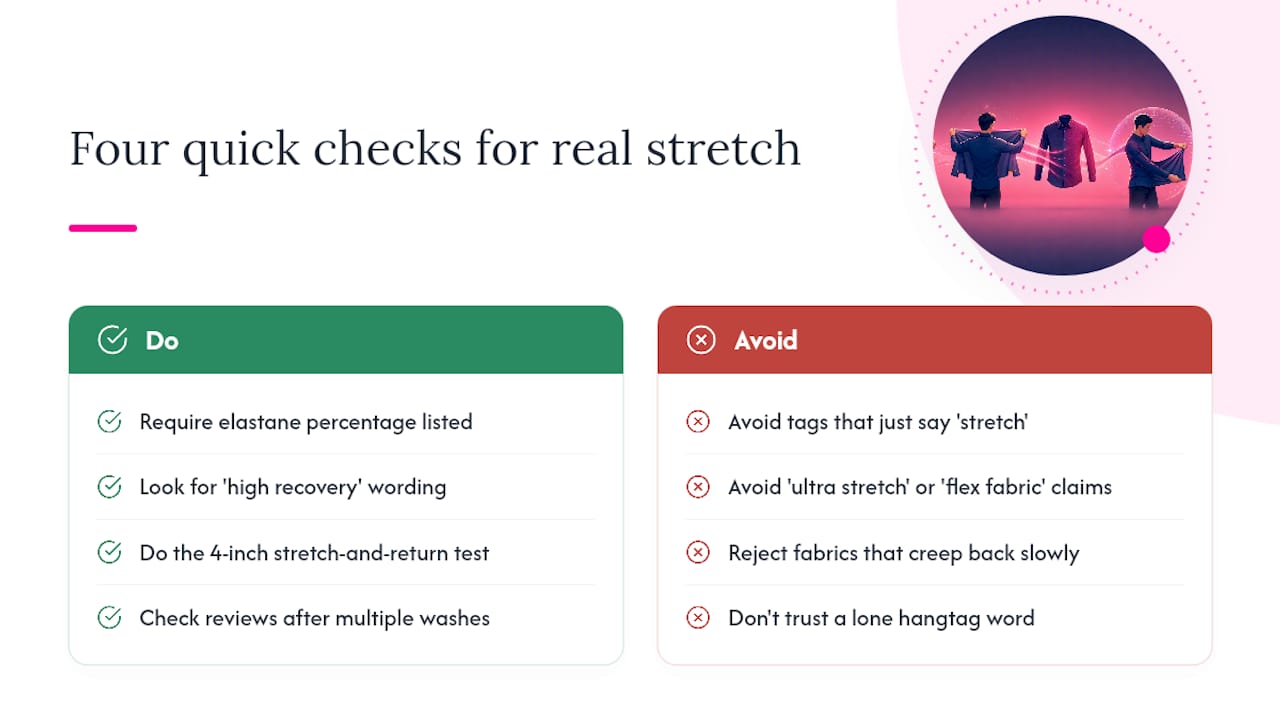
The gap between genuine four way stretch and a shirt that just says “stretch” on the tag comes down to what the brand is willing to disclose. A company confident in its fabric states the actual blend percentage, not a vague “stretch fabric” line with no numbers attached. If a product page lists cotton, polyester, or nylon but skips the elastane percentage entirely, treat that omission as the red flag it is.
Recovery language is the second tell. Brands that understand their own fabric use terms like “high recovery,” “shape retention,” or “four-directional stretch” because those phrases describe a tested property, not a feeling. Vague marketing that says “ultra stretch” or “flex fabric” without ever mentioning recovery is often describing a fabric that stretches once and stays stretched, which is the opposite of what you want in a dress shirt.
The 4-inch rule from earlier in this guide works as a tiebreaker for anything you can physically handle, whether that’s an in-store sample or a swatch that arrived with an online order. True four way stretch snaps back close to its starting measurement almost immediately. If a fabric takes several seconds to creep back to shape, or never fully returns, no amount of marketing language changes what you’re actually holding. Independent product reviews mentioning wear after multiple washes remain more reliable than any single word on a hangtag.
Our Take: Spec Sheets Beat Slogans Every Time
The conventional advice on stretch clothing stops at “look for spandex,” and that’s where most buyers get misled. Percentage alone is a lazy proxy for quality, and treating it as the whole story is how so many stretch shirts end up baggy at the elbows within a season.
What actually predicts a good four way stretch dress shirt is recovery, and recovery is testable in seconds with nothing but your own hands. That single habit, the 4-inch stretch and release, tells you more than any product description ever will. Pair that with reading the blend honestly and checking for collar stabilization, and you’ve done more diligence than most buyers manage in a lifetime of shirt shopping.
The sustainability angle deserves the same rigor, not less. A recycled-content stretch shirt that lasts five years beats a virgin-synthetic shirt that lasts one, on every environmental measure that matters. Buy fewer shirts, buy ones that pass the recovery test, and check the wash instructions before the first cycle. That’s the whole game.
— CZT
Shop Sustainable Stretch Shirts or Book a Custom Fit With Czt
Four way stretch pieces are built from recycled materials first, then engineered for recovery and collar structure that a real dress shirt needs to hold its shape all day. If you’d rather skip the sizing guesswork entirely, a custom couture service lets you commission a shirt cut to your own measurements, which means less negative ease strain on the fabric and a longer working life for the elastane inside it.
What to expect when you shop or book a consult:
- Recycled-material blends with disclosed spandex percentages, not vague “stretch fabric” labels.
- Fit options ranging from ready-to-wear cuts to fully custom couture sizing.
- Care guidance included with every order to protect recovery through years of wash cycles.
Browse the current collection or book a custom fit consultation at Czt and start with a shirt built for how you actually move through your day.
Sources
Core technical claims in this guide draw on Wikipedia’s overview of stretch fabric, the 4-inch rule testing method from SpandexByYard, LeelineWear’s sourcing and performance guide, and Lone Creek Apparel’s explainer on stretch and recovery. For care specifics on recycled-material garments, see Czt’s own guide to recycled material clothing care.
- Stretch fabric - Wikipedia
- Understanding 2-way vs 4-way stretch fabrics — SpandexByYard
- What is 4-Way Stretch Fabric? The Complete Sourcing and Performance Guide — LeelineWear