![CZT [CITI-ZEN-THEORY]](http://czt.rocks/cdn/shop/files/CZT_-_Brand_PINK_Label_1_330x.png?v=1774104725)
![CZT [CITI-ZEN-THEORY]](http://czt.rocks/cdn/shop/t/61/assets/CZT-Fast-Logo---Blue-Grey_330x.png?v=98224836737033641471695502660)
![CZT [CITI-ZEN-THEORY]](http://czt.rocks/cdn/shop/files/CZT_-_Brand_PINK_Label_1_170x.png?v=1774104725)
![CZT [CITI-ZEN-THEORY]](http://czt.rocks/cdn/shop/t/61/assets/CZT-Fast-Logo---Blue-Grey_170x.png?v=98224836737033641471695502660)
Wyzenbeek Bands: Abrasion Resistant Fabrics That Hold to 15,000+ Rubs
Aramids like Kevlar, engineered nylons such as CORDURA and ballistic nylon, coated surfaces like Superfabric, and heavyweight twill denim or leather sit at the top of the abrasion resistance hierarchy. The numbers that separate marketing language from measured performance are Wyzenbeek double rubs and Martindale cycles. Read the testing section first, then the material breakdown, then the buying checklist before you trust any hangtag claim.
TL;DR:
- Most abrasion-resistant fabrics, like aramids and ballistic nylon, perform best in high-friction environments but often trade off weight, flexibility, or breathability.
- Wyzenbeek and Martindale tests measure different wear mechanisms and cannot be directly compared or converted, so confirm test specifics for accurate performance expectations.
- Fabric selection should prioritize weave density, coatings, and construction over fiber name alone, as these factors significantly influence abrasion resistance.
- Recycled nylon can match the abrasion performance of virgin fibers if woven and finished properly, but verify certification and detailed test reports before trusting recycled claims.
- Always require specific test method details, double-rub or cycle counts, specimen direction, and raw sample access to validate abrasion claims from suppliers.
Table of Contents
- What Abrasion Resistant Fabrics Actually Resist
- How Labs Measure Wear: Wyzenbeek, Martindale, and Taber
- The Material Families Worth Knowing by Name
- Why Weave and Coating Matter More Than Fiber Name Alone
- Matching Fabric Choices to What You’re Actually Building
- The Datasheet Checklist Before You Commit to a Fabric
- How Recycled Fabrics Meet the Same Abrasion Thresholds
- What We Actually Prioritize When We Spec a Fabric
- Durable, Recycled Streetwear Built to Take a Beating
- Where to Verify Test Numbers and Vendor Claims
- Sources
What Abrasion Resistant Fabrics Actually Resist
Abrasion resistance measures how a textile holds up under repeated surface friction, the kind that comes from a knee dragging across pavement or a backpack sliding against a car seat for years. That’s a different quality than tear strength, which measures resistance to a ripping force, or tensile strength, which measures how much pulling a fiber withstands before snapping. A fabric can shrug off a hard yank and still wear through in months if the surface fibers can’t take repeated rubbing.
The failure modes look different depending on what you’re making. In apparel, abrasion shows up as pilling, thinning, and eventually holes at stress points like inner thighs or elbows. In upholstery, it’s a worn sheen where a couch arm meets a sleeve. In luggage or packs, it’s fraying at corners and zipper gussets where the bag scrapes against floors and overhead bins.
Application demands vary just as much:
- Footwear needs abrasion resistance that survives constant flexing, not just static rubbing.
- Geotextiles need surface hardness against soil, gravel, and root systems.
- Motorcycle gear needs abrasion resistance calibrated to a specific worst case: a body sliding across asphalt at speed.
The fiber that wins one contest often loses another, which is why nobody in textile engineering treats abrasion resistance as a single number you can shop by.
How Labs Measure Wear: Wyzenbeek, Martindale, and Taber
Three test methods dominate the industry, and they’re not interchangeable, no matter how often product copy implies otherwise. Wyzenbeek (ASTM D4157) rubs a fabric back and forth against an abradant in a straight line and counts double rubs. Martindale (ASTM D4966) moves a fabric in a figure eight pattern under a fixed weight and counts cycles. Taber rotates an abrasive wheel against a sample under controlled pressure, and it’s used more for coated or plastic-surfaced materials than for woven apparel goods.
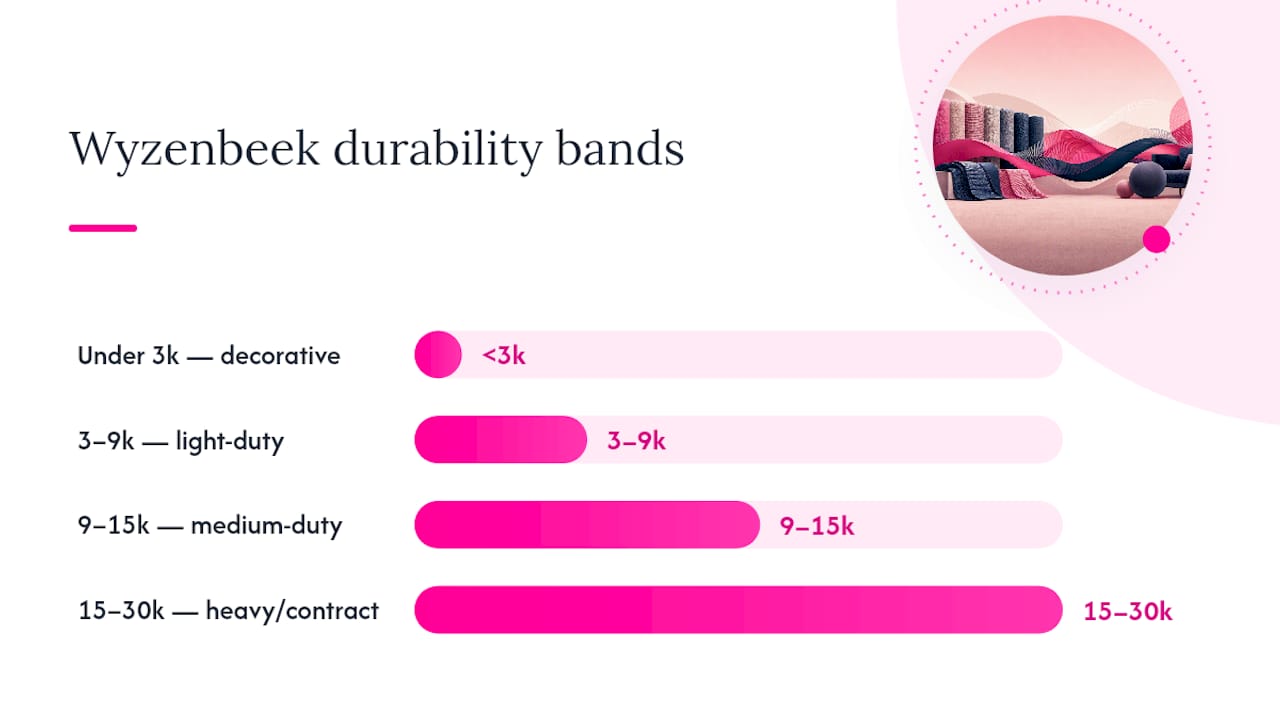
Wyzenbeek results in North America fall into recognizable bands:
- Under 3,000 double rubs: decorative use only, not meant for regular contact.
- 3,000 to 9,000 double rubs: light-duty, fine for occasional-use furniture or light apparel.
- 9,000 to 15,000 double rubs: medium-duty, suited to everyday residential upholstery.
- 15,000 to 30,000 double rubs: heavy-duty, the threshold that most contract and commercial upholstery specifications require.
- An extra heavy rating suited for high-traffic environments such as transit seating.
Pro Tip: A Martindale cycle number and a Wyzenbeek double-rub number can’t be converted into each other. They’re measuring different motions on different equipment, so a fabric rated 20,000 double rubs isn’t automatically equivalent to 20,000 Martindale cycles.
Here’s the part vendors rarely volunteer: lab numbers describe a specific abradant, a specific pressure, and a specific specimen orientation, not your actual product in actual use. Industry guidance documents note that inter-lab variance on identical fabric samples can run surprisingly wide depending on calibration and abradant wear, and that variance means a single certificate isn’t a lifespan guarantee. Ask any supplier what abradant they used (wool, cotton duck, or wire mesh all produce different wear patterns), what pressure was applied, and whether the specimen was tested warp-direction, weft-direction, or both.
The Material Families Worth Knowing by Name
Every abrasion resistant fabric on the market traces back to one of a handful of engineering approaches, and knowing which family you’re dealing with tells you more than any single test number.
- Aramids (Kevlar and similar fibers) owe their toughness to a rigid molecular chain structure that resists cutting and surface wear simultaneously, which is why they show up in cut-resistant gloves and motorcycle liners rather than everyday apparel. They’re expensive and don’t breathe well, so they’re rarely the whole garment.
- CORDURA and other engineered nylons use high-tenacity, higher-denier filament yarns woven tight enough that individual fibers can’t easily shear off. Cordura fabrics are specified across technical packs, luggage, and reinforcement panels precisely because the yarn engineering, not just the fiber chemistry, drives the wear performance.
- Ballistic nylon is a specific heavy weave, originally developed for flak jackets, prized for puncture and abrasion resistance in bags and cases where weight is a secondary concern.
- Superfabric and other coated composites bond small hard guard plates or resin coatings onto a base textile, trading some flexibility for abrasion numbers that outperform almost any woven fiber alone.
- Heavyweight denim, canvas, and leather still hold their own. Comparative testing across Martindale, Wyzenbeek, and Taber methods regularly shows heavy denim and leather outlasting many lighter synthetic apparel fabrics, which is why raw denim jeans and leather jackets remain a baseline for casual protective wear decades after synthetics became cheaper.
The trade-off running through all of it: every gain in abrasion resistance tends to cost you something in weight, flexibility, breathability, or price. There’s no free fiber.
Why Weave and Coating Matter More Than Fiber Name Alone
A tight twill or plain weave resists abrasion better than a loose knit made from the identical fiber, because tension in a dense weave keeps individual filaments from lifting and shearing off under friction. Denier (the yarn’s linear mass density) also matters: higher-denier, multifilament yarns spread wear across more fiber surface than a single thick strand would.
Coatings and laminates change the equation further:
- Polyurethane (PU) coatings add a protective skin that resists rubbing but reduce breathability.
- Ceramic overlays boost hardness for extreme applications, at a weight and flexibility cost.
- Superfabric-style composite layers stack a hard outer guard over a flexible base, which is why protective apparel favors layered composites over a single heavy fabric.
Reinforcement strategies follow the same logic on a garment scale. Paneling adds a second, tougher fabric only at high-wear zones. Backing laminates a stabilizing layer to a thinner face fabric. Multi-layer composites put a friction-resistant shell over a comfort layer that handles flex and insulation.
Pro Tip: Weave density and finish can matter more than fiber type. A poorly woven nylon can underperform a tightly woven cotton canvas in a straight abrasion test, even though nylon is generally the tougher fiber.
Matching Fabric Choices to What You’re Actually Building
Different products put friction in different places, so the right fabric depends on where the wear happens and how often.
- Backpacks and luggage call for CORDURA or ballistic nylon in the 1000 to 1680 denier range, reinforced at corners and strap attachment points.
- Workwear pants and jackets do well with heavyweight twill or duck canvas, typically 10 to 14 ounces per yard, at knees and seat panels.
- Motorcycle gear needs composite construction: an aramid or Superfabric-style outer shell over a comfort lining, since a slide impact demands abrasion resistance no single woven fabric reliably delivers alone.
- Footwear uppers need flex-fatigue-tested synthetics or leather, since footwear abrasion happens through constant bending, not just static rubbing.
- Upholstery should be checked against the Wyzenbeek band for its setting: residential seating can work at 9,000 to 15,000 double rubs, while contract or hospitality upholstery generally needs 15,000 or higher.
- Geotextiles prioritize surface hardness against soil and grit over flexibility, favoring dense, coated wovens.
Laundering matters more than most buyers assume: harsh detergents and high heat break down coatings and finishes years before the base fiber wears out, which quietly erases the abrasion advantage you paid for.
The Datasheet Checklist Before You Commit to a Fabric
A real technical datasheet names its test method, its cycle or double-rub count, and the specimen direction tested. If a spec sheet just says “high abrasion resistance” with no number attached, treat that as marketing copy, not engineering data.
Before you commit, require these details in writing:
- Test method used (Wyzenbeek, Martindale, or Taber) and the specific ASTM designation.
- Cycle or double-rub count, tested in both warp and weft directions if it’s a woven fabric.
- Denier, weave type, and any finish or coating applied.
- Backing or lamination details if the fabric is a composite.
Then ask your supplier a few pointed questions: Can you provide a physical sample, not just a swatch photo? How much does abrasion performance vary between production lots? Can you trace this test report to the actual roll you’re shipping, or is it a generic fiber-level claim? What laundering or cleaning method was assumed during testing?
Pro Tip: Treat an unspecified test method as a red flag on its own. A supplier who can quote a double-rub number but can’t name Wyzenbeek or Martindale specifically usually hasn’t seen the actual test report. Inconsistent numbers across documents, no available sample, and durability claims with zero attached report are the three warning signs that end a supplier conversation fast.
How Recycled Fabrics Meet the Same Abrasion Thresholds
Engineering, not virgin fiber, is what makes an abrasion resistant fabric perform. Recycled nylon can hit the same denier, yarn twist, and weave density as virgin nylon, which means a well-constructed recycled fabric can land in the same Wyzenbeek or Martindale band as its virgin counterpart. The fiber’s origin doesn’t set the ceiling; the spinning and weaving process does.
If a recycled-content claim matters to your purchase, ask for a Global Recycled Standard (GRS) certificate and a life cycle assessment (LCA) summary alongside the abrasion test report itself. Our guide to verifying recycled nylon claims walks through exactly what documentation should back up a “recycled” label, and our care guide for recycled-material clothing covers the laundering habits that keep those fibers performing for years.
What We Actually Prioritize When We Spec a Fabric
When we’re sourcing for a piece meant to survive a skate session, a work shift, or a kid’s third summer of climbing everything in sight, durability comes first, recycled content comes second, and washability comes third, in that order, because a fabric that fails one washing cycle helps no one regardless of what it’s made from. We ask suppliers for the same double-rub and cycle documentation we’d expect any buyer to demand, and we weigh weave density and finish as heavily as fiber origin. We keep proprietary wear trials and case-specific sourcing data internal, but we’re glad to walk any customer through the reasoning behind a specific fabric choice on request.
— CZT
Durable, Recycled Streetwear Built to Take a Beating
This brand offers an alternative for those seeking abrasion resistance without relying on fibers that have a high environmental cost. Our Botanic Camo collection and broader streetwear line use recycled materials engineered for real wear, not just a recycled-content sticker on the tag, and our custom couture design service lets you spec a piece built around your own durability needs, whether that’s skate decks, work shifts, or a kid who treats every fence as a climbing wall.
If you’re outfitting a family for outdoor play, our durable fabric guide for active kids pairs well with a browse through outdoor recreation gear built for the same abuse. Book a custom couture consultation through Czt’s site to talk through fabric choices for your next piece before you commit to a fiber that won’t hold up.
Where to Verify Test Numbers and Vendor Claims
Cross-check any abrasion claim against the ACT performance guidelines for indoor woven fabrics, which set the Wyzenbeek and Martindale threshold bands the industry actually uses. Swavelle’s breakdown of Martindale versus Wyzenbeek testing explains why the two numbers don’t convert. Always ask the supplier for the report tied to your specific fabric roll, not a generic fiber-level data sheet.
Sources
- ACT performance guidelines for abrasion (indoor woven fabrics)
- Textile Testing: How Is Fabric Durability Measured? - Swavelle
- CORDURA technical sheet (Cordura Lite fabric)
- Evaluating the Abrasion Resistance of Different Fabric Types - Testex