![CZT [CITI-ZEN-THEORY]](http://czt.rocks/cdn/shop/files/CZT_-_Brand_PINK_Label_1_330x.png?v=1774104725)
![CZT [CITI-ZEN-THEORY]](http://czt.rocks/cdn/shop/t/61/assets/CZT-Fast-Logo---Blue-Grey_330x.png?v=98224836737033641471695502660)
![CZT [CITI-ZEN-THEORY]](http://czt.rocks/cdn/shop/files/CZT_-_Brand_PINK_Label_1_170x.png?v=1774104725)
![CZT [CITI-ZEN-THEORY]](http://czt.rocks/cdn/shop/t/61/assets/CZT-Fast-Logo---Blue-Grey_170x.png?v=98224836737033641471695502660)
Skate Hoodie Picks for Durability and Skate-Ready Fit
For the best balance of durability, freedom of movement, and genuine eco credentials, choose a mid-weight pullover hoodie from Czt’s sustainable collection. An 80/20 or 70/30 cotton/polyester blend at mid-weight fleece gives you the warmth and shape retention that park sessions demand, without the stiffness that kills your pop. Browse the Czt collection at czt.rocks or read on for the full breakdown of types, sizing, and what to look for on any product page.
Table of Contents
- What types of skate hoodies should you buy?
- What should you look for when buying a skate hoodie?
- How do you size a skate hoodie for sessions and streetwear?
- What fabrics and sustainable materials work best for skaters?
- How to care for your hoodie, what to expect from shipping, and what price buys you
- How do you style a skate hoodie without losing credibility?
- Why Czt’s sustainable skate hoodies are worth your attention
- Two-minute checklist to pick the right skateboarding sweatshirt now
- Key Takeaways
- Sustainability and skate credibility are the same conversation
- Czt’s skate hoodie collection is ready when you are
What types of skate hoodies should you buy?
Skate-specific sweatshirts fall into four practical categories, each with a distinct trade-off between mobility, warmth, and versatility.

| Type | Best For | Key Trade-Off |
|---|---|---|
| Pullover hoodie | Park sessions, all-day wear | No front opening; hood stays secure mid-trick |
| Zip/hoodzip | Commuting, temperature control | Front zipper can catch or shift during skating |
| Crewneck sweatshirt | Mild days, layering under a shell | No hood; cleaner silhouette for streetwear |
| Kids hoodie | Youth skaters, casual play | Sized for growth; prioritize reinforced seams |
The pullover is the workhorse of skate culture. Because there is no zipper to snag on a rail or flap open mid-run, it keeps its composition intact through the kind of kinetic chaos that defines a good session. The zip style earns its place for commuters who need to regulate temperature on the ride over, though you will want a secure zipper garage at the collar. Crewneck sweatshirts, sometimes built from 100% cotton French terry, trade some durability for a softer hand and a cleaner, more architectural silhouette — a reasonable choice when the board stays in the bag. Kids-specific cuts deserve reinforced seams and a slightly longer torso to stay tucked during movement; sizing up one size is rarely the answer when a proper youth cut exists.
What should you look for when buying a skate hoodie?
The features that separate a genuinely performance-driven hoodie from a fashion piece are mostly invisible in a thumbnail. Here is the prioritized checklist.
- Fabric blend. An 80/20 or 70/30 cotton/polyester blend resists pilling and holds its shape after repeated washing and abrasion — pure cotton softens but stretches out.
- Fleece weight. Mid-weight fleece at 280–330 gsm (around 10 oz) moves with you. Heavyweight fleece is warmer but restricts shoulder rotation on technical tricks.
- Seam construction. Split-stitch double-needle seams and reinforced pocket seams are the marks of a hoodie built to survive concrete. Single-needle seams unravel faster under stress.
- Ribbing. Ribbed cuffs and hem recover their shape after stretching. Flat-knit hems look cleaner but bag out over time.
- Pocket design. A deep kangaroo pocket with reinforced seams keeps your phone and wax secure. Shallow pockets are a styling choice, not a functional one. Czt’s guide on pocket functionality for skaters breaks this down further.
- Hood and drawcord. A fitted hood with a flat drawcord (not a round cord) sits closer to the head and is less likely to catch on obstacles.
- Price tier. Value hoodies (~$40–$70) cover the basics; mid-range (~$70–$120) is where most skate hoodies in mainstream retail land; premium ($120+) typically signals heavier fabric, limited graphics, or certified sustainable materials.
Pro Tip: When evaluating a hoodie online, zoom into the product photos and look for stitching close-ups near the pocket corners and cuffs. If the brand does not show those details, check the size chart for model measurements — a brand confident in its construction shows both.
How do you size a skate hoodie for sessions and streetwear?
Fit is the most personal decision in this purchase, and it splits cleanly between two use cases.

True-to-fit works best for active skating. A hoodie that sits close to the torso without bunching under the arms preserves shoulder mobility and keeps fabric from catching on obstacles. If you are between sizes, go up one — not two.
Oversized is the streetwear standard, worn one to two sizes up for that dropped-shoulder silhouette. It layers well over a thermal or long-sleeve base on colder sessions, though the extra fabric can bunch at the waist under a backpack. Czt’s cold-weather layering guide covers how to build a functional layering system without sacrificing mobility.
How to measure yourself
- Chest: measure around the fullest part of your chest, just under the arms, keeping the tape level.
- Sleeve: measure from the center back of the neck, across the shoulder, and down to the wrist.
- Torso length: measure from the top of the shoulder straight down to where you want the hem to fall.
Sample size chart (men’s unisex reference)
| Size | Chest (in) | Sleeve (in) | Torso Length (in) |
|---|---|---|---|
| XL | — | — | 30 |
- For layering over a thermal, add 1–2 inches to your chest measurement before selecting a size.
- Kids sizing runs by age and height; always cross-reference the brand’s specific chart rather than assuming standard sizing.
- Unisex cuts typically run slightly wide through the torso — women who prefer a fitted silhouette often size down one.
What fabrics and sustainable materials work best for skaters?
The fabric story for skateboarding sweatshirts is more nuanced than “cotton is natural, therefore better.” Polyester is the ingredient that keeps a hoodie looking like a hoodie after six months of sessions and weekly washes.
Cotton/polyester blends at 80/20 or 70/30 ratios are the industry standard for a reason: the cotton delivers breathability and a soft hand, while the polyester resists abrasion, retains shape, and dries faster. Pure cotton French terry, as seen on some comfort-first cuts, offers a luxurious feel but stretches and pills more readily under skate conditions.
On the sustainability side, recycled polyester content is increasingly common, even in small percentages, as a way to reduce plastic waste without compromising fabric performance. Transparency about that content is the trust signal worth looking for. Czt’s technical skate apparel guide explains what performance-driven fabric claims actually mean in practice.
- GOTS certification (Global Organic Textile Standard) covers the entire supply chain, from fiber to finished garment.
- OEKO-TEX Standard 100 certifies that every component has been tested for harmful substances — a baseline worth expecting on any hoodie worn close to skin.
- Recycled content labeling should name the source material (e.g., post-consumer plastic bottles) and state the percentage clearly.
- Fleece weight should appear in gsm or oz on the product page; if it does not, that absence is itself informative.
Mid-weight fleece is the most versatile choice for skaters who want one hoodie that works year-round across most U.S. climates, balancing warmth with the shoulder mobility that technical skating demands.
How to care for your hoodie, what to expect from shipping, and what price buys you
A hoodie that survives the park can still be ruined in the laundry. These practices preserve the print, the ribbing, and the fabric integrity.
- Wash cold, inside out. Hot water degrades print adhesion and accelerates pilling on polyester-blend fleece.
- Skip the dryer when possible. High heat shrinks cotton content and breaks down ribbing elasticity. Air-dry flat or hang.
- No fabric softener on fleece. Softener coats the fibers and reduces moisture management over time.
- Wash with similar weights. Heavy denim against a fleece hoodie creates abrasion that mimics a session on concrete.
Shipping and returns: Most reputable U.S. skate retailers offer free shipping above a threshold (commonly $50–$75) and a 30-day return window. Before buying, confirm the brand publishes a clear size chart with model measurements and action shots — both are signals that the brand stands behind its fit. A returns policy without a restocking fee is the standard to expect at mid-range and above.
Price and what it buys you: Value hoodies (~$40–$70) cover the blend and basic construction. The mid-range (~$70–$120) is where most skate hoodies in mainstream retail land, with features like double-needle seams, heavier fleece, and more considered graphics. Premium ($120+) typically adds certified sustainable materials, limited-run artwork, or heavier-weight construction.
How do you style a skate hoodie without losing credibility?
Skate culture has always worn its values on its sleeve — literally. The hoodie you choose communicates something about your relationship to the board, and brand heritage matters to many skaters as a signal of genuine community participation rather than trend adoption. Czt’s deep dive into skateboarding subcultures and streetwear traces exactly how those aesthetic codes developed.
Three looks that balance function and credibility:
- Park session: mid-weight pullover, baggy cargo or drop-crotch skate pants, chunky skate shoes. Keep the palette muted so graphic details read clearly.
- Commuting: — zip hoodie over a long-sleeve tee, slim chinos or tapered joggers, low-profile sneakers. The zip gives you temperature control between the session and the coffee shop.
The sustainable angle is not a compromise on credibility. Skate culture has always been about resourcefulness and anti-waste — a hoodie made from recycled materials fits that ethos more naturally than most trend cycles suggest.
Why Czt’s sustainable skate hoodies are worth your attention
Czt builds its hoodies around recycled materials and a design philosophy rooted in skate culture, not borrowed from it. The Botanic Camo collection, one of the brand’s signature lines, uses recycled content to minimize waste while delivering the kind of aesthetically intriguing graphic work that holds up as art, not just apparel.
- Recycled fabric construction: Czt uses recycled materials across its collection, with sourcing details available on individual product pages.
- Graphic integrity: prints are designed to survive washing and wear, not just a product photo.
- Sizing transparency: Czt publishes model measurements alongside size charts so you can match your body measurements to an actual fit, not an abstraction.
- Custom couture option: if the standard collection does not match your vision, Czt offers personalized design consultations for fully custom pieces.
Czt’s brand story and skate-culture roots explain why these design decisions are not marketing language — they are the architecture of every piece.
Pro Tip: Before ordering, compare your chest and torso measurements against Czt’s published model measurements. If the model is listed at 6’1" wearing a Large and your proportions are similar, that is a more reliable fit signal than the size label alone.
Two-minute checklist to pick the right skateboarding sweatshirt now
Run through these five points and you will have a shortlist in under two minutes.
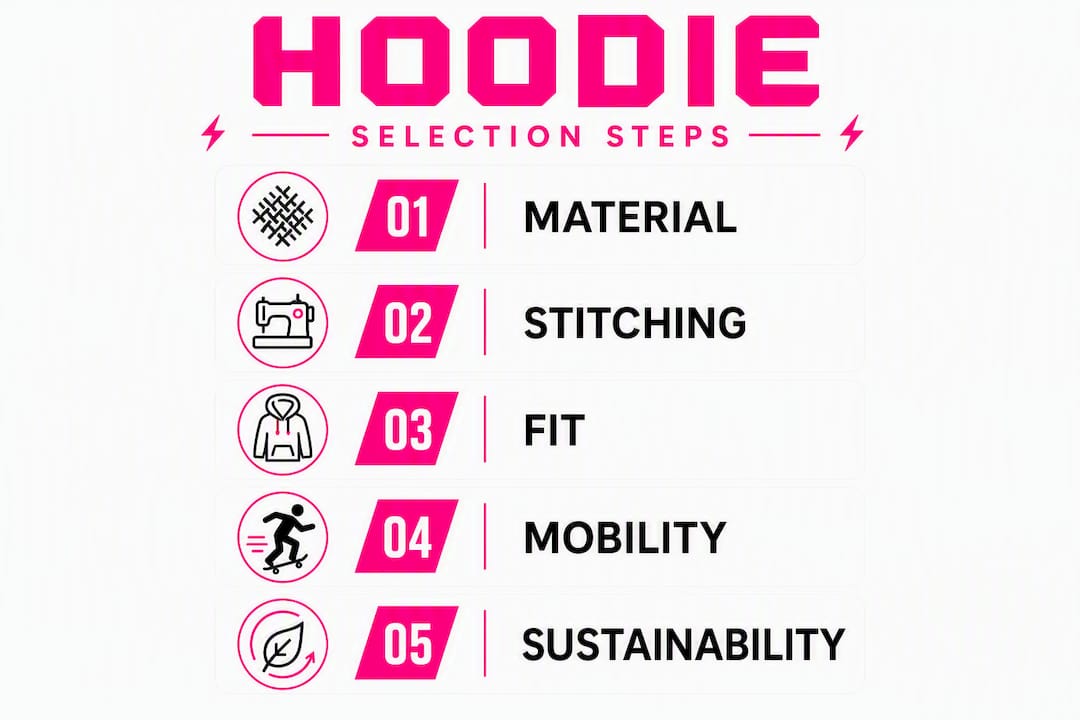
- Category: pullover for active skating, zip for commuting and layering, crewneck for streetwear.
- Fabric blend: look for a cotton/polyester blend; confirm the fleece weight is mid-weight.
- Fit: measure your chest and torso, compare to the brand’s model measurements, and decide true-to-fit or one size up.
- Sustainability claim: check for recycled content percentage, GOTS or OEKO-TEX certification, or clear sourcing language — not just the word “sustainable.”
- Returns: confirm a no-restocking-fee return window and a published size chart before you check out.
Czt’s collection at czt.rocks covers all five points with full material transparency and model sizing details.
Key Takeaways
A mid-weight pullover in a cotton/polyester blend with mid-weight fleece is the most versatile skate hoodie for both active sessions and everyday streetwear.
| Point | Details |
|---|---|
| Best hoodie type | Mid-weight pullover; hood stays secure and mobility is unrestricted during skating. |
| Fabric standard | 80/20 or 70/30 cotton/polyester blend at 280–330 gsm balances durability, shape retention, and warmth. |
| Sizing approach | Measure chest and torso; compare to model measurements on the brand’s size chart before ordering. |
| Sustainability check | Look for recycled content percentage, GOTS or OEKO-TEX certification, and clear sourcing language. |
| Czt recommendation | Czt’s sustainable collection offers recycled-material hoodies with published model measurements and a custom couture option. |
Sustainability and skate credibility are the same conversation
There is a tendency in skate apparel writing to treat sustainability as a concession — something you accept when you want to feel good about a purchase, at the cost of authenticity or performance. We do not share that view at Czt, and the more we have studied the culture, the more we believe it misreads skate history entirely.
Skate culture was built on making something from nothing: repurposed pools, hand-shaped decks, DIY spots carved out of parking structures. The ethos was never about consumption — it was about craft, resourcefulness, and a certain refusal to accept the world as it was handed to you. A hoodie made from recycled materials, designed with genuine attention to construction and fit, is not a departure from that tradition. It is a continuation of it.
What we push back against is the performance of sustainability: a brand that drops the word “eco” on a product page without naming a certification, a percentage, or a supply chain. That is marketing, not craft. The standard we hold ourselves to at Czt is transparency — material sourcing you can read, construction details you can see in the product photos, and sizing information grounded in real model measurements. If a brand cannot show you those things, the hoodie might still be fine. But you are buying on faith, not evidence.
Czt’s skate hoodie collection is ready when you are
Czt brings together recycled-material construction, graphic artistry rooted in skate culture, and sizing transparency that most apparel brands still treat as optional. Every piece in the collection is built to perform on the board and hold its composition through the kind of wear that tests lesser fabrics — and every product page gives you the material details and model measurements to make a confident decision before you buy.
Free shipping details and return terms are listed at checkout. The size chart and model measurements are on every product page. If you want something fully your own, Czt’s custom couture design service lets you commission a piece built around your exact vision. Browse the full collection, check your measurements against the size guide, and find the hoodie that earns its place in your rotation at czt.rocks.
Recommended
- Skate Apparel Layering Techniques That Actually Work – CZT [CITI-ZEN-THEORY]
- Layer Streetwear for Cold Weather Skating in Style – CZT [CITI-ZEN-THEORY]
- What Is Technical Skate Apparel: A 2026 Guide – CZT [CITI-ZEN-THEORY]
- How Pockets Improve Skate Functionality and Performance – CZT [CITI-ZEN-THEORY]