![CZT [CITI-ZEN-THEORY]](http://czt.rocks/cdn/shop/files/CZT_-_Brand_PINK_Label_1_330x.png?v=1774104725)
![CZT [CITI-ZEN-THEORY]](http://czt.rocks/cdn/shop/t/61/assets/CZT-Fast-Logo---Blue-Grey_330x.png?v=98224836737033641471695502660)
![CZT [CITI-ZEN-THEORY]](http://czt.rocks/cdn/shop/files/CZT_-_Brand_PINK_Label_1_170x.png?v=1774104725)
![CZT [CITI-ZEN-THEORY]](http://czt.rocks/cdn/shop/t/61/assets/CZT-Fast-Logo---Blue-Grey_170x.png?v=98224836737033641471695502660)
Eco Buyers: PFC-Free DWR Needs Reproof Every 10–20 Washes
PFC-free DWR is a durable water repellent coating made without fluorocarbons, using chemistries like silicones, waxes, or modified polyurethanes instead. For most rainy-day and trail use, it performs close to the fluorinated finishes it replaces. The trade-offs show up at the margins: slightly less oil and stain resistance, and a shorter stretch between reproofing. Buy it for the sustainability gain, and treat care as part of the deal, not an afterthought.
TL;DR:
- PFC-free DWR coatings perform nearly as well as fluorinated finishes in water bead test ratings above 80, but are less durable and stain-resistant after multiple washes.
- Achieving high water-repellency with PFC-free finishes depends on precise application methods, and cross-contamination in factories can reduce performance and environmental claims.
- Regular maintenance—including washing with technical detergents, heating to reactivate coatings, and reproofing every 10 to 20 washes—is essential to maintain water resistance.
- Authentic PFC-free products must claim full garment coverage, not just surface finishes, and certifications like bluesign or OEKO-TEX confirm chemical input transparency.
- For everyday outdoor gear, PFC-free DWR provides a sustainable alternative, but heavy oil or stain resistance still favors legacy fluorinated coatings.
Table of Contents
- How PFC-Free DWR Works: Chemistries and Manufacturing Realities
- Performance vs. Fluorinated DWR: Water, Oil, and Wash Durability
- PFC-Free Technologies You’ll See on Hangtags
- Keeping PFC-Free Gear Working: Wash, Dry, Reproof
- Shopping for Real PFC-Free Performance
- Where CZT Stands on Sustainable Finishes
- The Next Few Seasons of PFC-Free DWR
- Sustainable Streetwear That Shares the Same Values
- Sources
How PFC-Free DWR Works: Chemistries and Manufacturing Realities
Every DWR coating does the same basic job: it lowers the surface energy of a fabric so water forms beads and rolls off instead of soaking in. Fluorinated finishes did this by aligning long carbon-fluorine chains on the fiber surface, which happen to be extraordinarily good at repelling both water and oil. PFC-free alternatives chase the same effect through different chemistry, and the industry has largely settled on a handful of approaches.
Silicone emulsions coat fibers in a flexible, hydrophobic film, common on tents, softshells, and packs because they hold up well to flexing and abrasion. Wax and paraffin dispersions, the oldest trick in the book, still show up on canvas and workwear where a slightly waxy hand feel is acceptable. Modified polyurethanes and bio-based polymer finishes are newer entrants, engineered to create micro-textured surfaces that mimic the water-shedding structure of a lotus leaf rather than relying on chemical repulsion alone.
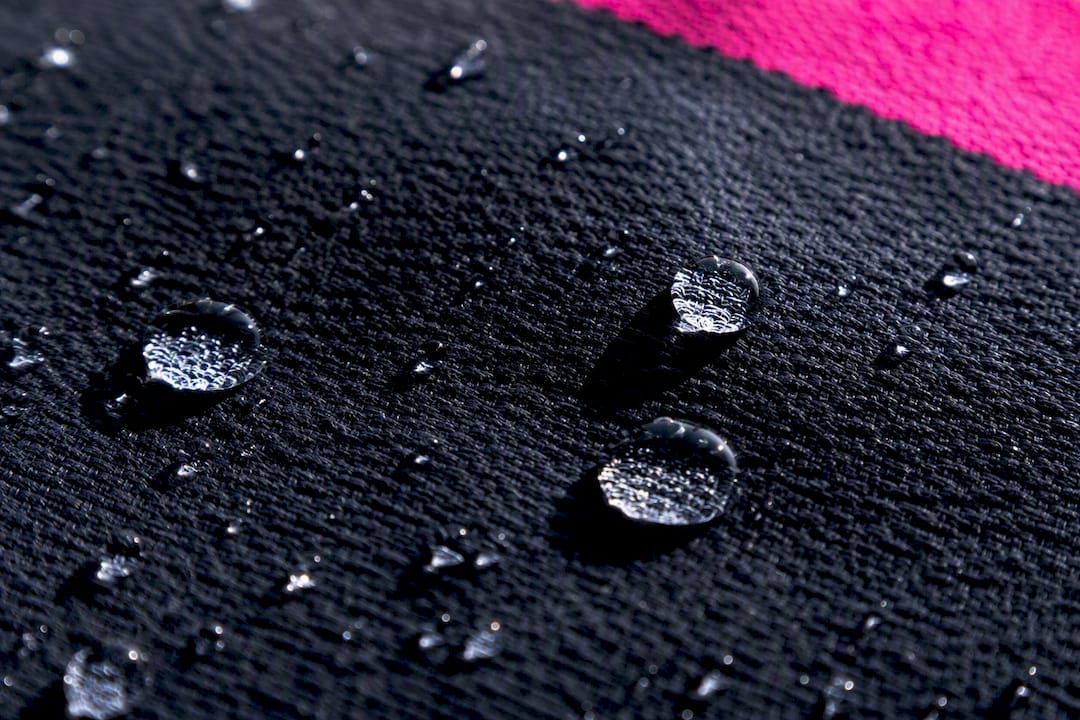
Getting any of these to perform depends heavily on how they’re applied, not just what they’re made of. Curing temperature, fabric weave tightness, and dwell time all affect how evenly the coating bonds to fibers. There’s also a quieter production issue: cross-contamination. If a factory runs legacy fluorinated finishes on the same equipment as PFC-free lines without thorough cleaning, residue can compromise both the environmental claim and the finish quality. Brands serious about C0 production increasingly run dedicated lines to avoid exactly that.
Performance vs. Fluorinated DWR: Water, Oil, and Wash Durability
Fresh off the shelf, a well-made PFC-free DWR beads water almost as aggressively as its fluorinated predecessor. A 2026 materials study on nylon/cotton blends found that optimized PFAS-free formulations can hit AATCC TM 22 spray ratings above 80, the same industry-standard water-spray test brands have used for decades, while keeping the fabric breathable. That’s a meaningful shift from where C0 chemistry stood even five years ago.
Statistic Callout: Optimal PFAS-free formulations in lab testing reached high AATCC water-repellency scores at about 2% solids content, a narrow formulation window that shows performance is achievable but far less forgiving than with fluorinated chemistry.
Where the gap still shows up is durability and oil resistance. Legacy C8 and C6 fluorinated finishes could often survive dozens of wash cycles before needing reproofing. Field testing and trade reviews report that modern PFC-free finishes hold up comparably for rain protection but tend to wear down faster with repeated washing, and oil or stain repellency lags behind fluorinated coatings across the board. If you’re wiping down a rain jacket after light drizzle, you won’t notice a difference. If you’re bushwhacking through sap and grime on a multi-day trip and expect the fabric to shrug off oils the way an old Gore-Tex shell did, expect PFC-free to need more attention.
PFC-Free Technologies You’ll See on Hangtags
A handful of named technologies now dominate the PFC-free shelf, and knowing them helps you shop with confidence instead of guessing at marketing copy.
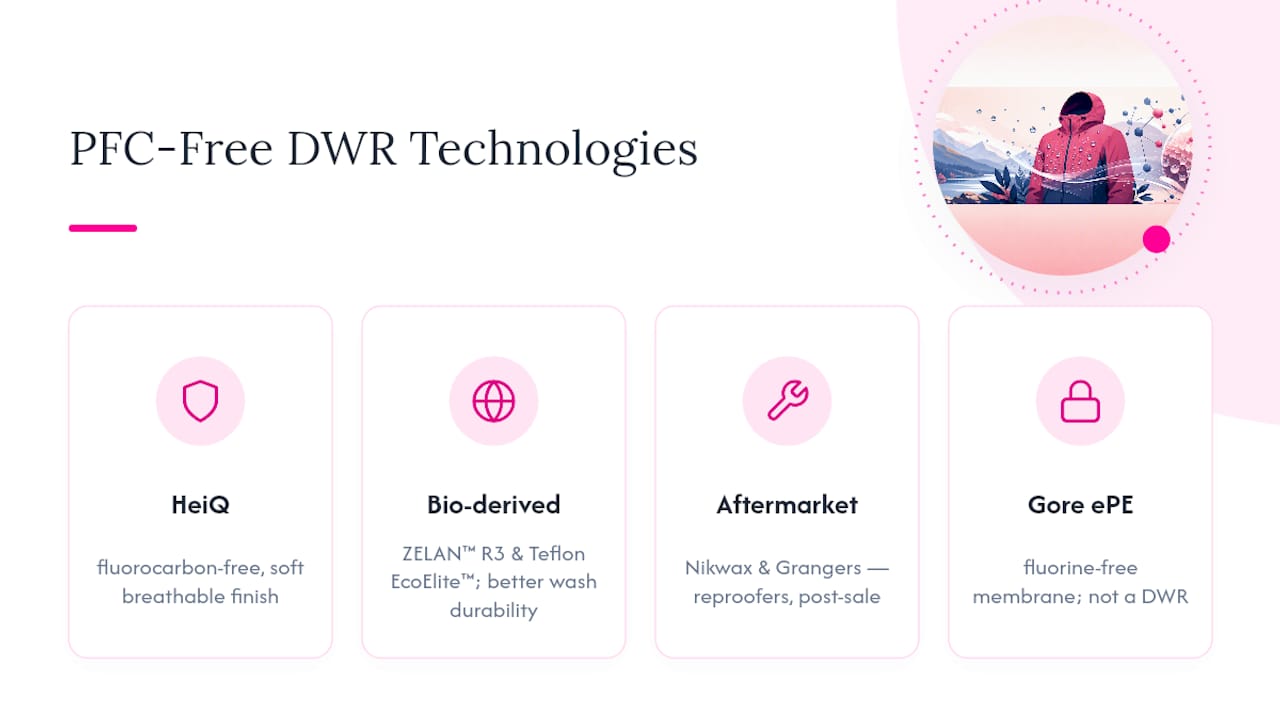
HeiQ X-Repell™ is a widely licensed treatment that delivers water repellency without fluorocarbons while keeping fabric soft and breathable, making it a common choice for apparel brands transitioning entire product lines at once. ZELAN™ R3 and Teflon EcoElite™ lean on renewable or bio-derived inputs and have shown notable gains in wash durability compared to earlier C0 attempts. Nikwax and Grangers occupy the aftermarket side, producing PFC-free reproofers rather than factory finishes. And the Gore ePE membrane deserves a separate mention: it’s not a DWR coating at all, but a fluorine-free expanded polyethylene membrane that replaced Gore’s older ePTFE construction, handling the waterproof barrier while a separate DWR treatment handles surface beading.
Here’s the catch worth knowing before you buy: a “PFC-free” label sometimes only covers the DWR coating while the membrane or laminate underneath still contains fluorinated compounds. Genuine PFC-free construction covers the whole garment, not just the topical finish.
Keeping PFC-Free Gear Working: Wash, Dry, Reproof
Dirt, body oils, and detergent residue clog the microscopic texture that makes any DWR coating work, fluorinated or not. Because PFC-free finishes have a thinner margin for error to begin with, regular upkeep matters more here than it did with older gear you could neglect for a season.
- Wash before the beading fails, not after. A grimy jacket that’s stopped beading water needs cleaning before reproofing does any good.
- Use a technical wash, not regular detergent. Standard detergents leave residue that suppresses repellency; PFC-free options from Nikwax and Grangers are formulated to rinse clean.
- Reactivate with heat. A warm tumble dry or a low iron setting (check the care label) reheats the coating and restores beading on many finishes.
- Reproof when beading doesn’t return. Spray-on and wash-in reproofers, most now PFC-free themselves, rebuild the surface chemistry that’s worn away.
Expect to reproof PFC-free shells somewhat more often than you would fluorinated ones, roughly every 10 to 20 washes depending on use, versus 20 to 40 for older C8 finishes.
Pro Tip: Reactivate with heat before you assume a jacket needs reproofing. Half the “dead” DWR complaints are really just dirty or dehydrated coatings that a warm dryer cycle brings right back.
Shopping for Real PFC-Free Performance
Marketing language around water repellency is loose enough that “eco-friendly” and “PFC-free” sometimes describe two different things on the same hangtag. A short checklist keeps you honest:
- Look for explicit “PFC-free” or “C0” language, not vaguer terms like “eco DWR” or “green finish.”
- Confirm the claim covers the whole garment, membrane included, not just the outer face fabric.
- Check for bluesign® or OEKO-TEX® certification, which independently verifies chemical inputs rather than taking a brand’s word for it.
- Ask retailers directly which AATCC rating or wash-durability testing backs the claim if it isn’t listed.
If you need heavy oil or stain resistance for industrial or fishing use with minimal upkeep, legacy fluorinated tech still has an edge. For everyday hiking, commuting, and casual outdoor wear, PFC-free is the better call.
Where CZT Stands on Sustainable Finishes
Czt built its Botanic Camo collection around recycled materials because we think sustainable choices shouldn’t be a compromise you apologize for. We’re straightforward about scope, though: we make streetwear, not technical hardshells built for alpine storms, so our finishing priorities center on fabric durability and responsible dyes rather than extreme-weather DWR performance. If you’re piecing together a wardrobe that reflects the same values driving the PFC-free shift, our sourcing approach follows the same logic: fewer harmful inputs, longer-lasting pieces.
The Next Few Seasons of PFC-Free DWR
Regulatory pressure and brand commitments are moving faster than most shoppers realize, and the shift to C0 finishes is now a supply-chain default rather than a marketing choice. Expect the maintenance gap to keep narrowing as formulations mature. If sustainability matters to you, buy PFC-free now. Just build reproofing into your gear routine rather than treating it as a one-time purchase decision.
— CZT
Sustainable Streetwear That Shares the Same Values
There are other routes to a lower-impact wardrobe, from technical shell brands retooling their DWR lines to secondhand outdoor gear marketplaces. Czt takes a different one: everyday streetwear, accessories, and home goods built from recycled materials from the start, not retrofitted for compliance.

The Botanic Camo collection turns reclaimed fabric into pieces designed to last, backed by a custom couture design service if you want something built entirely around your own fit and story rather than picking off a rack. We’re not chasing alpine performance claims. We’re focused on making pieces you’ll actually keep wearing years from now, which is its own form of sustainability math. If that sounds like the wardrobe you’re trying to build, browse the current collection at Czt and see what a recycled-material approach looks like when it’s designed for the street instead of the summit.