![CZT [CITI-ZEN-THEORY]](http://czt.rocks/cdn/shop/files/CZT_-_Brand_PINK_Label_1_330x.png?v=1774104725)
![CZT [CITI-ZEN-THEORY]](http://czt.rocks/cdn/shop/t/61/assets/CZT-Fast-Logo---Blue-Grey_330x.png?v=98224836737033641471695502660)
![CZT [CITI-ZEN-THEORY]](http://czt.rocks/cdn/shop/files/CZT_-_Brand_PINK_Label_1_170x.png?v=1774104725)
![CZT [CITI-ZEN-THEORY]](http://czt.rocks/cdn/shop/t/61/assets/CZT-Fast-Logo---Blue-Grey_170x.png?v=98224836737033641471695502660)
What Does Adjustable Waistband Mean for Kids?
An adjustable waistband in kids’ clothing is a built-in mechanism that lets parents modify the waist size of a garment, using elastic with snaps, internal tabs, or drawstrings, to maintain a proper fit as the child grows. The industry term for this design philosophy is “grow-with-me” construction, and it has become one of the most practical innovations in children’s apparel. Understanding what does adjustable waistband mean for kids goes beyond a simple definition. It shapes how long a garment stays useful, how comfortable your child feels during active play, and how much you spend replacing clothes that no longer fit.
What does adjustable waistband mean in kids’ clothing?
An adjustable waistband is defined as any waistband construction that includes a mechanical or elastic system allowing the wearer, or a parent, to change the effective waist circumference of the garment without altering the fabric itself. This is distinct from simply buying a stretchy waistband. True adjustability means the garment can be set to different fixed sizes, not just stretched to accommodate.
The grow-with-me design philosophy uses multi-point snaps or buttons for incremental adjustment, giving parents precise control over fit rather than relying on the garment’s maximum stretch. Brands like PatPat have built entire product lines around this concept, recognizing that children’s bodies change rapidly and unpredictably. A pair of pants that fits perfectly in September may gap at the waist by January, even if the leg length is still correct.
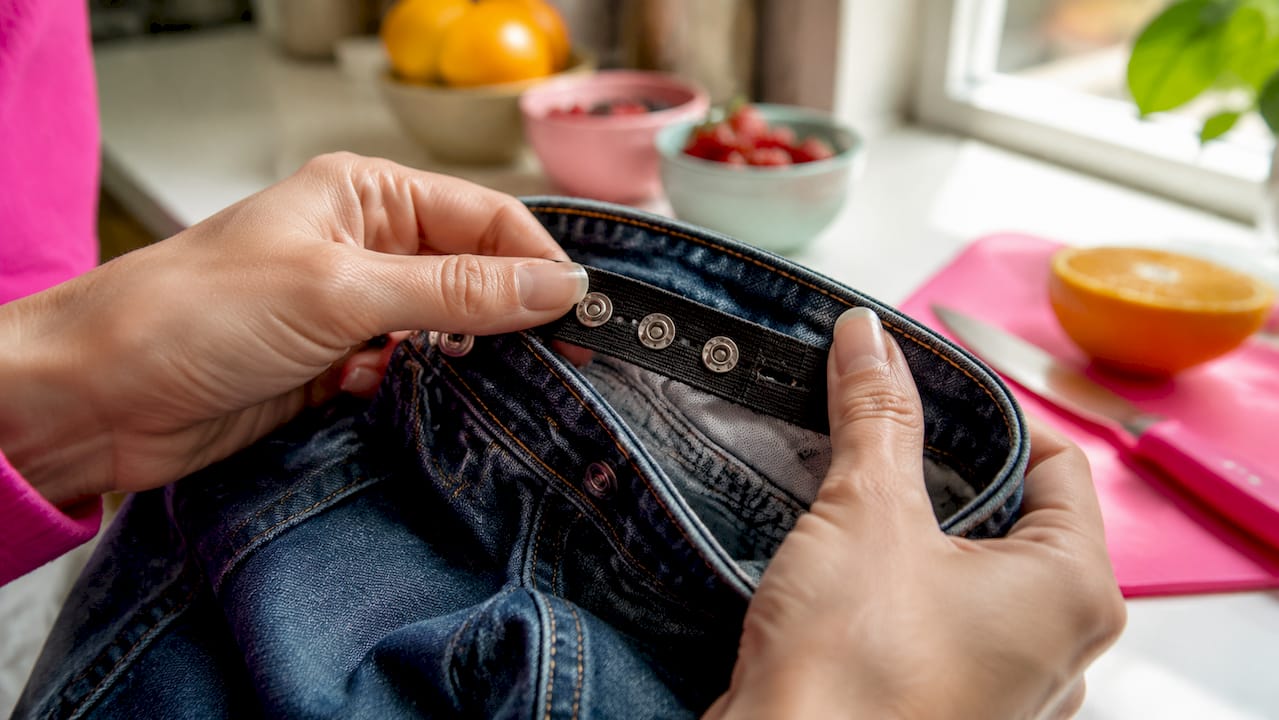
This feature matters most for tall or lanky kids, who often face waistband fit mismatch during growth spurts. Their legs grow faster than their waist circumference, making standard sizing almost impossible to get right. An adjustable waistband solves that specific problem without forcing you to size up and deal with a garment that looks and feels too large everywhere else.
What are the different types of adjustable waistbands for kids?
Three primary systems define kids clothing with adjustable waistbands, and each serves a different age group, activity level, and parent preference.
Full elastic waistbands use a single band of stretchy material that expands and contracts with the child’s body. This is the simplest system and the most common in toddler and infant clothing. The adjustment range is limited to the elastic’s stretch capacity, which means it works well for small size variations but cannot accommodate significant growth.
Snap-adjust waistbands are the most precise option. These use internal elastic with snap points that allow parents to set the waistband at different fixed positions. Grow With Me jeans, for example, feature internal adjustable elastic tabs with multiple button positions so the waistband can be tightened or loosened in measured increments. This system is ideal for school-age children in denim and structured pants, where a clean fit matters aesthetically and functionally.
Drawstring and tie-waist systems use a cord threaded through a casing at the waist, pulled to tighten and tied or tucked to secure. Beach Scout swim shorts use a 5.5-inch adjustable drawstring waist for this reason. Drawstrings offer the widest adjustment range but require supervision for younger children due to safety concerns around cords near the body.
| Type | Best Age Range | Adjustment Precision | Safety Notes |
|---|---|---|---|
| Full elastic | Infant to toddler | Low (stretch only) | Safe for all ages |
| Snap-adjust | Toddler to school-age | High (fixed positions) | Safe, no loose parts |
| Drawstring | School-age and older | Medium to high | Supervise under age 5 |
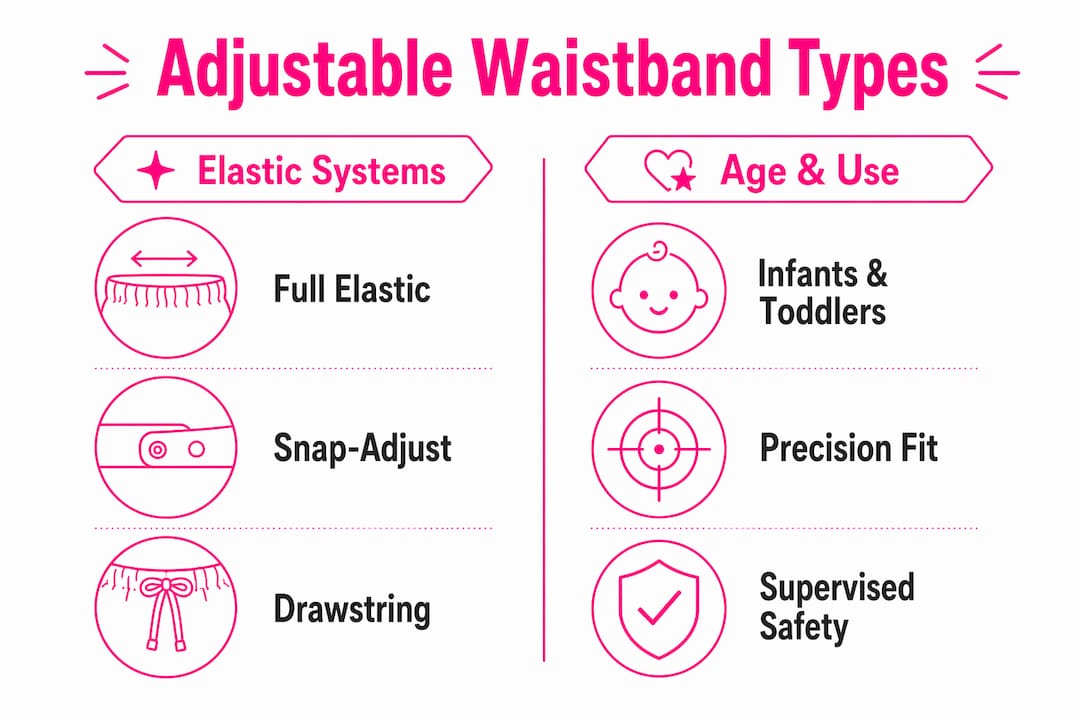
Pro Tip: When shopping for snap-adjust pants, count the number of snap positions before buying. Two positions offer minimal range. Four or more positions give you meaningful size adjustment across multiple growth stages.
How do adjustable waistbands benefit kids and parents?
The advantages of adjustable waistbands reach well beyond simple convenience. They address a structural problem in children’s clothing: standard sizing assumes a proportional relationship between waist and height that many children simply do not have.
Adjustable waistbands maintain proper fit through growth spurts in a way that sizing up cannot replicate. A larger size may solve the waist problem but creates a garment that sags, bunches, and restricts movement in all the wrong places. Children who wear ill-fitting clothes during active play, whether skating, climbing, or running, face real physical limitations and discomfort.
The financial argument is equally strong. A single pair of grow-with-me jeans that fits across two or three size increments replaces two or three separate purchases. For families dressing multiple children, that math compounds quickly. PatPat’s budget-friendly adjustable pants demonstrate that this feature does not require a premium price point.
Practical daily life also improves. Retailers like Oso & Me frame adjustability for bathroom breaks as a core selling point, and any parent who has wrestled with a tight waistband during a rushed school morning understands why. A well-adjusted waistband comes on and off quickly, which matters enormously for potty training and early independence.
“The best kids’ clothing is clothing that disappears. When a waistband fits correctly, children forget they’re wearing pants at all. That freedom of movement is the whole point.”
The benefits in summary:
- Maintains correct fit through growth spurts without sizing up
- Reduces wardrobe waste and clothing replacement costs
- Supports faster, easier bathroom breaks and outfit changes
- Keeps active children comfortable during physical play
- Produces a cleaner, more intentional appearance than oversized garments
How to use and adjust kids’ clothing with adjustable waistbands
Knowing the mechanism exists is only half the work. Using it correctly determines whether your child actually benefits from the feature.
-
Start with the waistband. Adjust the waist first so it sits correctly on the body before assessing leg length or rise. Parents frequently make the mistake of judging overall fit before the waist is properly set, which skews every other measurement.
-
For snap-adjust systems, open the waistband lining and locate the internal elastic band. Move the snap or button to the tightest position that still allows two fingers to fit flat between the waistband and your child’s stomach. This is the standard comfort check used by children’s clothing fitters.
-
For drawstring systems, thread the cord evenly on both sides before tying. An uneven pull creates a twisted waistband that sits off-center and causes discomfort during movement. Tie the cord in a bow rather than a knot for quick release, and tuck the ends inside the waistband casing when possible.
-
For full elastic waistbands, the adjustment is passive. Check that the band does not leave red marks on the skin after an hour of wear. Marks indicate the elastic is too tight and the child needs the next size up.
-
Check fit after movement, not just standing still. Have your child sit, squat, and bend forward. A waistband that feels fine standing can dig in or gap significantly during the movements children actually make throughout the day.
-
Reassess every four to six weeks during active growth periods. A snap-adjust waistband that was set correctly in the fall may need to be loosened by winter without any change in the pants’ overall size.
Pro Tip: For multi-point snap waistbands, always adjust both sides of the internal elastic symmetrically. Adjusting only one side creates uneven tension that pulls the waistband to one hip.
How to choose the best adjustable waistband clothes for your child
Not all adjustable waistbands are created equal, and the difference between a true size adjustment and a simple elastic stretch is significant. Here is what to evaluate before buying.
Age and independence level. Toddlers benefit most from simple elastic or snap-adjust systems they cannot accidentally undo. Older children who dress themselves may prefer drawstring systems they can manage independently, provided they are past the age where cord safety is a concern.
Number of adjustment points. A product described as “adjustable” may use only basic elastic with a single snap. Look specifically for multiple snap positions or a clearly described tab system. Grow With Me jeans and similar products from brands like PatPat specify the number of adjustment positions in their product descriptions.
Fabric and construction durability. An adjustable waistband on a fragile fabric defeats the purpose. The garment needs to survive the same number of wash cycles as the adjustment range implies. Look for reinforced snap attachment points and quality elastic that does not degrade after repeated washing.
Safety for the specific child. Drawstring supervision is recommended for children under a certain age. If your child is younger than five or tends to play unsupervised, snap-adjust or elastic systems are the safer choice.
Activity level and garment type. Active kids who skate, climb, or play contact sports need waistbands that stay put under dynamic movement. Multi-point adjustable waistbands with snaps distribute tension more evenly and prevent gaps or slipping at the back, which simple elastic cannot guarantee. Czt’s elastic track pants reflect this philosophy, combining performance construction with the kind of adjustable comfort that keeps up with kids who never stop moving.
Key takeaways
Adjustable waistbands in kids’ clothing are defined by their mechanical precision: snap-adjust systems outperform simple elastic for fit accuracy, longevity, and comfort across growth stages.
| Point | Details |
|---|---|
| Definition matters | True adjustable waistbands use snaps, tabs, or drawstrings, not just elastic stretch. |
| Snap-adjust is most precise | Multi-point snap systems allow incremental fit changes across multiple growth stages. |
| Adjust waist first | Set the waistband correctly before assessing leg length or any other fit element. |
| Safety by age | Supervise drawstring waistbands for children under five; use snap or elastic systems instead. |
| Cost efficiency | Grow-with-me designs reduce clothing replacement frequency across multiple size increments. |
Why fit is the most underrated act of care in kids’ clothing
We have spent years at Czt thinking about what it means to build clothing that moves with the body rather than against it. And the honest truth we have arrived at is this: most parents underestimate how much an ill-fitting waistband shapes a child’s entire relationship with getting dressed.
Children who wear clothes that pinch, gap, or slip spend mental energy managing their clothing instead of being present in whatever they are doing. That is a quiet tax on their attention and comfort that most adults do not notice because we have learned to tolerate it. Kids have not learned that tolerance yet, and they should not have to.
What parents often overlook is that adjustable waistbands are not just a convenience feature. They are a design philosophy that says the garment should serve the child, not the other way around. The snap-adjust system in a well-made pair of grow-with-me jeans is, in its own way, a small act of respect for how children actually live and grow.
The advice we give every parent who asks: buy fewer pieces, buy them with real adjustment range, and check the fit regularly. A wardrobe of five well-fitting garments with adjustable waistbands will serve your child better than fifteen pieces that fit perfectly only on the day you bought them.
— CZT
Explore Czt’s performance kids’ clothing
At Czt, we build clothing for families who refuse to choose between function and intention. Our pieces, crafted from recycled materials and designed with the kind of compositional care that streetwear culture demands, include adjustable and performance-fit construction that grows with active kids.
Whether your child is frolicking at the skate park or navigating a full school day, Czt’s sustainable kids’ jerseys and adjustable bottoms are built to keep up. Browse our full collection of kids’ streetwear and find pieces that fit today, tomorrow, and through every growth spurt in between.
FAQ
What does adjustable waistband mean on kids’ pants?
An adjustable waistband on kids’ pants means the garment includes a built-in mechanism, such as internal elastic with snaps, tabs, or a drawstring, that allows parents to change the waist size for a better fit as the child grows.
How do I use a snap-adjust waistband on kids’ jeans?
Open the inner waistband lining, locate the internal elastic band, and move the snap or button to the desired position. The correct fit allows two fingers to sit flat between the waistband and your child’s stomach.
Are drawstring waistbands safe for young children?
Drawstring waistbands require supervision for children under approximately five years old due to safety concerns around cords. For younger children, snap-adjust or full elastic waistbands are the safer choice.
What is the difference between elastic and adjustable waistbands?
A full elastic waistband stretches to fit but has a fixed size range. A true adjustable waistband uses snaps, tabs, or drawstrings to set the waist at different fixed sizes, offering greater precision and a longer useful lifespan across growth stages.
How often should I readjust my child’s waistband?
Check and readjust the waistband every four to six weeks during active growth periods. A waistband that fit correctly in the fall may need loosening by winter even if the pants’ overall size has not changed.
Recommended
- What Does Custom Fit Clothing Mean for You – CZT [CITI-ZEN-THEORY]
- CZT Active Endurance High-Waisted Pocket Capri Leggings for Ultimate Comfort – CZT [CITI-ZEN-THEORY]
- CZT Graf Comfortable 5-Strap Easy Tie-back Apron for Style & Function – CZT [CITI-ZEN-THEORY]
- CZT Full SK8 Trick List V-cut Bikini Bottoms – Sustainable & Flattering Fit – CZT [CITI-ZEN-THEORY]